With the Worcester area box visits concluded, the next day (Sat 29 Jun 2024) our group gathered at Kidderminster for Part 2. On the agenda were all seven Severn Valley Railway boxes, plus the fine Kidderminster Railway Museum box. The Museum provides a useful leaflet giving detailed information about the boxes (likewise such information can be found on the SVR Wiki online); this report does not aim to replace that. A visit to the railway and museum can only be recommended! All semaphore signals on the Severn Valley Railway are GWR style lower quadrant, although now electrically lit rather than with oil lamps; a rare hint of modernity in what is otherwise a magnificent portrayal of times past.
The group started by briefly visiting Kidderminster Railway Museum, which holds a very fine array of signalling and other railway items (highly recommended, as is their fruit cake). There is everything from old token instruments to lineside signs. In addition, the reconstructed Wrangaton signal box is next door.
This provides opportunities to practice on a real lever frame, with some levers connected to signals outside. While the structure preserves the box at Wrangaton (from the main line between Plymouth and Totnes), the original GWR stud-locked lever frame is from Bersham Sidings box, near Wrexham. The diagram and instruments are laid out as would have been found when Bersham box opened in 1897, with single-deck Spagnoletti block instruments. The box closed 15 Feb 1987. There is also a very fine cast iron stove (with hob and small oven) in this box, of a form the author has not seen elsewhere. Adjacent to the box are different stored lever frames for future use, with various other interesting items.
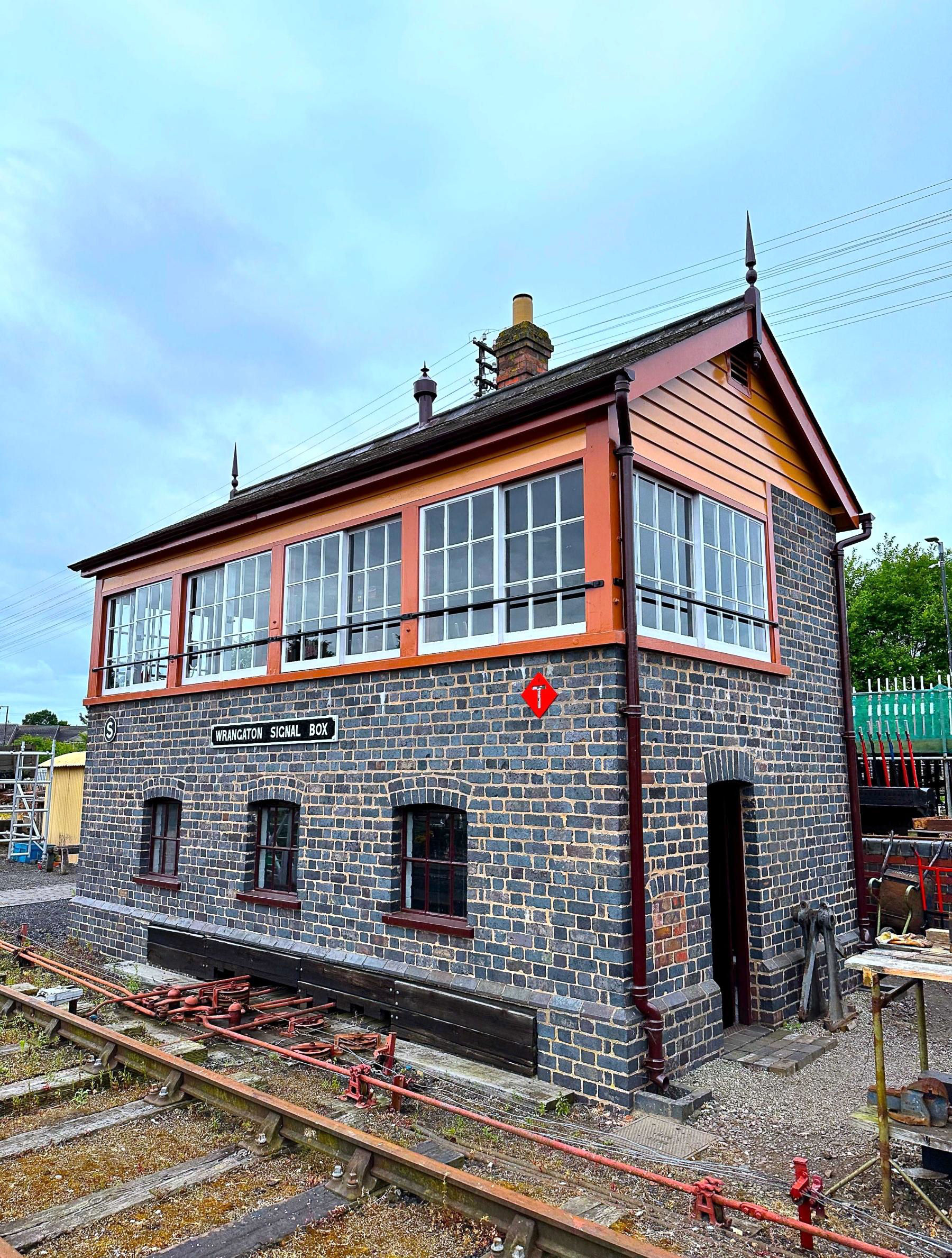
Wrangaton box at Kidderminster Railway Museum.
[© Mark Shinwell 2024]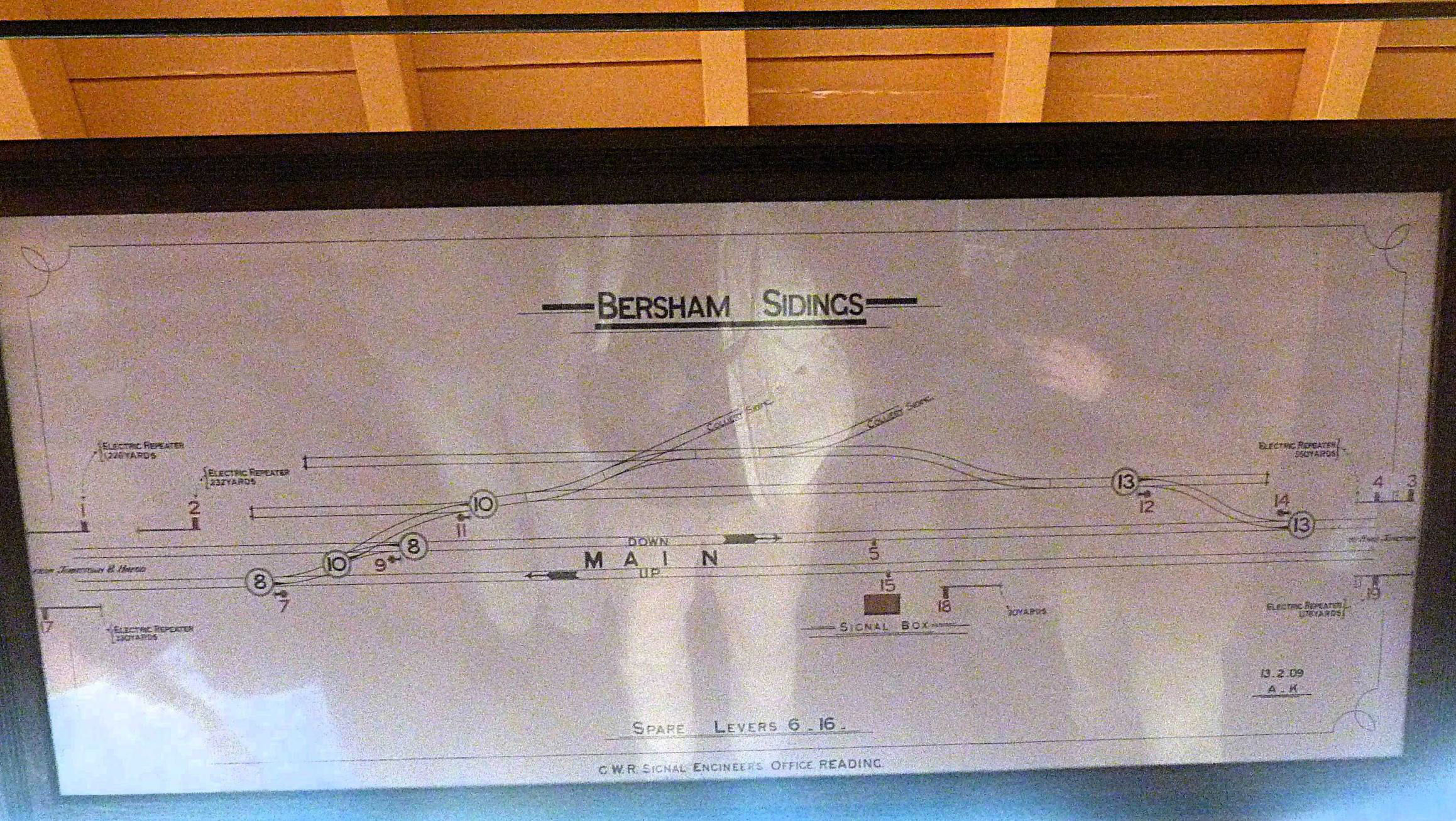
Participants on a previous Society visit during our AGM visits in 2014 reflect on Bersham Sidings box diagram in Wrangaton signal box at Kidderminster Railway Museum.
[© Angus McDougall 2014]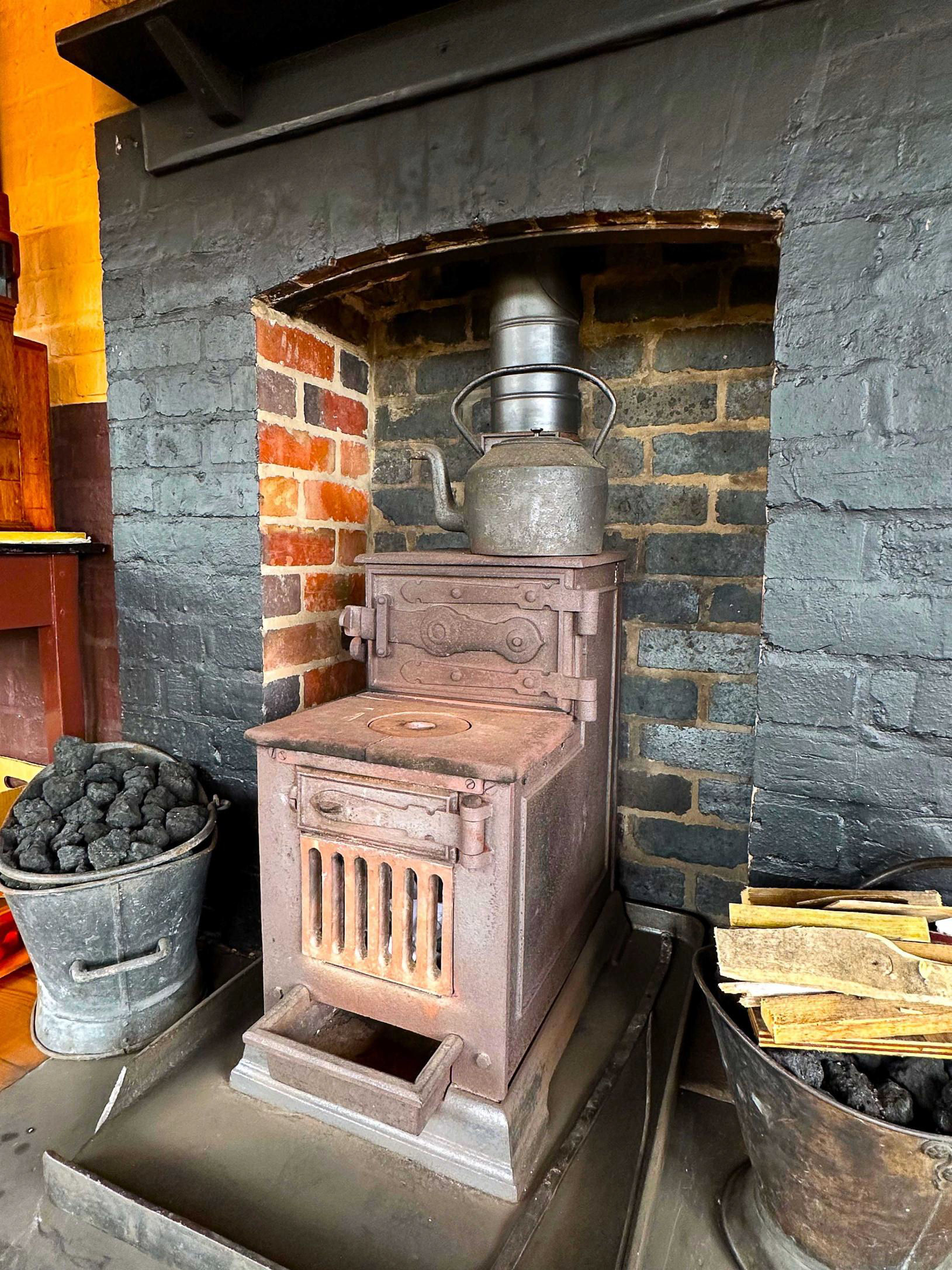
For our stove aficionados, a Romesse cast iron pot-bellied stove, normal variety, in the box.
[© Mark Shinwell 2024]The first working Severn Valley Railway box to be visited was Kidderminster Station, newly built in GWR 7d style with commissioning on 21 Nov 1987. The box is accessed past sidings alongside the Severn Valley Railway Kidderminster Town station and sits just to the north of the connection between the Severn Valley Railway and the Network Rail main line. The 62-lever, British Rail 5-bar vertical tappet frame with 4 inch lever spacing was from Acton Yard signal box (58 levers) and extended, with most parts from Acton West box and others from Stourport-on-Severn box. The box works via acceptance lever track circuit block to Bewdley South. Movements over the main line connection are ultimately controlled by Birmingham ROC, with working conducted over the telephone to Kidderminster. Birmingham ROC signals are slotted by the SVR Kidderminster signaller. The signal controlling this connection on the SVR side is the only colour light signal on the whole Railway. A Romesse cast iron pot-bellied stove, of the normal variety (not the 'Flat Top Romesse'), provides heating. These stoves (of which many were used in signal boxes) were originally made by Smith & Wellstood in Bonnybridge, Scotland, not far from the main line at Falkirk between Edinburgh and Glasgow Queen Street. However, the author suspects that production in the later 20th century moved to Barnoldswick, Lancashire. [The things you learn from BLN!]
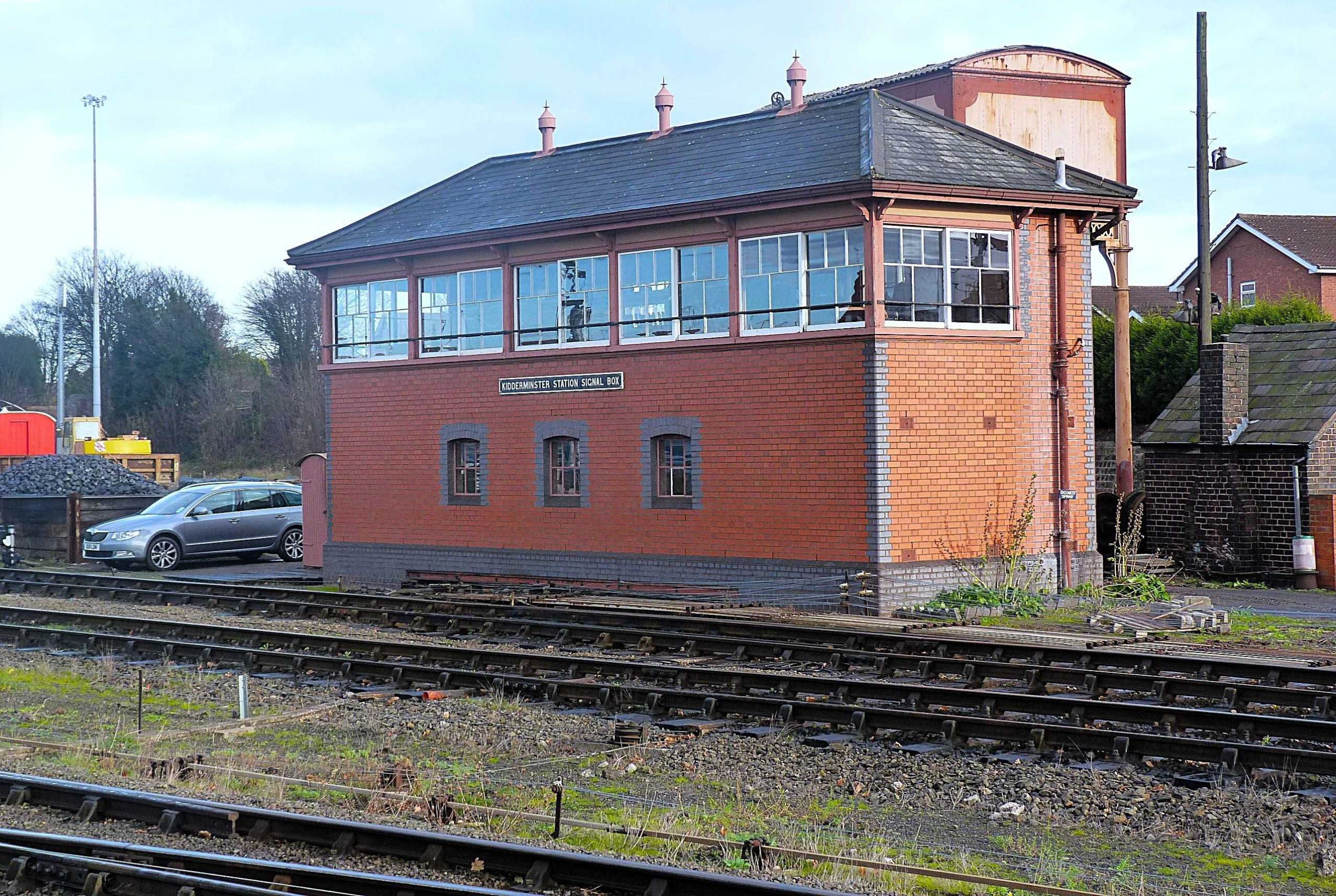
Kidderminster Station signal box (Severn Valley Railway) during an even earlier Society visit, also arranged by your BLN Editor.
[© Angus McDougall 2011]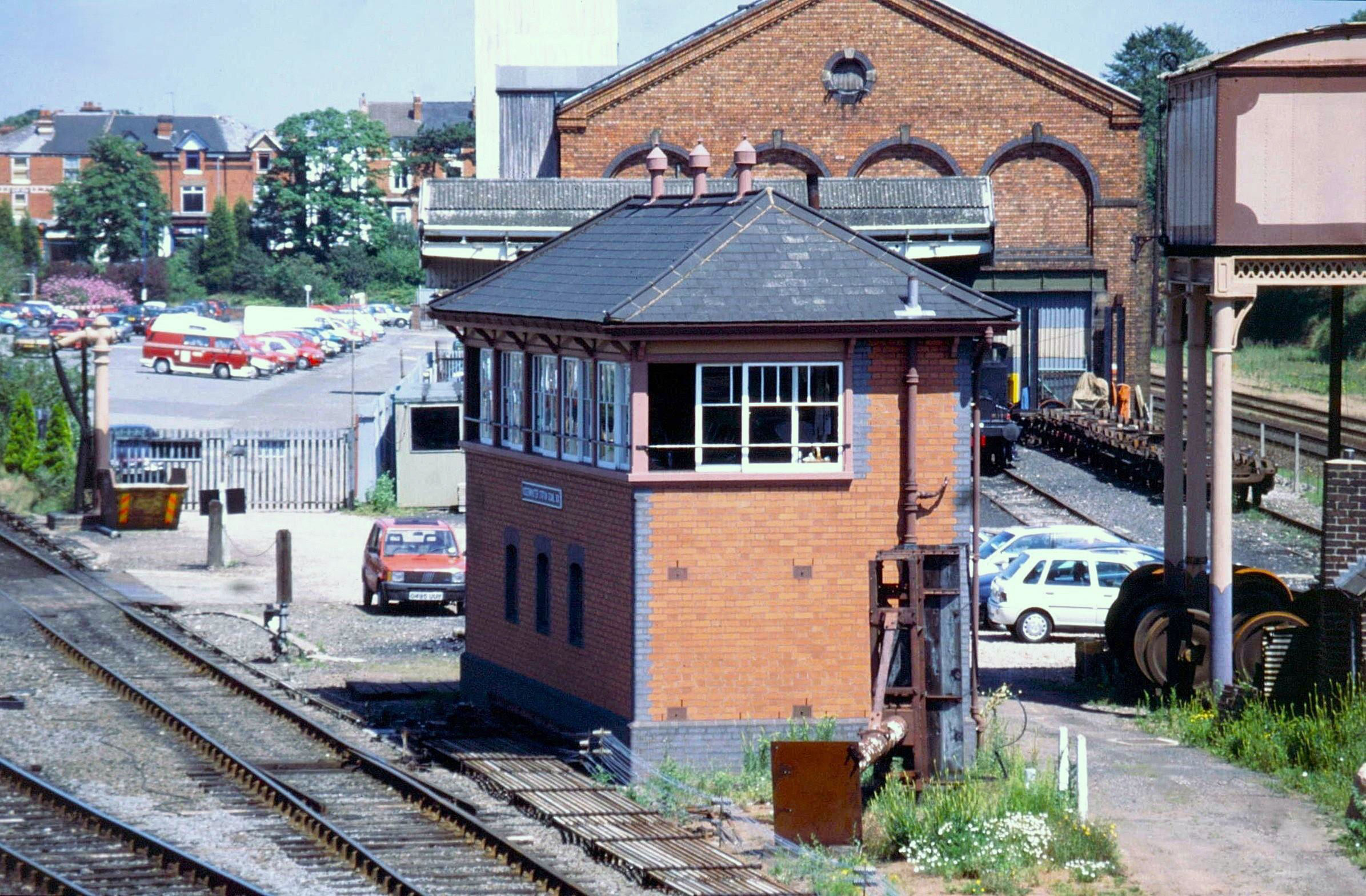
A 19 Jul 1997 photo with the mainline to the right - the road vehicles certainly belong to a different era.
[© Angus McDougall 1997]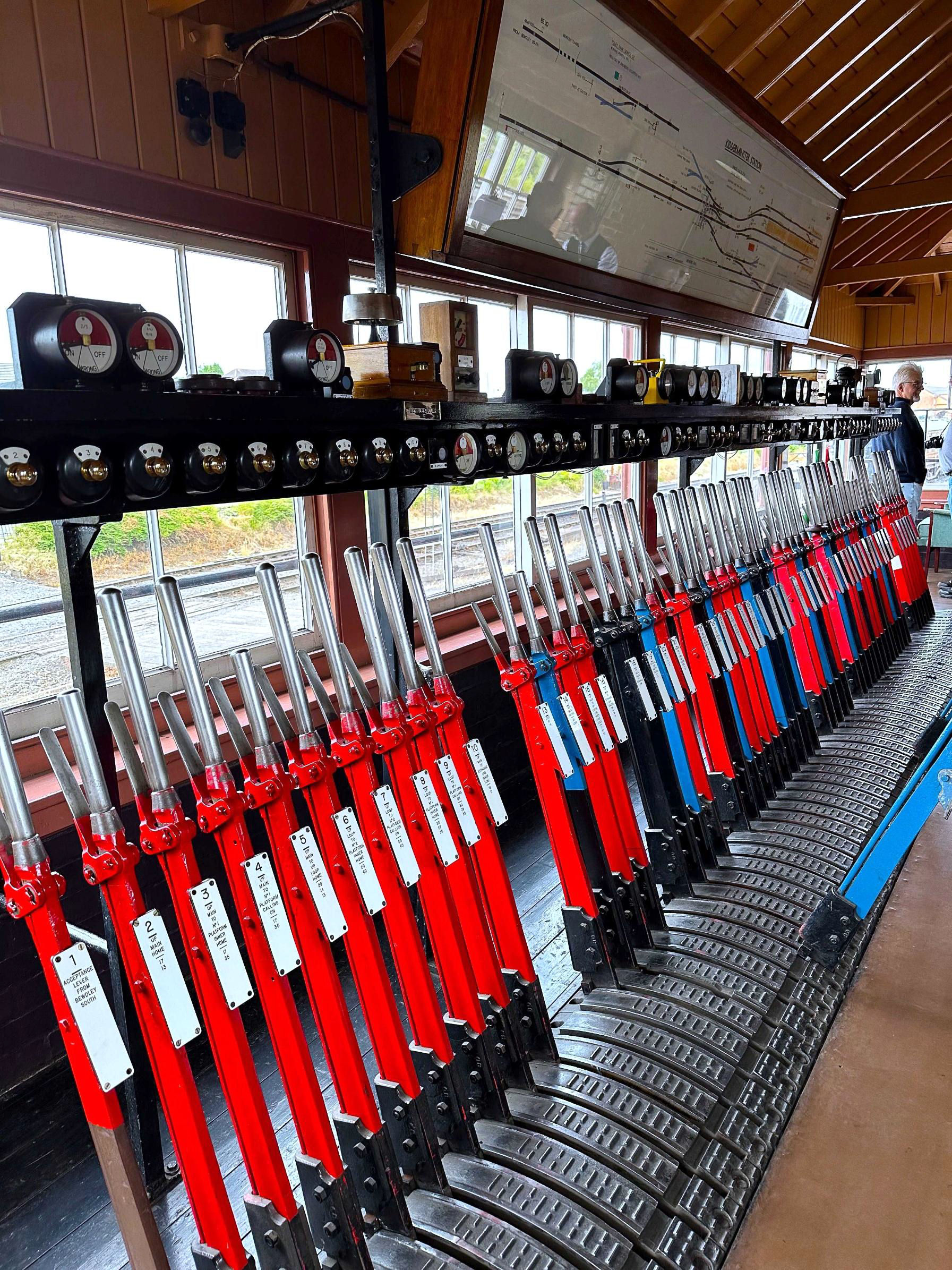
The lever frame in Kidderminster Station signal box - Kidderminster Town station is to the right.
[© Mark Shinwell 2024]Bewdley South (a McKenzie & Holland Type 3 signal box built in 1878) is a short way along the track to the south of Bewdley station itself, with access via the running lines. It is set into the eastern bank of the railway and had recently been underpinned. The box has changed little over the years. The original privy, atop the bank to the north, was out of use, which caused some inconvenience. Wooden steps lead up to the operating floor, where what would appear to be the height of luxury is to be found: two armchairs and a Romesse stove (again of the usual variety, although it looked as if the bottom front swinging plate had been replaced). The GWR 34 lever, 3-bar vertical tappet frame dates from 1923. The box works track circuit block to Kidderminster via acceptance lever and absolute block to Bewdley North for the Main Up and Down lines (P1 & 2), with 1947 Tyers wooden cased block instruments. This is in fact the only use of absolute block on the Severn Valley Railway. Additionally, the box works ETB (Electronic Token Block) regulations using direction levers to Bewdley North for the 'back road' through P3. Some moves, in contrast, still require signalling with flags.
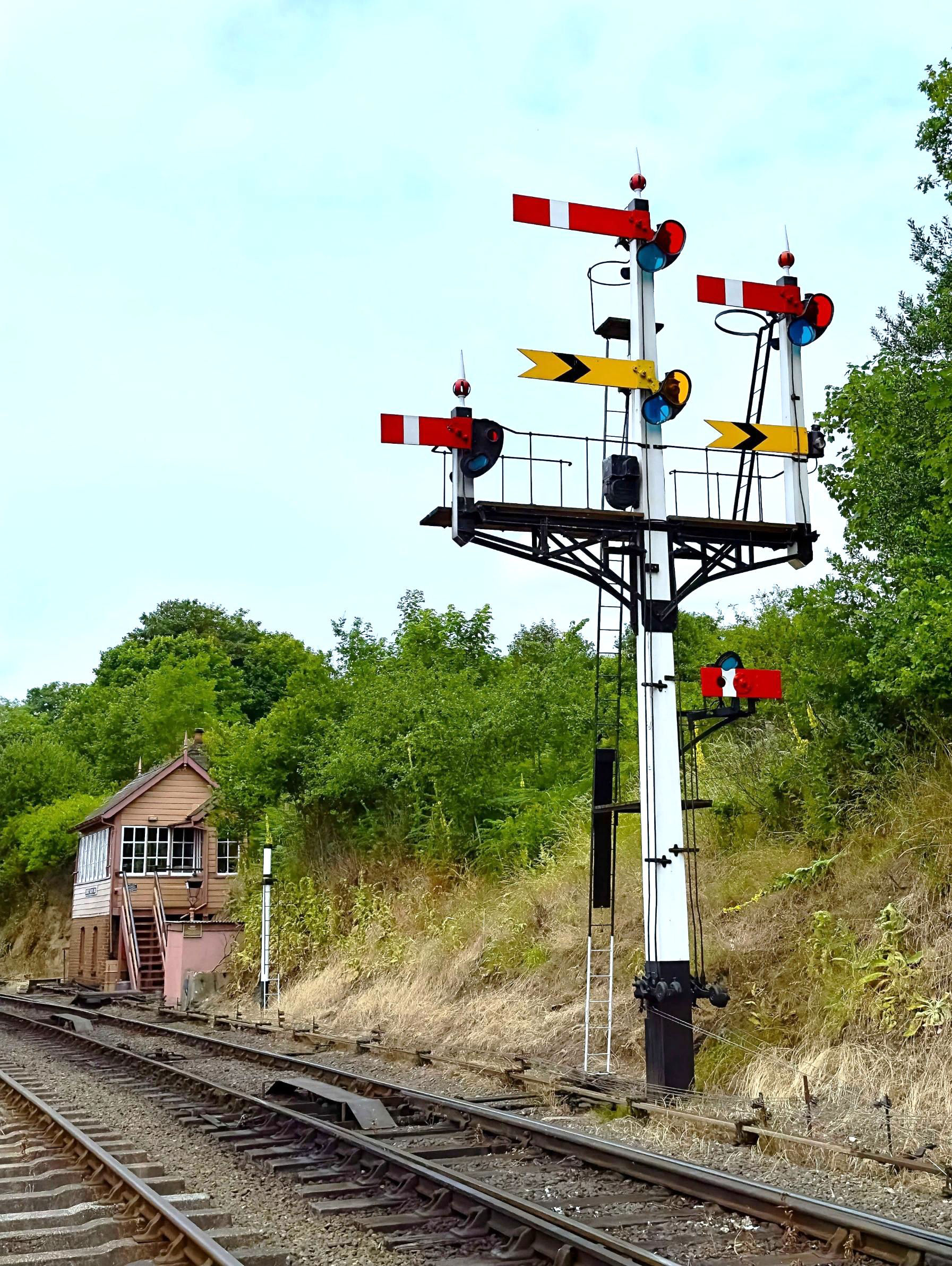
Bewdley South box from the south with the magnificent array of inner home signals.
[© Mark Shinwell 2024]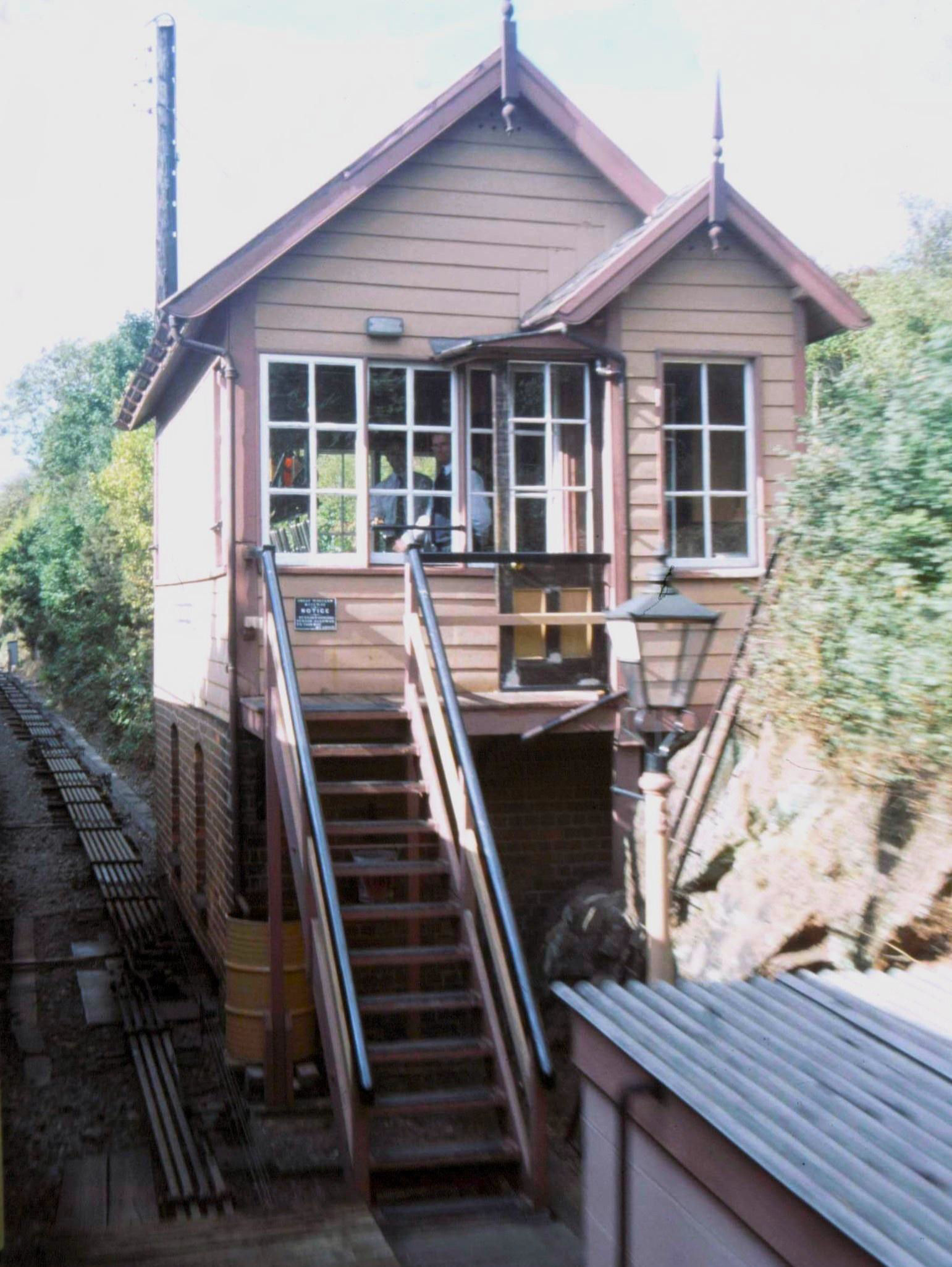
Bewdley South signal box from a train on 28 Sep 2003.
[© Angus McDougall 2003]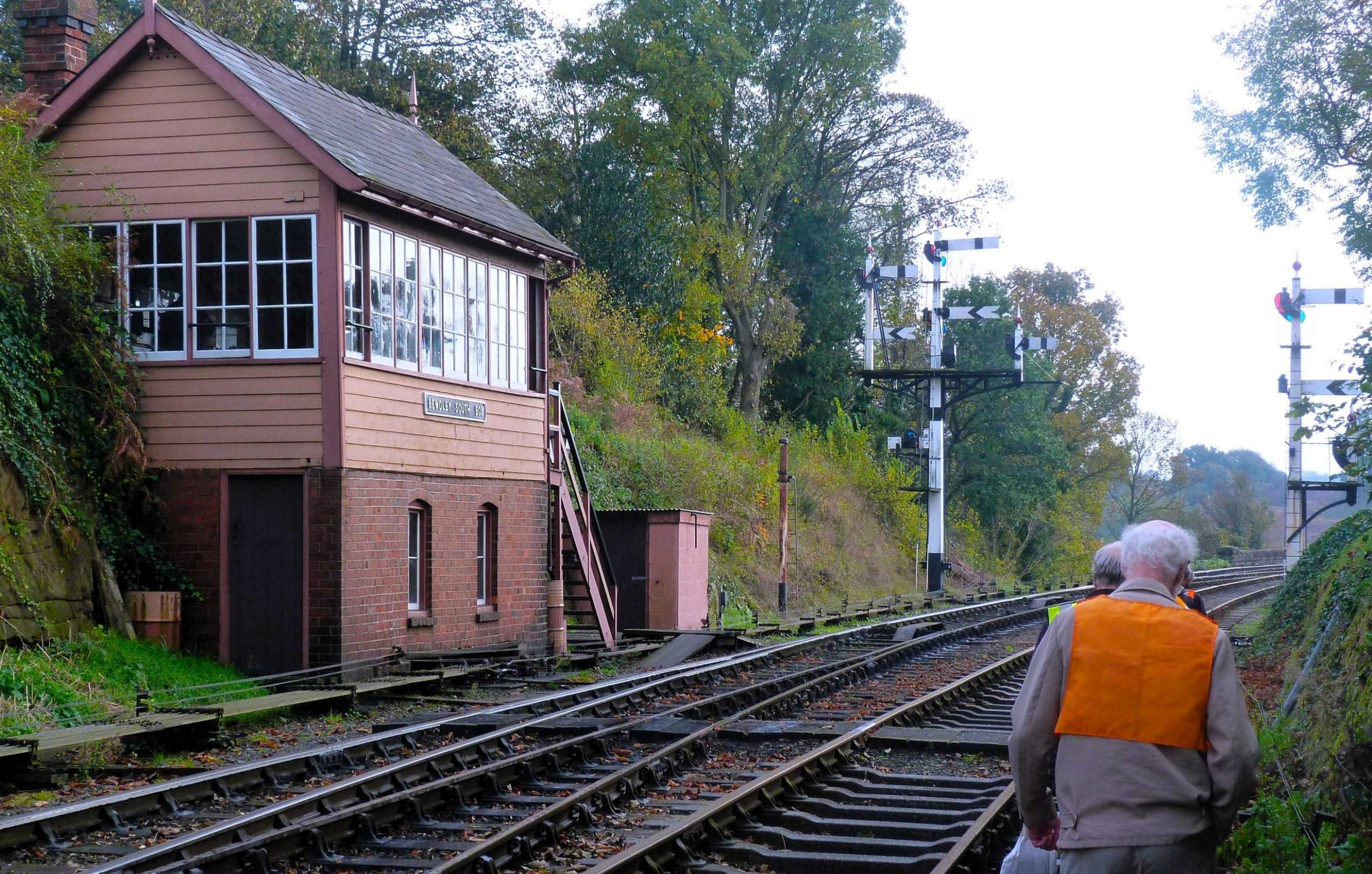
Looking south, during our 30 Oct 2014 AGM visits arranged by your Editor, all boxes were visited using SVR trains.
[© Angus McDougall 2024](TRACKmaps 4 p23A 2022) The layout at this box and Bewdley in general is interesting and deserves some description. The Absolute Block sections are staggered. On the Down line (towards Bridgnorth) the home signal is 798yds towards Kidderminster. A magnificent array of inner homes, just to the south of the box (where the short remaining section of the former Stourport line also joins) actually form the section signals towards Bewdley North. Bewdley North Down Main home is then just to the south of Bewdley P1- not a very long section! P1 is then within the station limits of Bewdley North. Meanwhile, on the Up line, the Bewdley North section signal is in fact 250yds north of that signal box, so out past the viaduct (with the home 925yds north). As such, the Up section includes all of P2 with the pointwork beforehand. It continues to the Bewdley South Up Main home at the southern end of the platform.
Station limits, not including any part of the station, continue past the box until the section signal towards Kidderminster 321yds past the box (near the Safari Park). The crossover from the Kidderminster single line to Down P1 means that acceptance of up trains from Bewdley North, such that they can enter the up P2, sometimes has to be under Regulation 5 (bell code 3-5-5) as the clearing point may be fouled. For those unaware (let's be honest, that's probably most of us) it stands for 'section clear but station or junction blocked' and allows a train into an occupied block section. It acts as a 'permission to proceed with caution'. The signaller warns the driver to stop if necessary, since the track ahead is not fully clear.
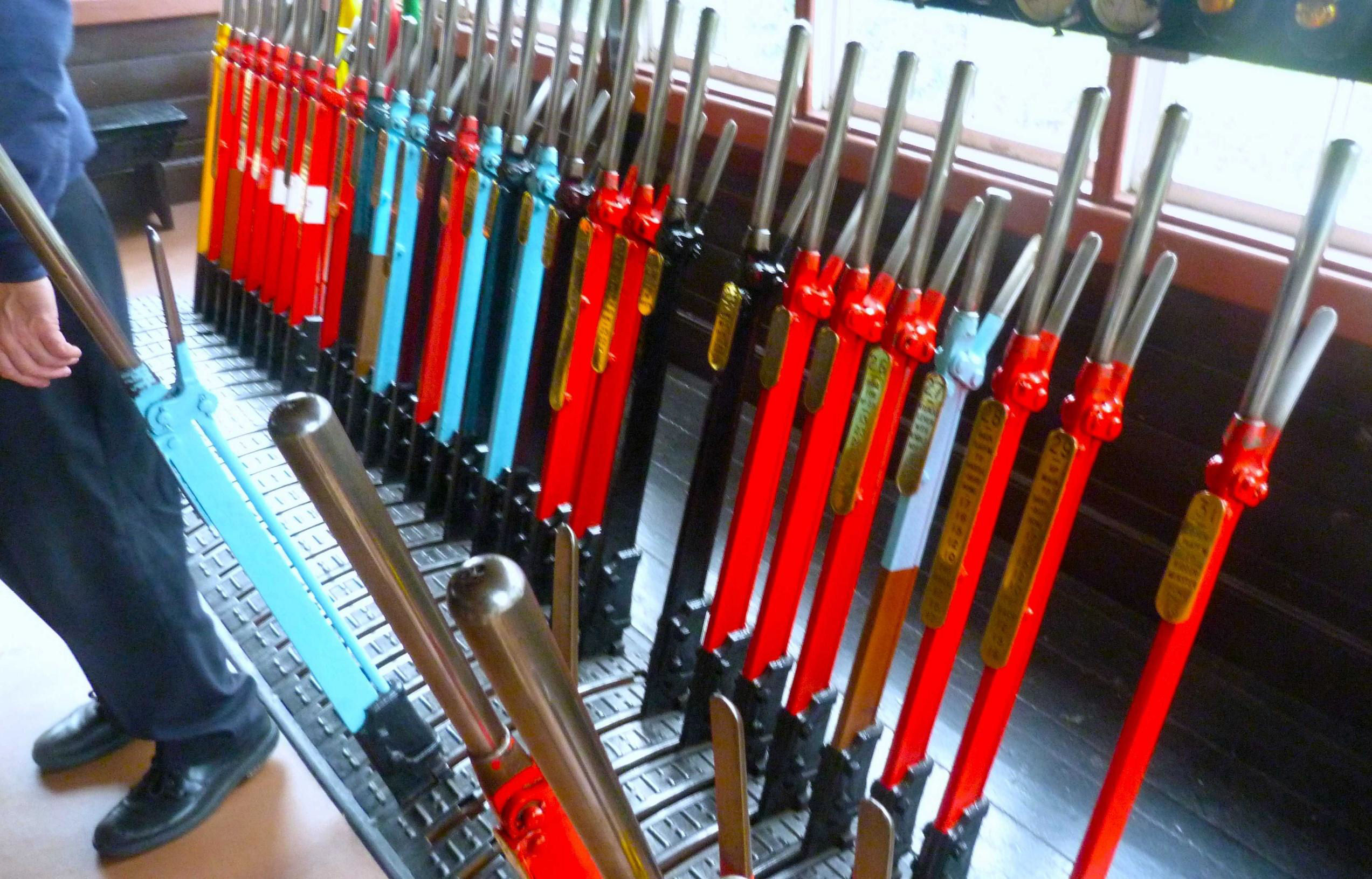
Bewdley South signal box lever frame looking north.
[© Angus McDougall 2014]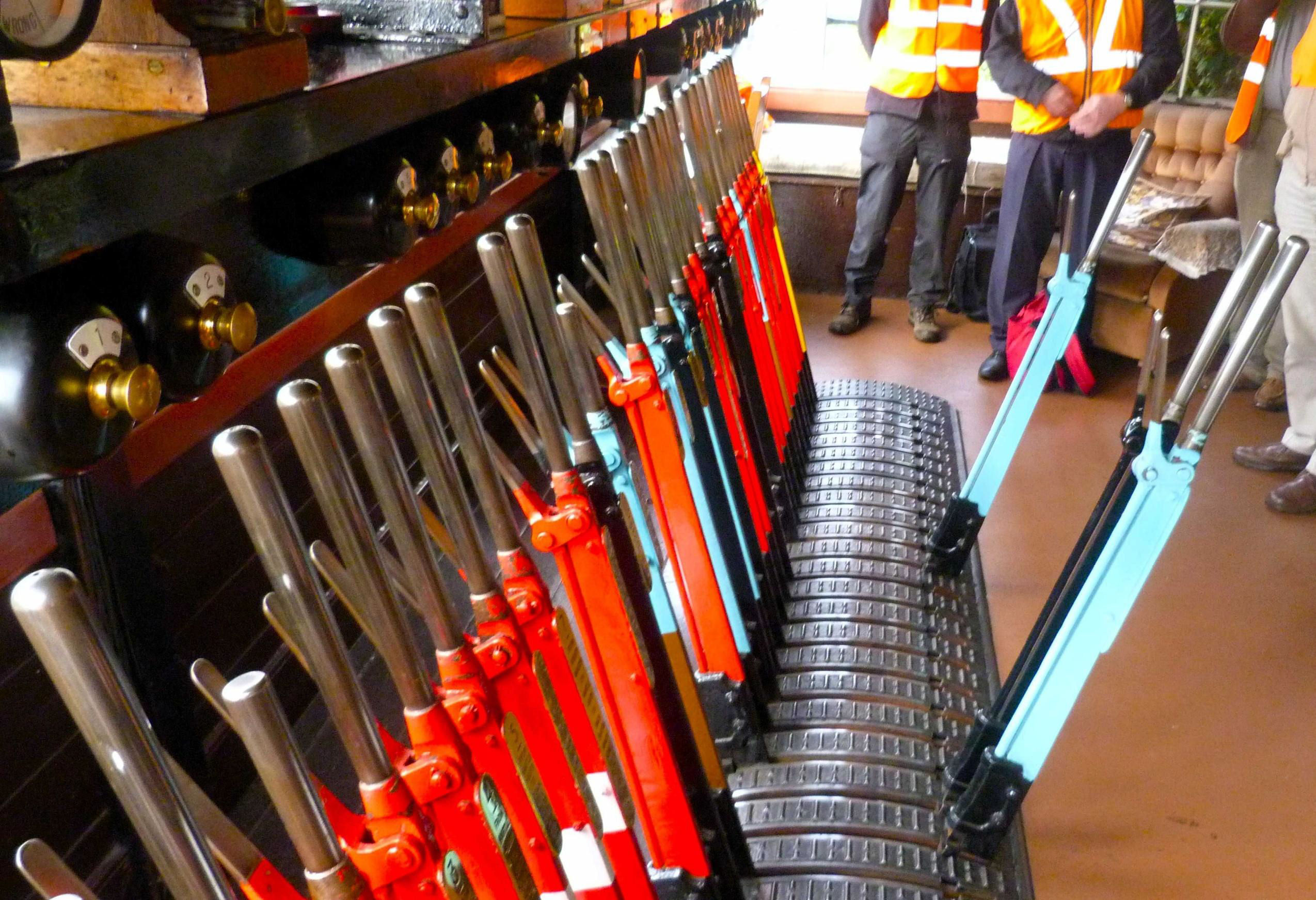
Bewdley South signal box lever frame looking south.
[© Angus McDougall 2014]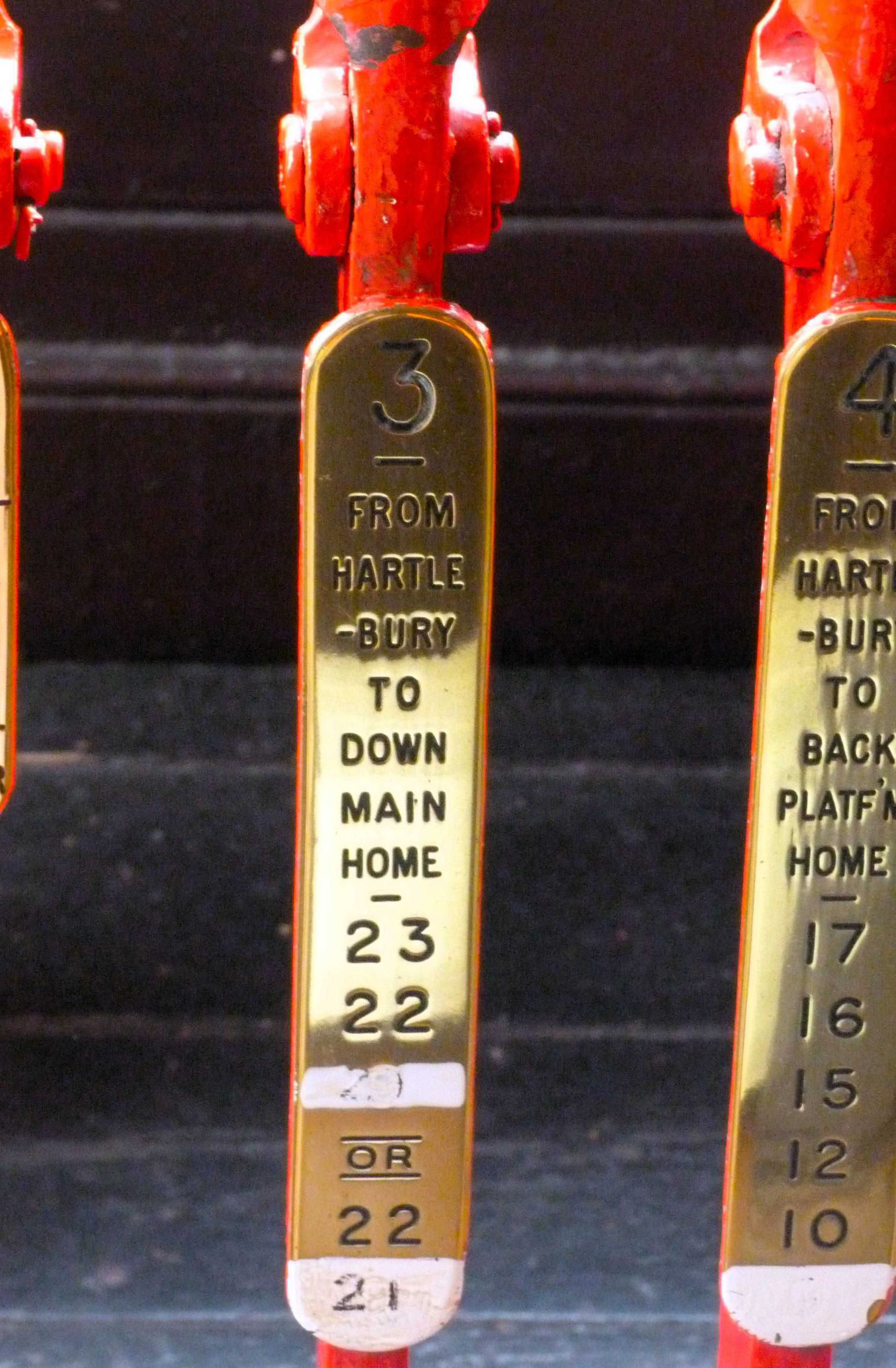
Bewdley South signal box levers No 3 & 4.
[© Angus McDougall 2014]On our way back from Bewdley South box through the yard, a fine tall Romesse stove (not often seen) was spotted in the paint shop, together with what appeared to be the original signal box sign from Ludlow, on the North & West line from Shrewsbury to Hereford and Newport. The bottom plate on the stove was embossed 'J. W. Rains Ltd Albert St. Birmingham 5'.
Bewdley North box (a McKenzie & Holland Type 3 box, built in 1878) is just past the northern end of Bewdley station Down P1, cantilevered out over the embankment descending to the west and just short of the fine skew arch viaduct. The 37 lever frame dates from 1908.
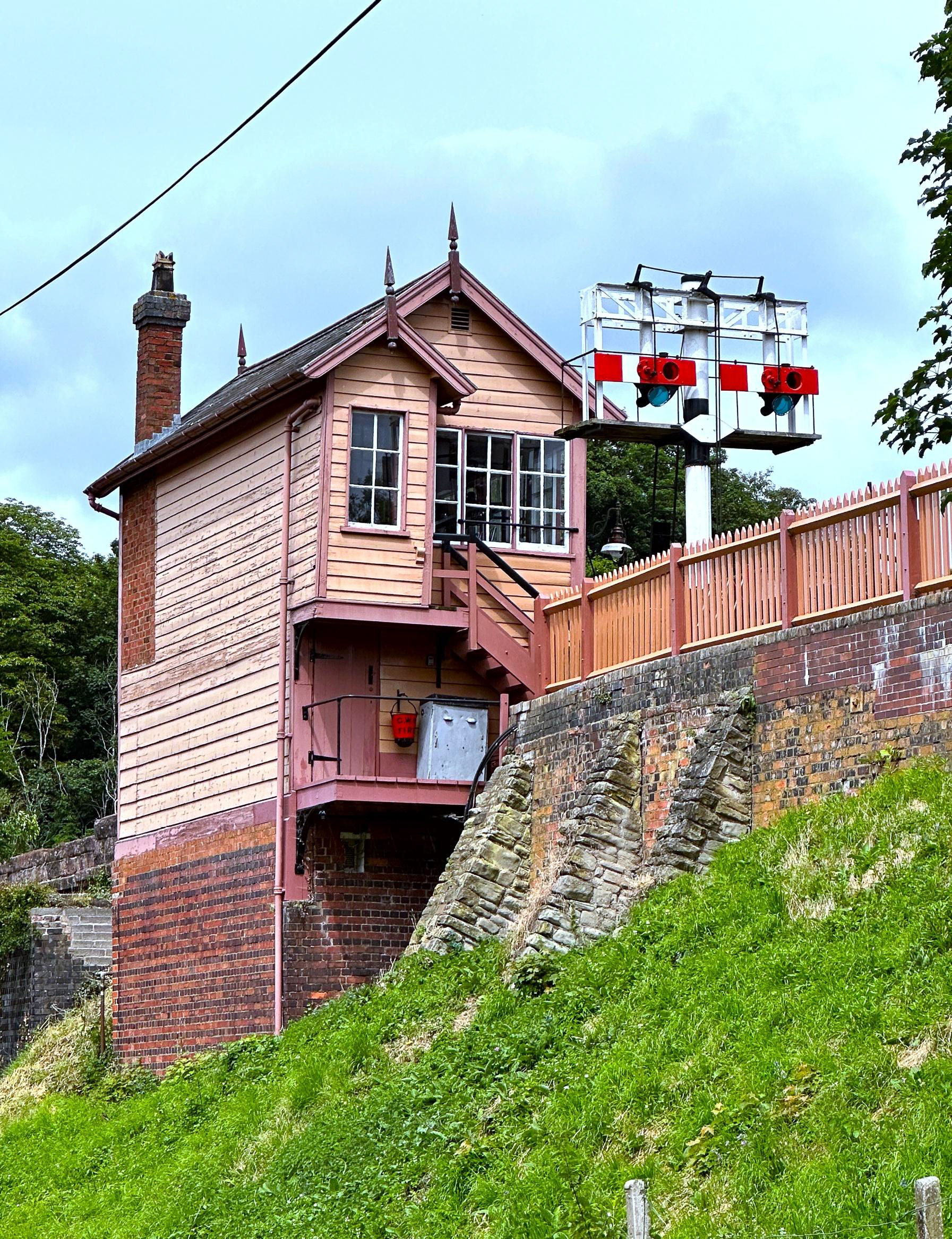
Bewdley North signal box, built on an embankment, with a fine pair of centre pivoted semaphores. Bridgnorth is off to the left with Kidderminster right.
[© Mark Shinwell 2024]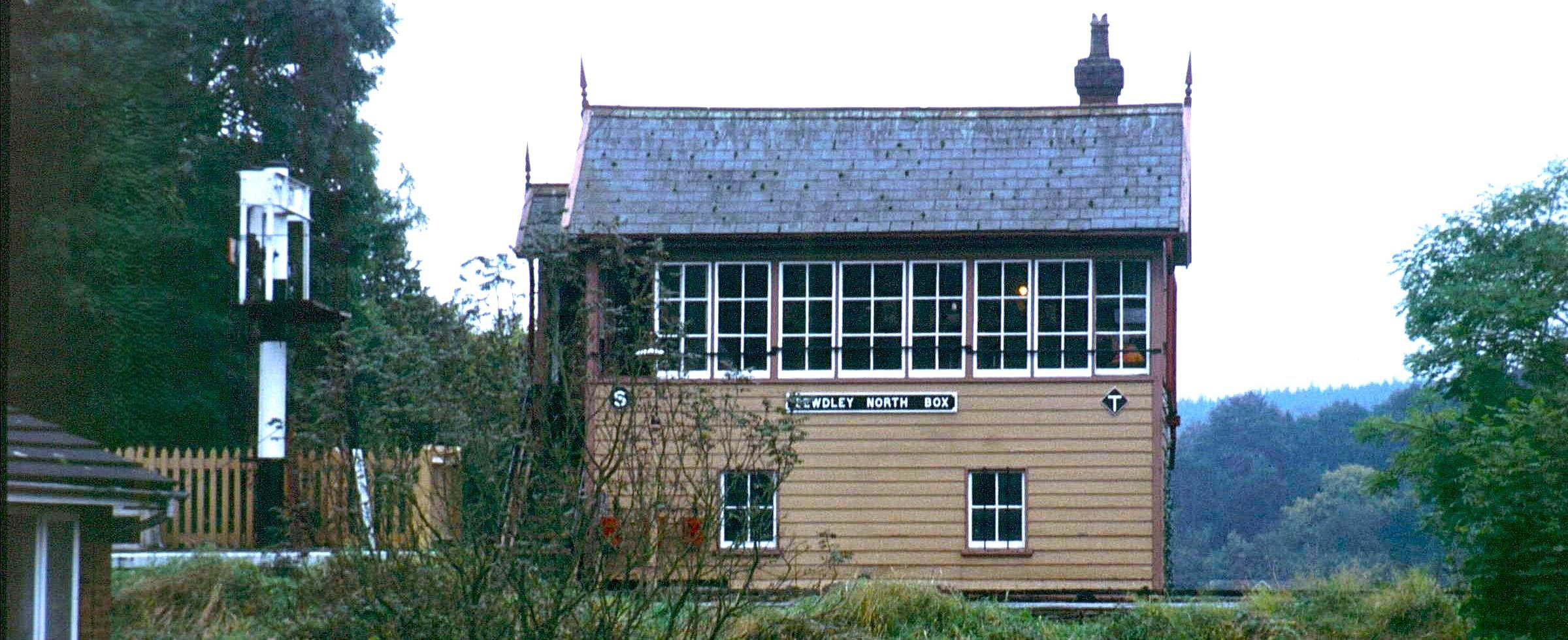
A view of the front of Bewdley North signal box.
[© Angus McDougall 2000]Two interesting centre-pivoted semaphores stand alongside, similar to those seen at Droitwich Spa. (These are Down inner homes but, unlike at Bewdley South, they are not the section signals; the section signal towards Arley is out beyond the viaduct). Inside the box, the stove is a small traditional open hearth range, with a fire in the centre and an oven to the right. There are some interesting GWR single deck, Spagnoletti block instruments on the block shelf, together with two Tyers token machines. Indeed, it is claimed that these are the last pegging Spagnoletti instruments in service on a standard gauge railway. Absolute block is used to Bewdley South with token working towards Arley, to the north. Arley can be switched out (quite a complicated procedure, as is switching it back in) in which case 'long section' working is by token to Highley in the same manner, with bidirectional use of Arley Up Platform 1 then.
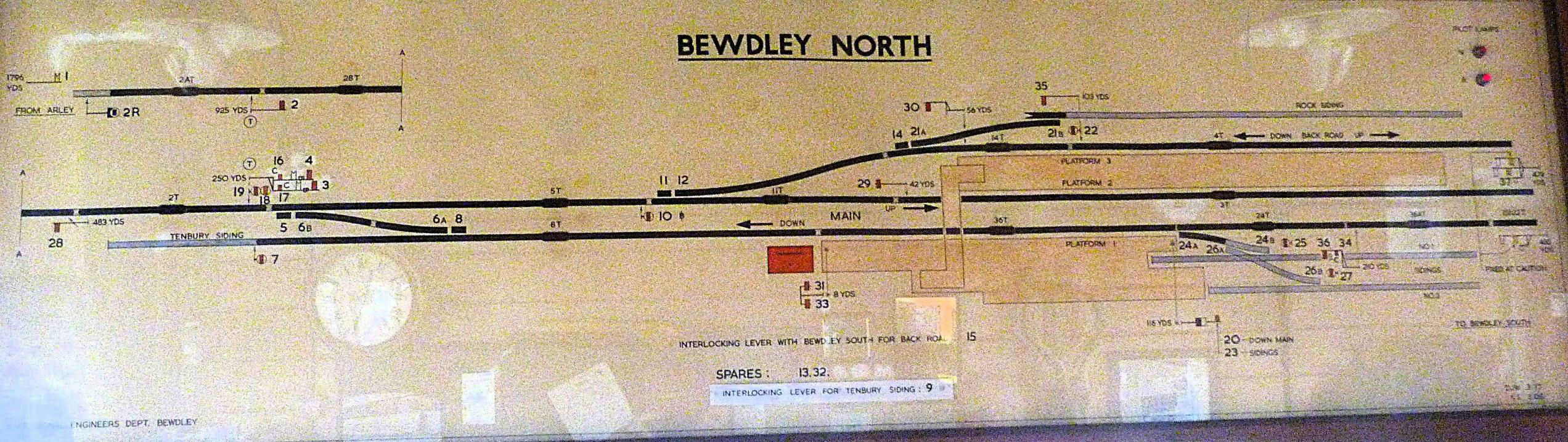
Bewdley North signal box diagram.
[© Angus McDougall 2014]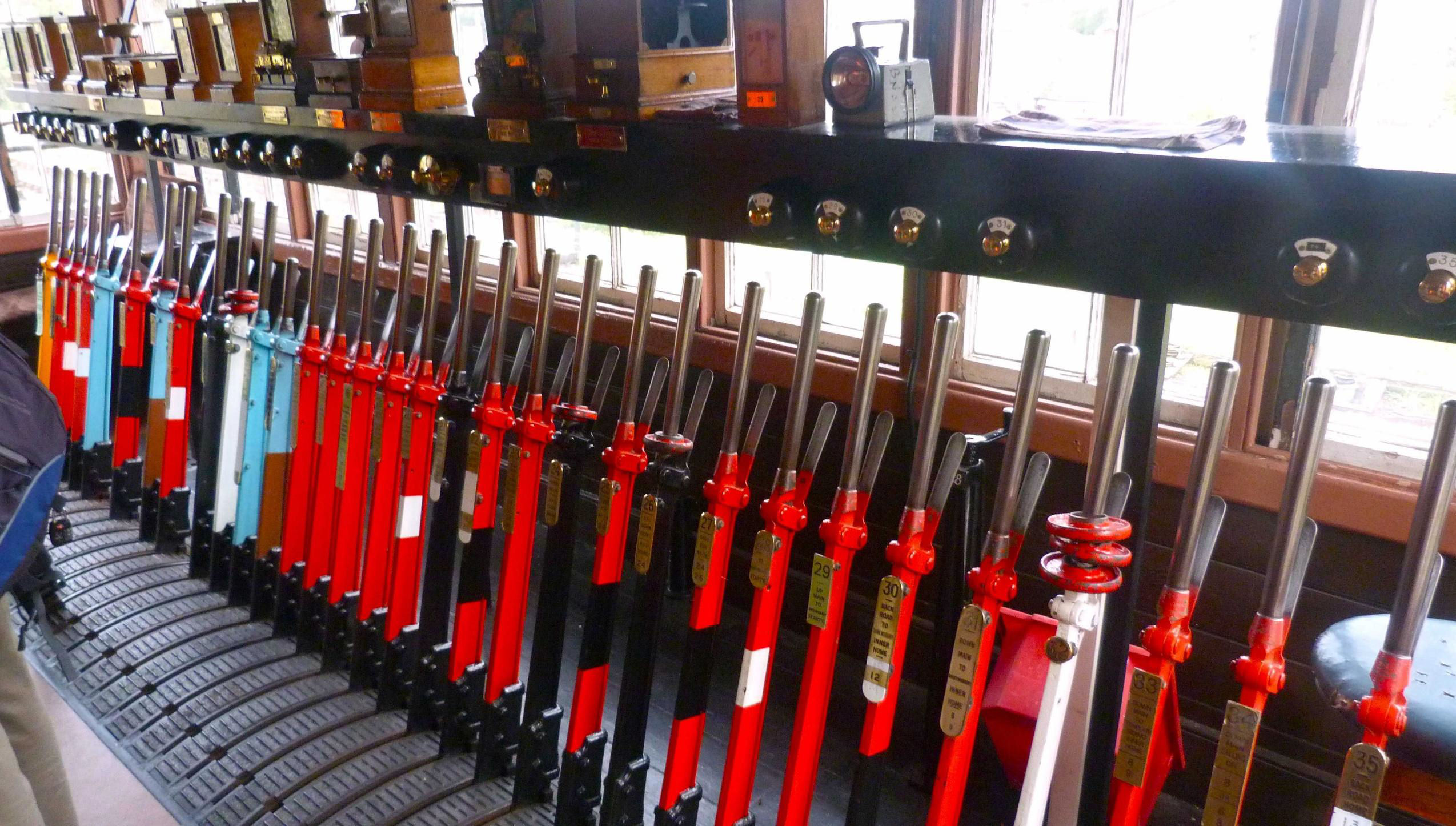
The lever frame during our 30 Oct 2014 AGM visits when all boxes were visited by SVR service trains except Kidderminster - visited on foot.
[© Angus McDougall 2014]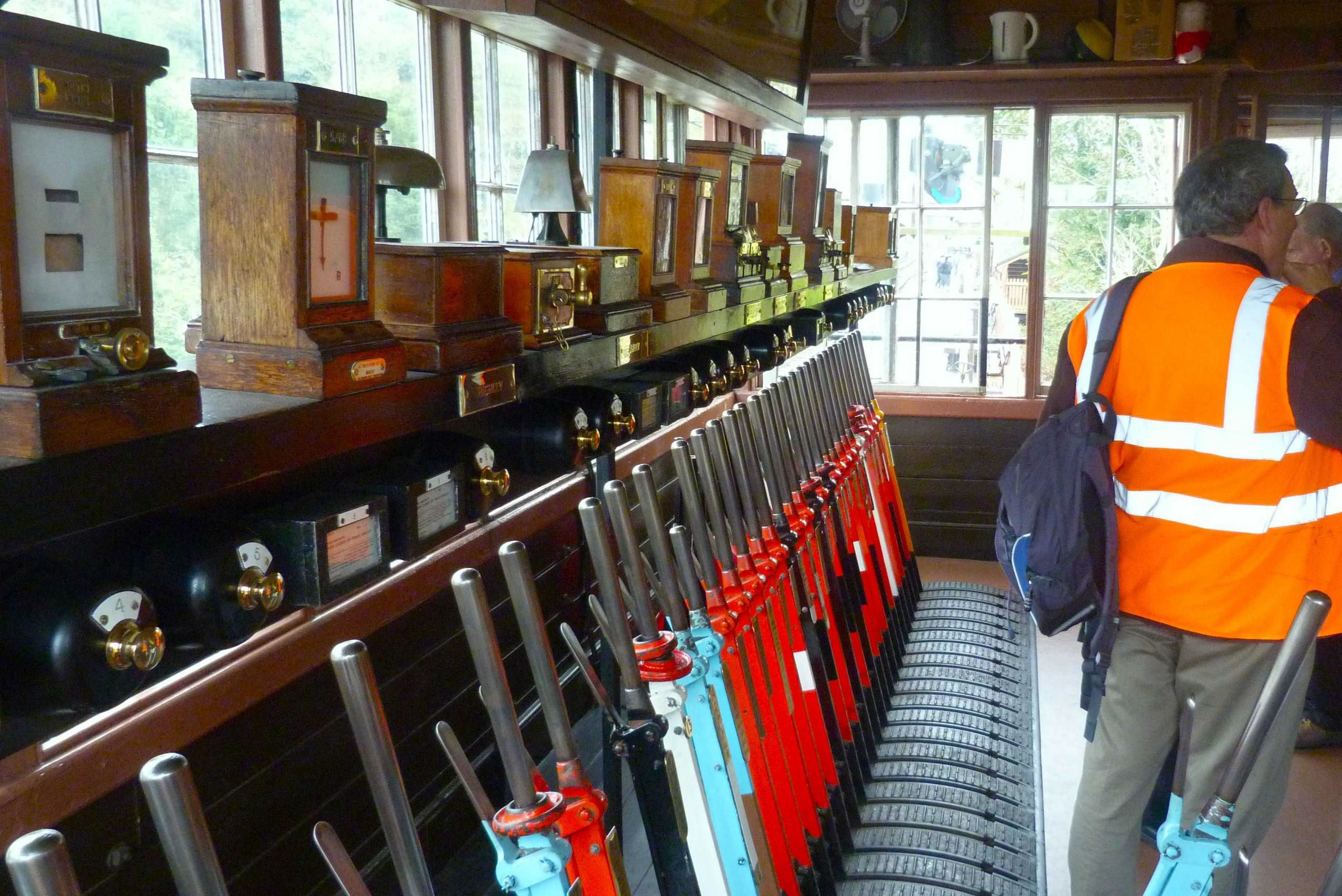
On the same occasion, is it a museum or a working signal box? No - it's both. Our current East Midlands Editor is first right.
[© Angus McDougall 2014]Of note, Bewdley North and Bewdley South boxes were both abolished by British Rail from 5 Jan 1970 with passenger closure of the line from Kidderminster and to Hartlebury. The South box was reopened by the Severn Valley Railway in 1974 and extended in 1990. The North box reopened in 1977.
After driving to Arley, our group was greeted by the signaller at the 30-lever frame, originally from Kidderminster Station box (as opposed to Kidderminster Junction box). This was located on the end of Kidderminster Up main line platform (to Worcester). Arley box stands alone behind the Up Platform 1 north end between two sidings. The L&NWR Type 4 design box came from Yorton station (where it dated from 1882) on the Shrewsbury to Crewe line. Interestingly, it was moved by road to Eardington Halt siding then onwards by rail to Arley!
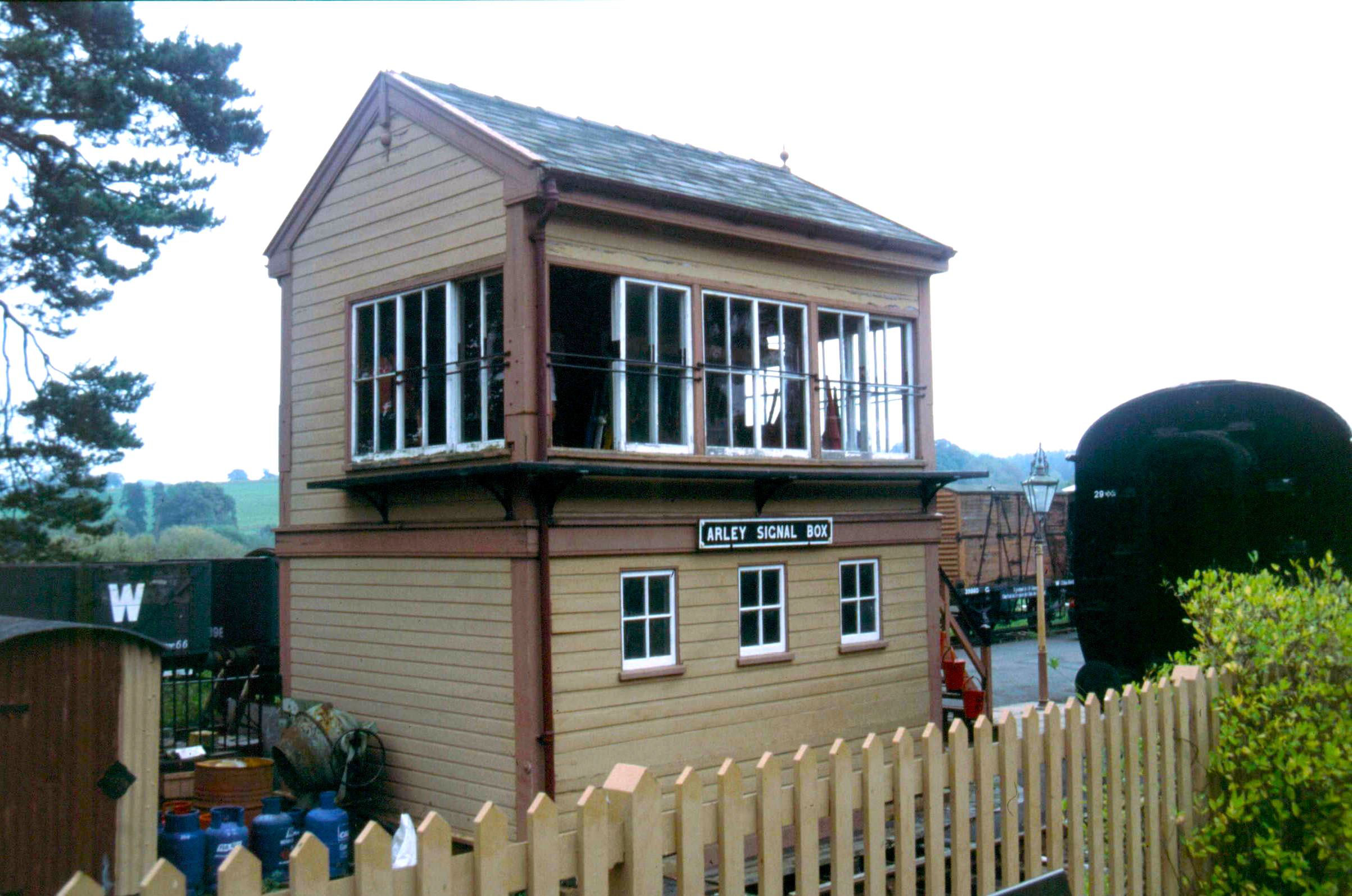
Arley signal box on 15 Oct 2000, it has since been renovated.
[© Angus McDougall 2000]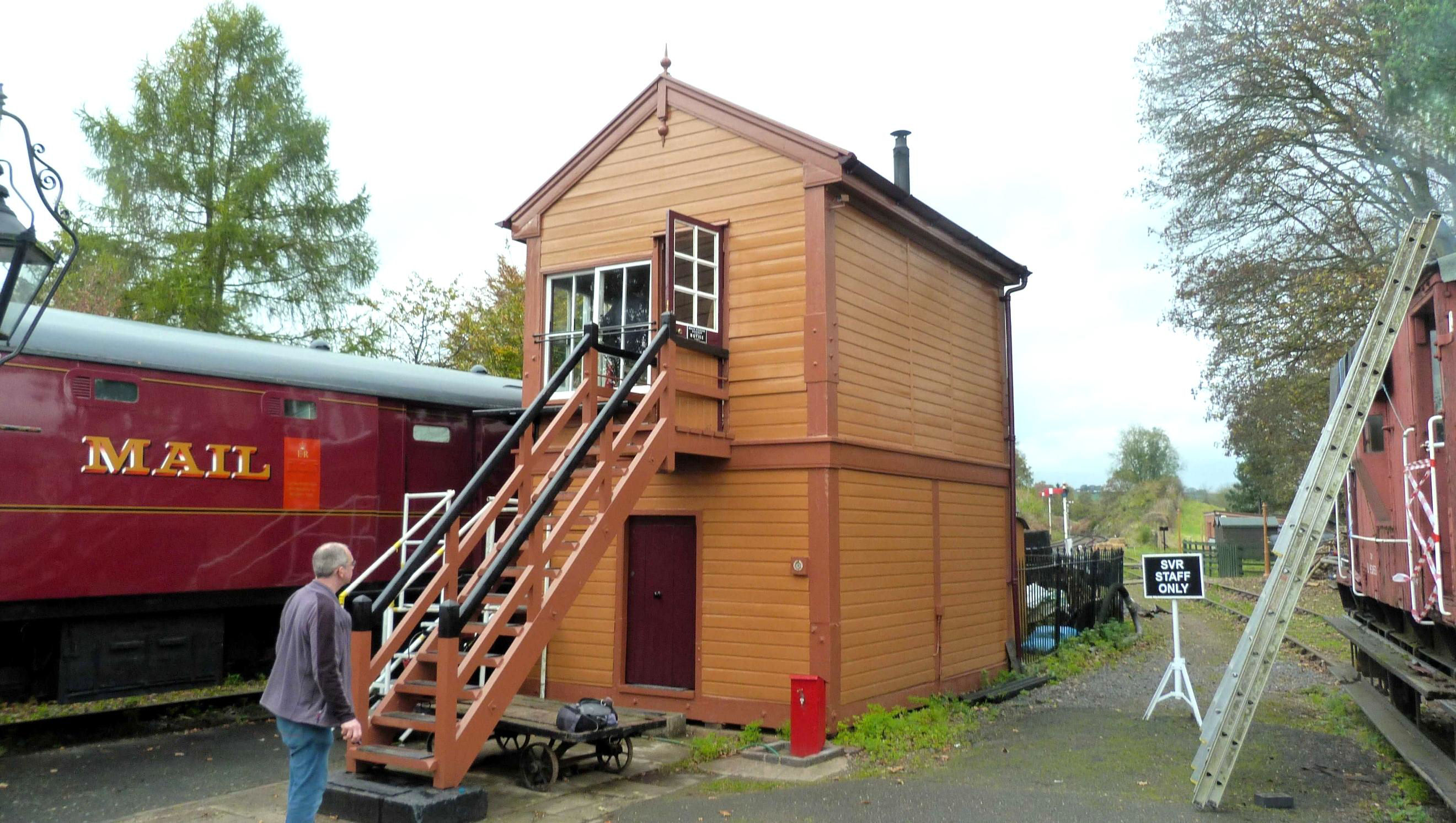
Taken during our 30 Oct 2014 AGM visits made by train. Arley signal box with Highley and Bridgnorth off to the right.
[© Angus McDougall 2014]At its 1 Feb 1862 opening, Arley had just a single track with one considerably shorter platform. A passing loop and second platform were installed in the 1880s; the original platform was also lengthened and raised. Both were further lengthened in 1907. After passenger closure from 9 Sep 1963, the original McKenzie & Holland box was closed by British Railways from 28 Jun 1964. The Up line through the station and sidings were lifted and the Down platform edgings were removed to improve clearance for coal trains from Alveley Colliery Sidings that continued to run until early 1969. According to 'SVR Live', the original box was demolished by British Railways as a redundant asset but there are reports that SVR volunteers demolished it as they envisaged that Hampton Loade would be the line's southern terminus.
Arley loop was reinstated and first used on 25 May 1975, initially with flagmen and the token instrument temporarily in the station master's office; the box was commissioned on 10 Apr 1976.
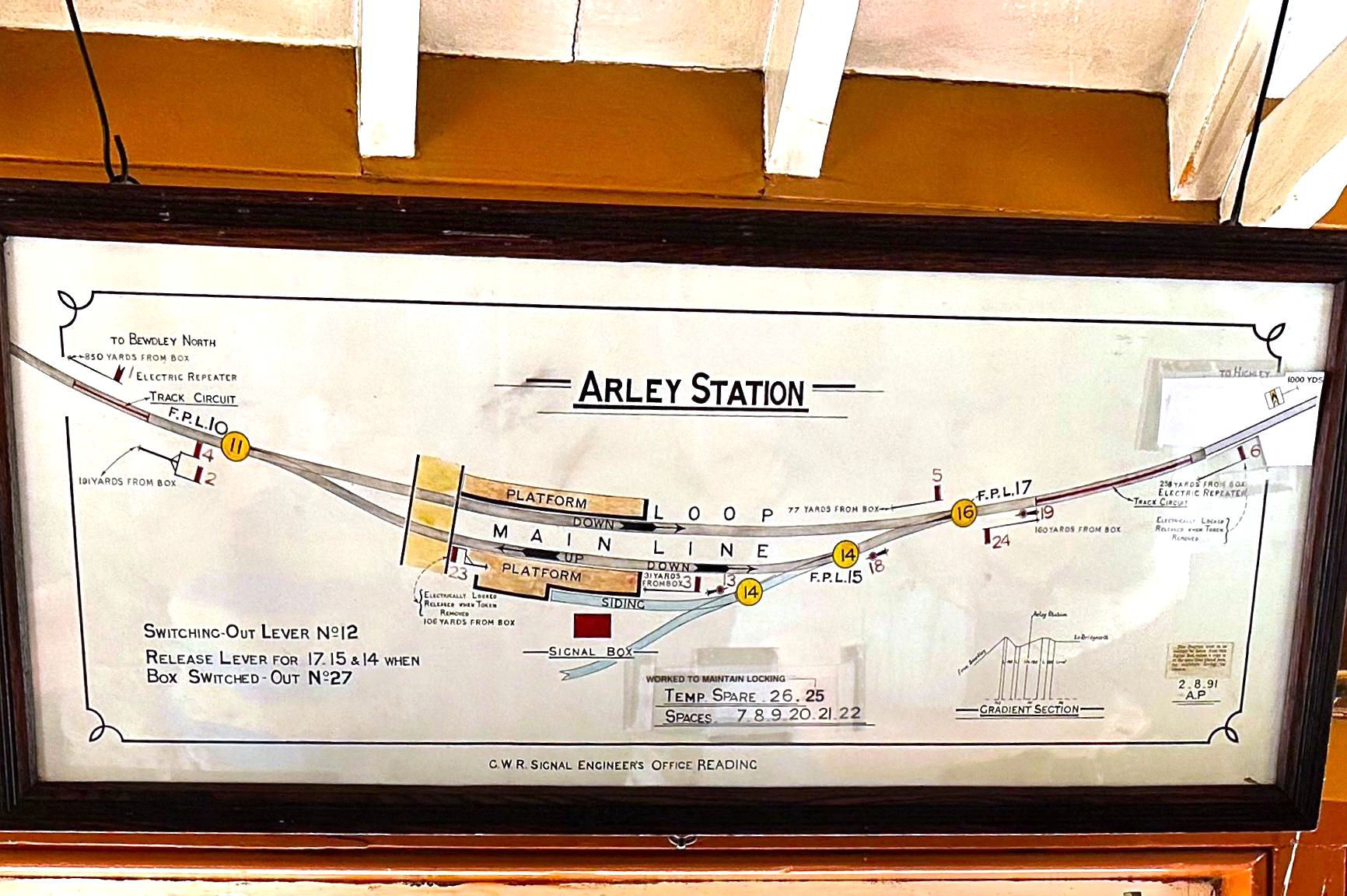
Arley signal box diagram.
[© Mark Shinwell 2024]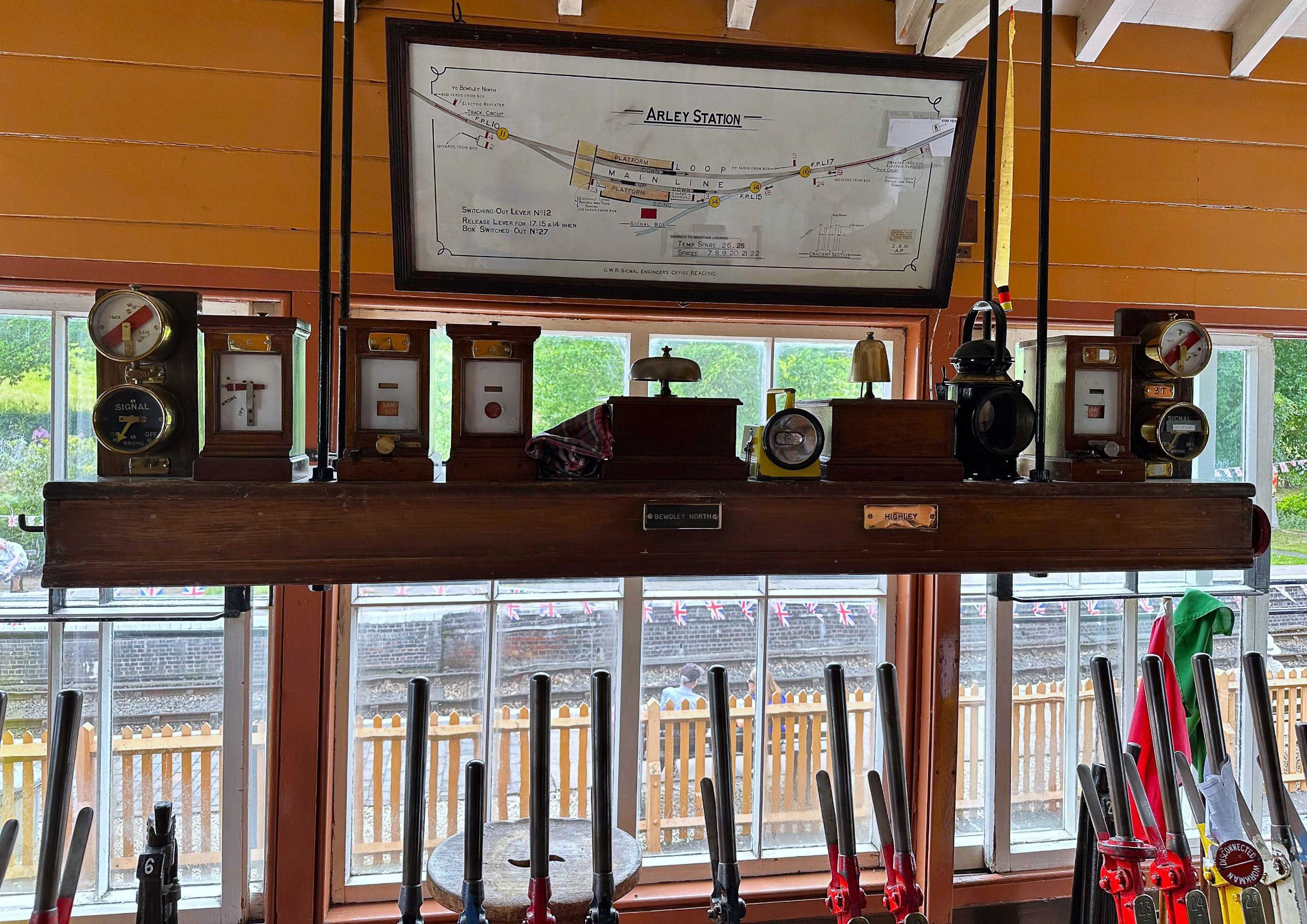
Arley signal box diagram and block instruments.
[© Mark Shinwell 2024]The GWR 3-bar vertical tappet frame has 23 working levers, one spare and six spaces, the levers (uniquely on the SVR) do not have plungers as the catches are electrically locked. There is again a normal Romesse stove (without inscription on the bottom plate). Two Tyers token machines are used to work the line southwards (Up) to Bewdley North and northwards (Down) to Highley. A third smaller Tyers token machine situated in a hut nearby provides an 'intermediate' token which can be used to lock trains into the yard when the box is switched out, by using a signal box as a ground frame. When the box is switched out (a complex but commonly used procedure), all trains use the bidirectional Arley Up P1.
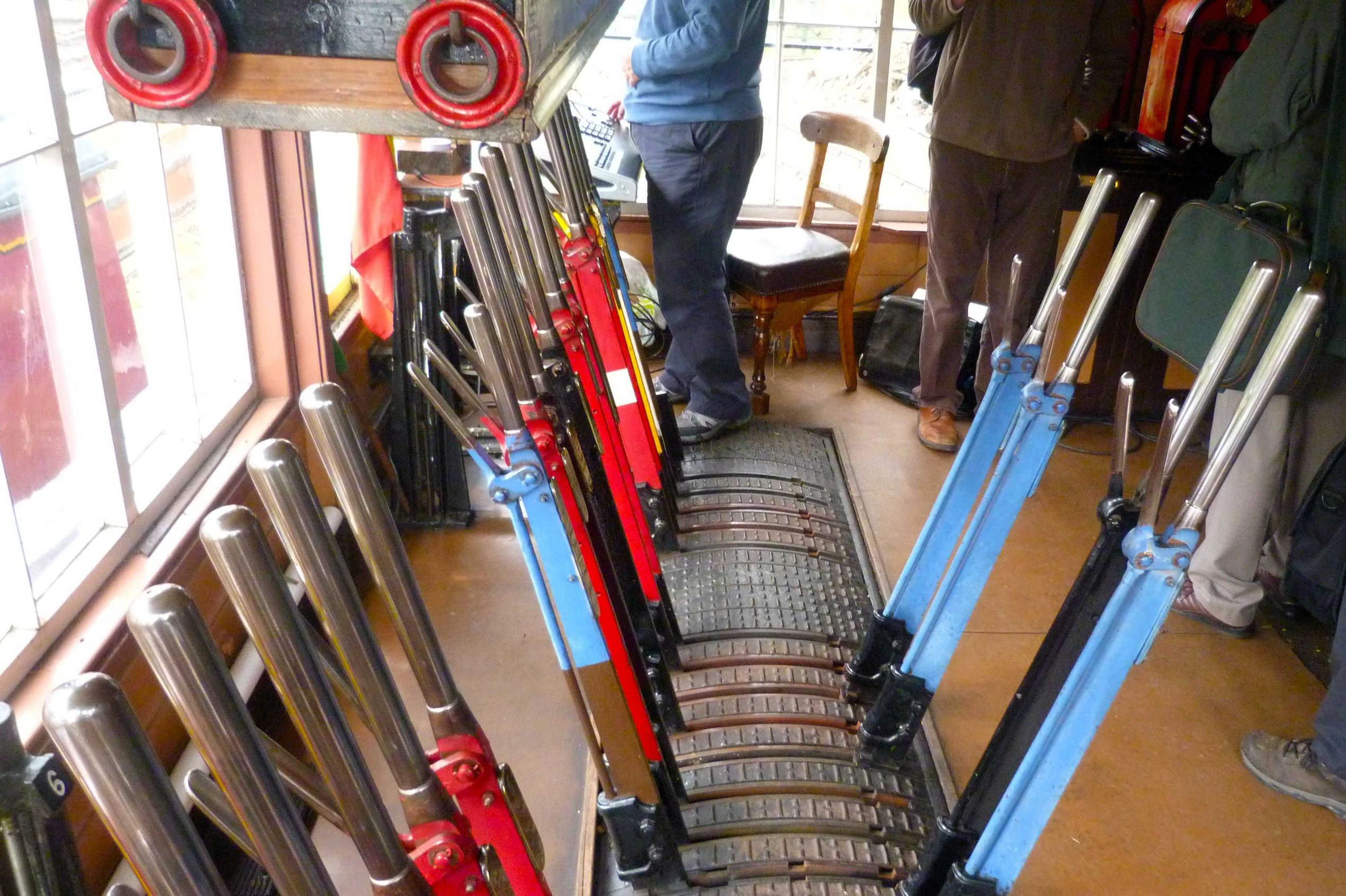
Arley signal box lever frame looking towards Highley and Bridgnorth
[© Angus McDougall 2014]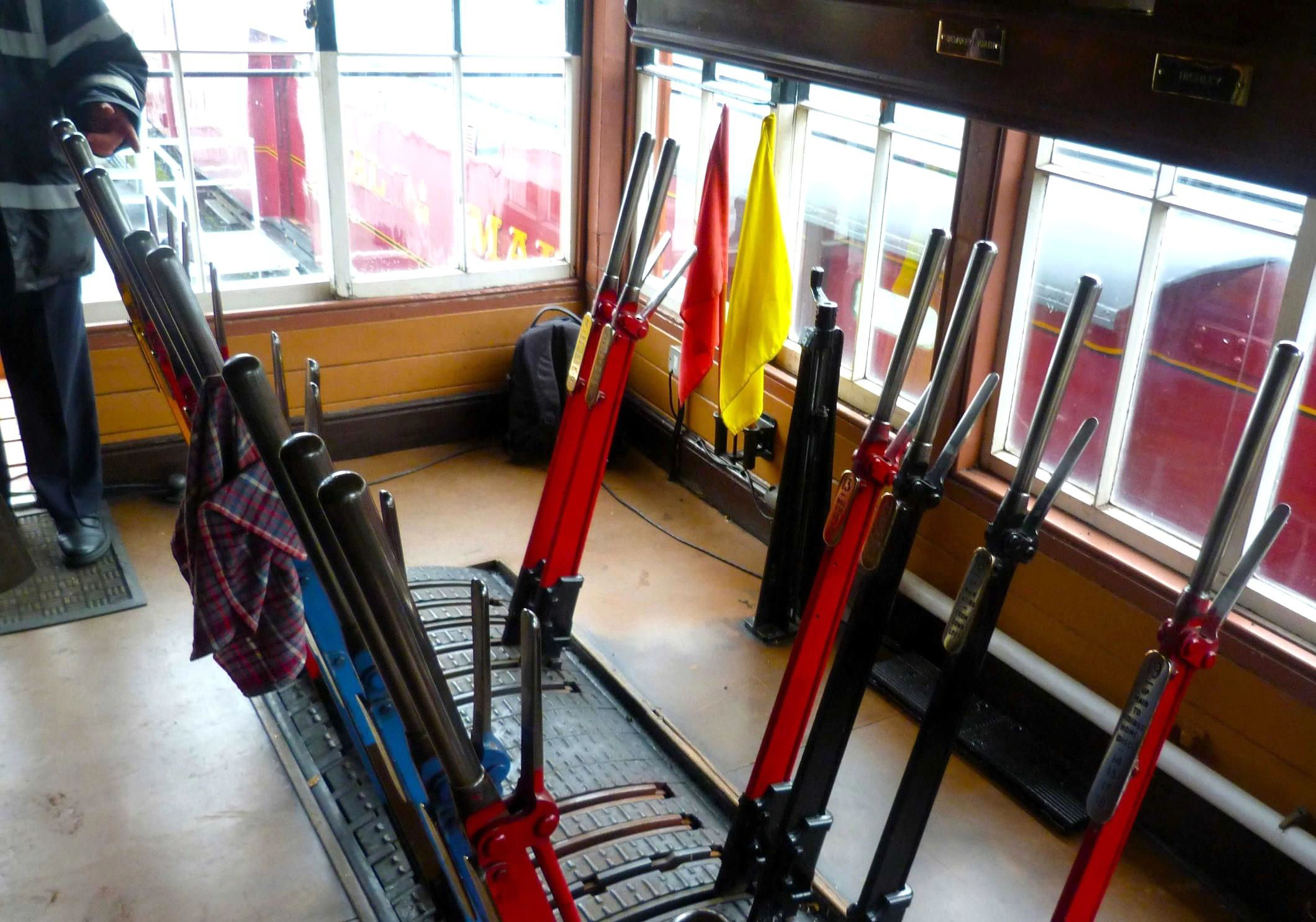
Arley signal box lever frame looking towards Bewdley and Kidderminster.
[© Angus McDougall 2014]Our group of members next drove to Highley. From a parking area near the top of the lane, a steep walk took us to the SVR with the station and box alongside.
The box (a Type 3) was built in 1883 by Mackenzie & Holland of Worcester who, in the late 19th Century, become the foremost manufacturer of signalling equipment in the UK. It is in yellow brick with a chimney constructed from the same. The original (demolished) signal box at Arley (BLN 1499) was a mirror image of Highley box. The weatherboarding and woodwork are painted in standard GWR two-tone buff ('light stone') and buff / dark pink ('dark stone') shade. At the base of the front is the 143¼ milepost -miles from Paddington via Oxford, Worcester and Stourport. Inside, a small range appeared very similar to that seen at Bewdley North, manufactured by Price & Sons of Abergavenny. There is a Cambrian Railways Co fender. Highley station was popular this day with visitors to the SVR, not least because the 'Engine House' attraction is nearby; the signaller is very visibly in the middle of the action here.
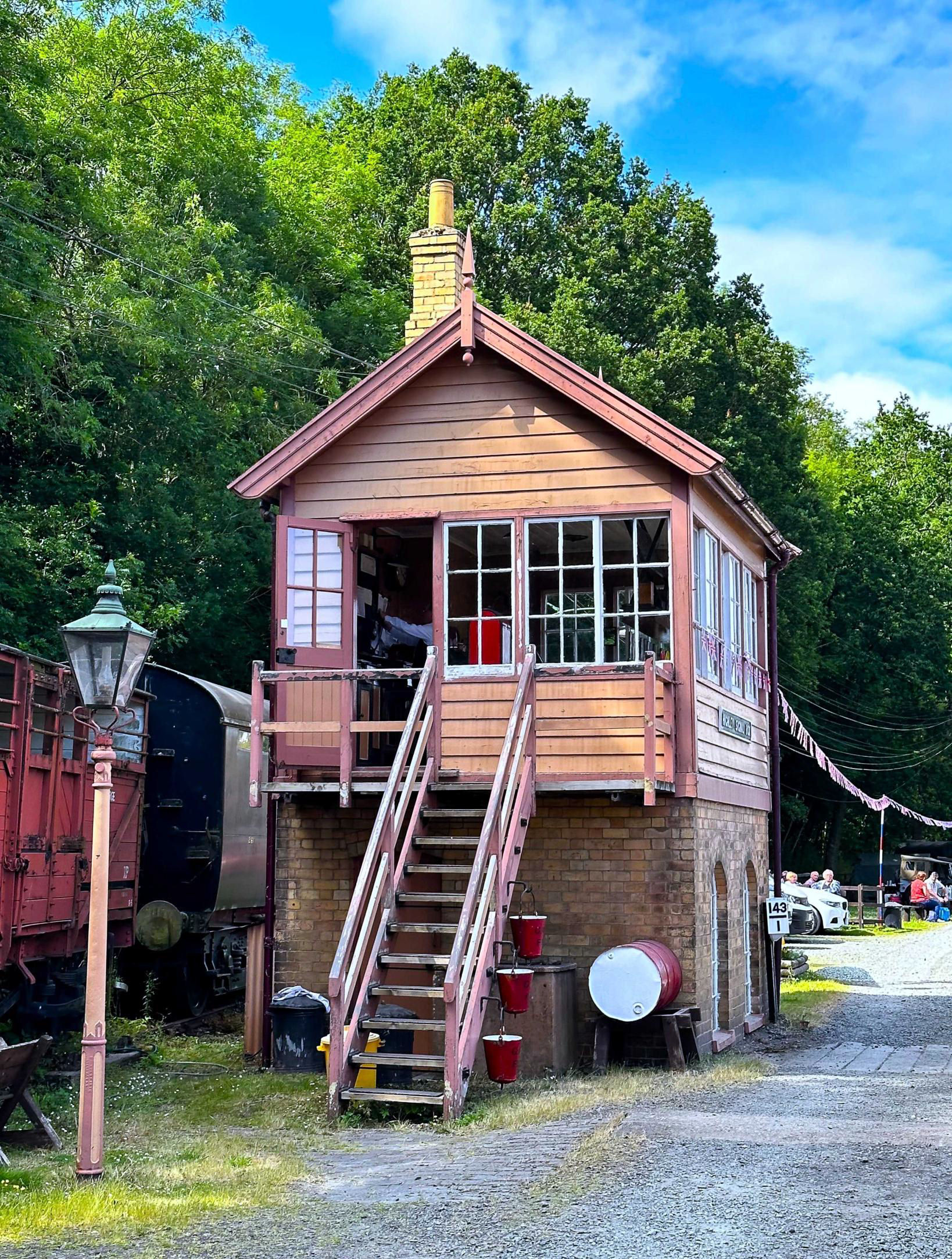
Highley signal box towards Bridgnorth, platform off right.
[© Mark Shinwell 2024]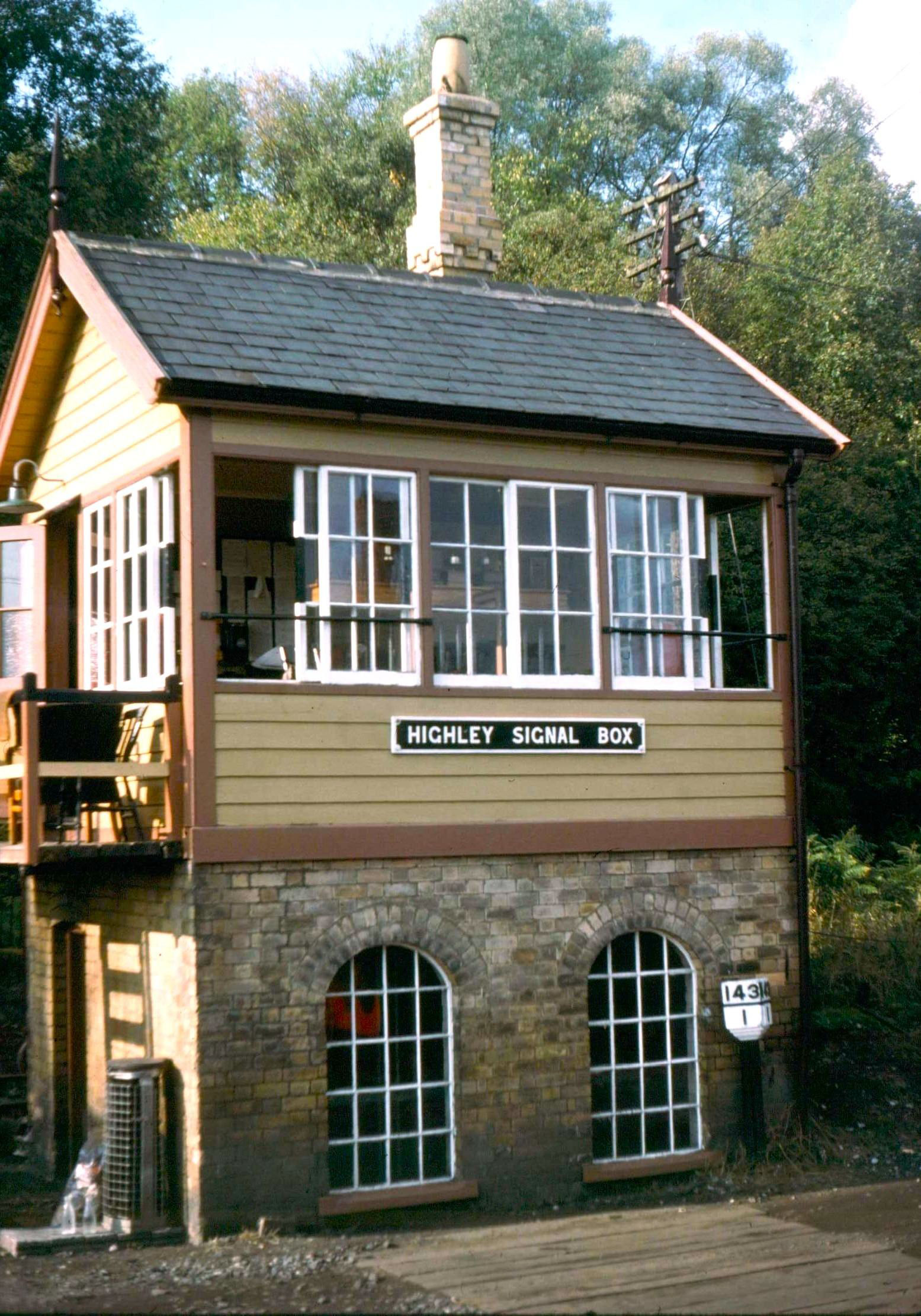
Highley signal box on 19 Jan 1975.
[© Angus McDougall 1975 ]The box once controlled access to Highley Colliery Exchange Sidings where The Engine House now is. When Highley Colliery was linked underground with the then new Alveley Colliery in 1937, it became the coal landsale site. On 30 Jan 1939, two ground frames were commissioned in the section to Hampton Loade to access Alveley Sidings. They were Alveley Sidings (South) and Alveley Sidings (North), released by the Highley to Hampton Loade token. An intermediate token instrument was provided for trains to be locked in the looped sidings. The North ground frame was taken out of use in 1974, the South frame survived until an unknown later date. The SVR took Highley box over in Dec 1972. British Rail (BR) was aware of this, so left a virtually intact, working box with original signals and associated track and points. Thus, it retains its original 14-lever McKenzie & Holland 1873 patent lever frame, with 11 working levers, 3 spare and no spaces. The interlocking was replaced by GWR 5-bar vertical tappet interlocking in 1947.
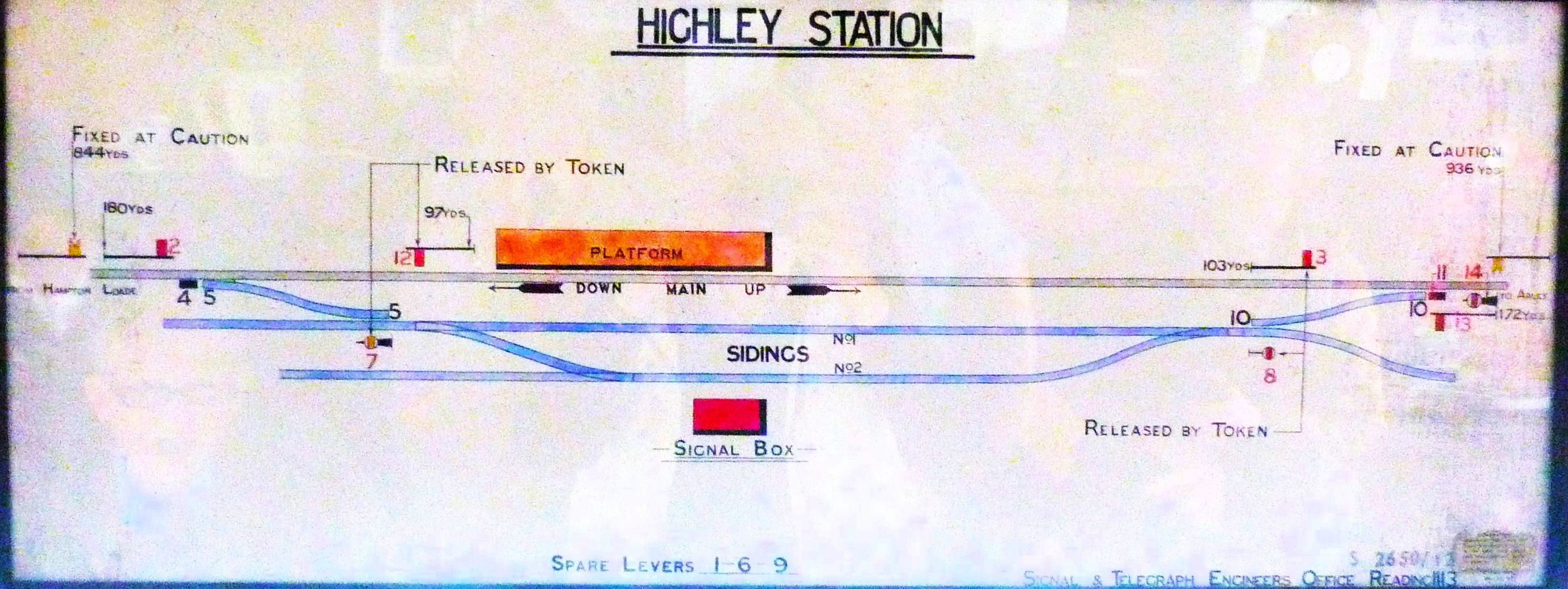
Highley signal box diagram which dates from British Railways days (Signal & Telegraph Engineers Office, Reading).
[© Angus McDougall 2014]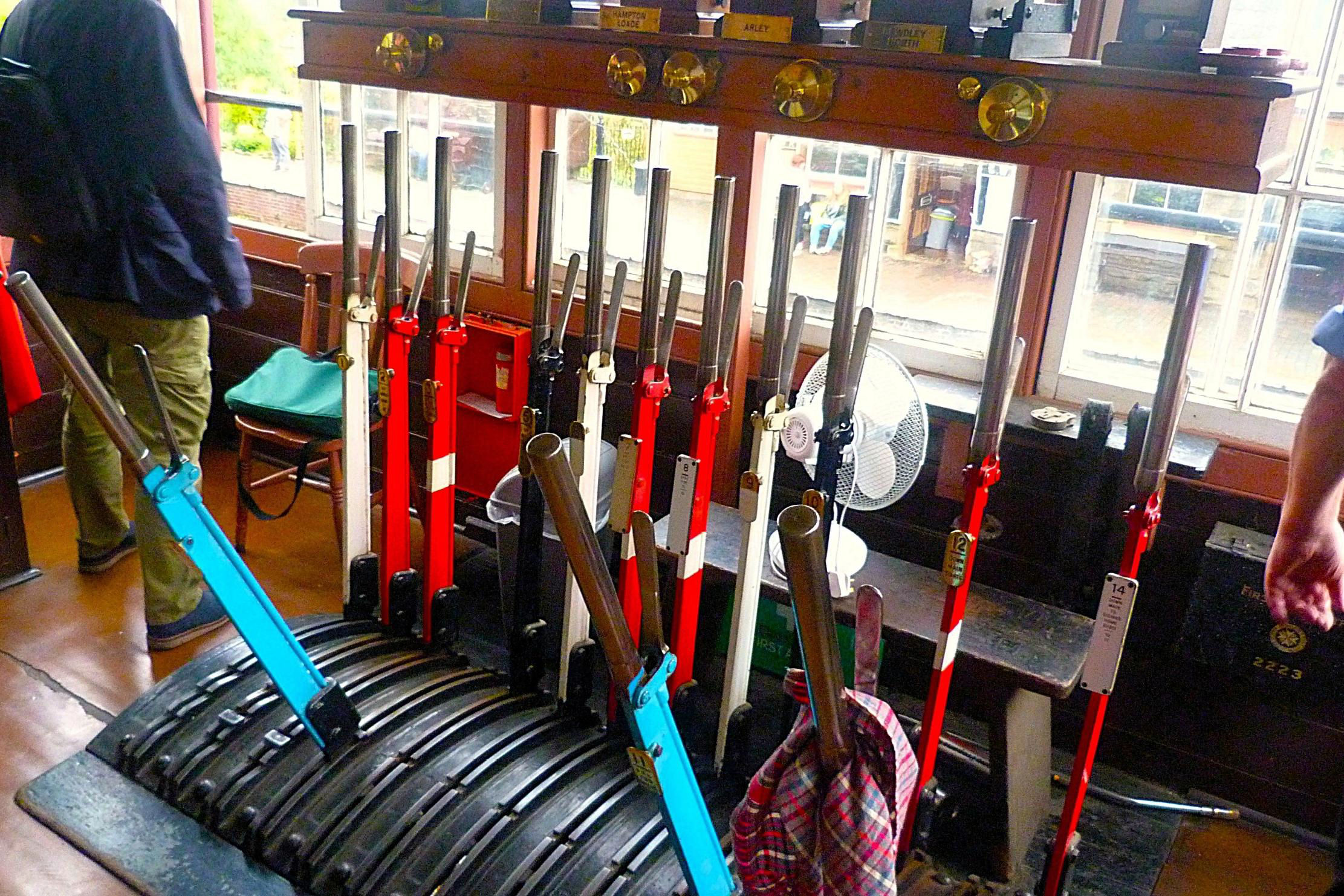
Highley lever frame during our highly successful Fri 30 Oct 2014 AGM visits (travelling on SVR trains), the platform is ahead.
[© Angus McDougall 2014]The box was originally abolished by BR from 3 May 1970. Rail traffic (coal from Alveley Sidings about ¾ mile to the north - where Country Park Halt is now) ended when the colliery closed on 31 Jan 1969. The last coal train left for Stourport Power Stations on 6 Feb 1969, then light engines continued to run on Thursdays only for a short period taking cash for staff wages! The line was taken out of use between Kidderminster, British Sugar Factory at Foley Park through Bewdley to Alveley Sidings, along with that south from Bewdley to Stourport station, from 3 May 1970. Passenger services between Kidderminster / Hartlebury and Bewdley had been withdrawn from 5 Jan 1970. Foley Park to Bewdley was used for stock transfers and, after the SVR took over, for occasional through trains. The SVR once had stock approved for mainline use (e.g. Bridgnorth to Paddington on 6 May 1978). After May 1970, Hartlebury to Stourport remained open for coal traffic to Stourport 'A' & 'B' Power Stations (last train Feb 1978, line taken out of use 12 Jan 1981). The Power Station headshunt extended into the former Up platform.
Closed to passengers 9 Sep 1963, the SVR reopened Bridgnorth to Hampton Loade on 23 May 1970. After purchasing Alveley Sidings to Foley Park on 1 Jun 1972, they extended to Highley on 12 Apr 1974. Bewdley was reached on 18 May 1974 with, from 11 Sep 1976, occasional gala running, 'top & tail' to the then SVR boundary at Foley Park. SVR passenger services extended to Kidderminster on 30 Jul 1984.
Continued in Part 4