I had been following the Branch Line Society on social media for some time now, interested in the activities on offer. However, when I saw a post promoting the springtime Scunthorpe Steeler, I could not resist. Following the link to the webpage, I soon found myself paying for membership and then booking myself on this tour. I mean, how else do you get to see around such an important site in detail when it comes to the growth, development and eventual decline of British heavy industry?
While many were heading for the seaside etc, there I was, at 08.00 on Easter Bank Holiday morning having my 'All you can eat' breakfast at the Premier Inn, Lakeside, Scunthorpe, wondering what the day would bring. Having fuelled up for the day and made a flask of tea to take with me, I found myself on the very short drive to Gate 'E' of British Steel (or 敬业集团 = Jingye Group to give it the correct title).
Just a brief walk from the car park and I found myself on the short platform of the Appleby Frodingham Railway-Scunthorpe (so named since 6 Dec 2021) with fellow enthusiasts - 57 were booked on our tour. In 1990, the Steelworks celebrated its centenary; the Rail Traffic department borrowed a steam engine and coach to run a commemorative train around the site for dignitaries, followed by over 100 trips for local school children. In 1991, some of the British Steel drivers met with management and the original Appleby Frodingham Railway Preservation Society (AFRPS) was formed. The rest is history as they say.
Our train for the day was made up of Yorkshire Engine Company 0-6-0DE Janus No1 (works number 2877), four smartly turned out AFR-S brakevans (two BR Standard 20T, one LMS 20T and a BR 20T Shark). The train arrived exceptionally early around 9am and we departed promptly at 9.30, with the light cloud clearing becoming a day of glorious sunshine with a cool, light breeze - a photographer's delight.
Passing the main onsite power station with its large cooling tower right and the AFR-S yard left, we soon saw the redundant coking plant now being demolished, more on it later. This brought us to a bottleneck on the system, a short piece of single track (there used to be four tracks), like the neck of an hour glass, over Dawes Lane underbridge. We reversed up the incline to the Rail Service Centre.
In the sidings here was ex-Norwegian State Railways (NSB) Di8 diesel electric loco No817, shunting a train of rails forming part of a contract for 36,000 tonnes of rail heading to Turkey for their new high speed rail link between Ankara and Izmir. As a result of this contract, announced in February this year, the site is once again working 24/7. At the 2 bay despatch area, we touched the buffers of wagons loaded with short lengths of rail awaiting welding, We then proceeded to the ultra-modern rail stockyard, this time nudging up to a rake of empty wagons and seeing one of the feral cats that seem to thrive in the works. This £10M facility can store 25,000 tonnes of rail in 108m lengths and was pretty full. Remarkably, we even saw some brand new bullhead rail, thought to be destined for the Rother Valley Railway extension.
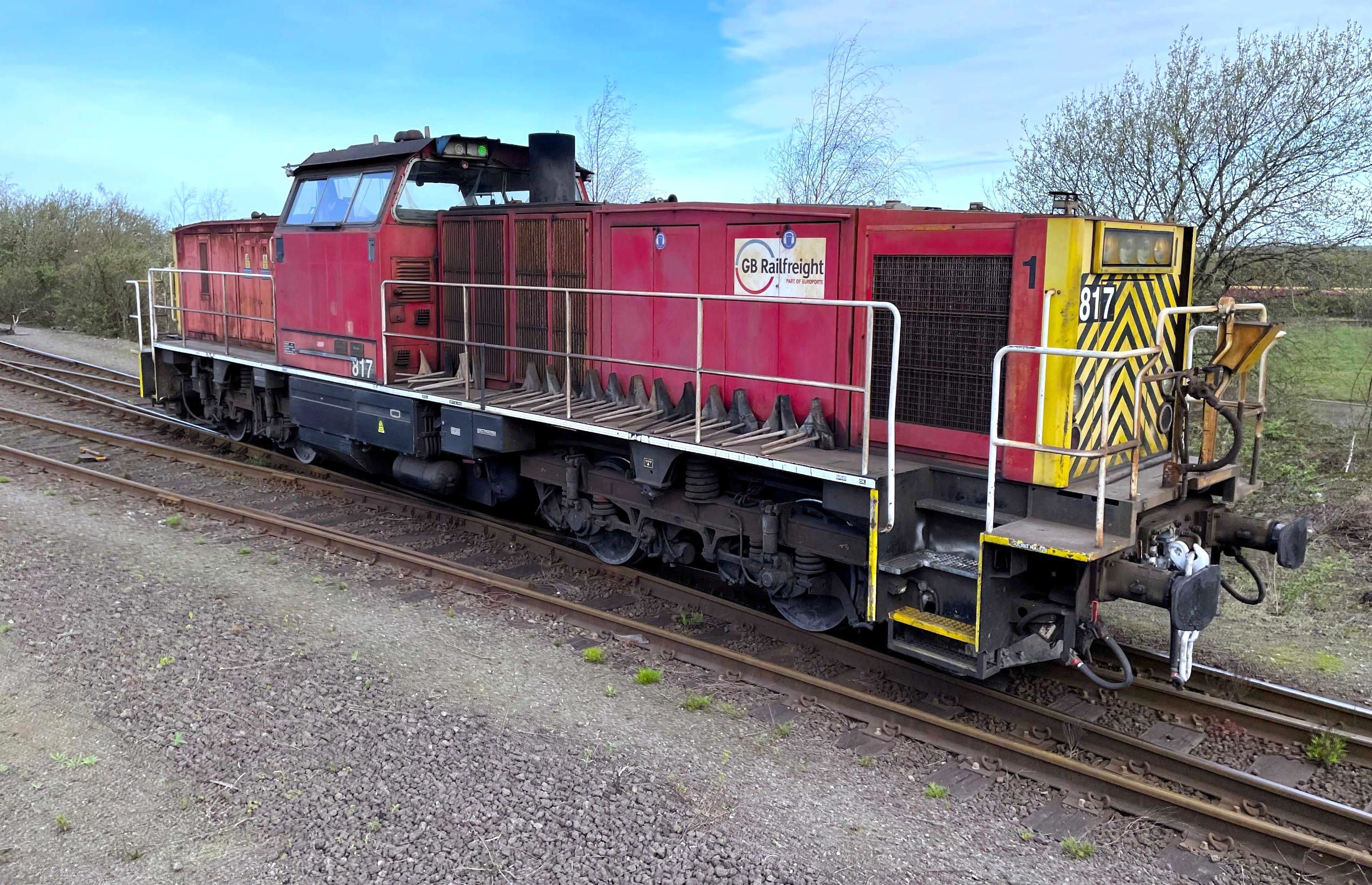
Di8 loco 817 at Scunthorpe (nothing to do with GBRf now) are there enough wheel chocks?
[© Adam Turner 2026]A series of manoeuvres saw us cover various sidings and gave us views of the British Oxygen air separation unit that feeds the steel works. We also saw Trent Sidings, where coke trains from the main line access the steelworks, then exited the rail production site past the welding plant, where rails are joined into 108m continuous welded rail. From here, it was back through the 'hour glass' and under the coal feed conveyor system (still in use as coal is required in the blast furnaces to make virgin iron).
Next, our tour ran to Redbourn semi-finished steel stockyard at a very strict 10mph along line C2, to the headshunt buffers, of course. We had excellent views of DBC Class 66, 66099, at a higher level, taking a rake of empty iron ore wagons back to Immingham along with the rake of full wagons for unloading at the Foreign Ore Terminal that it had brought in earlier. The ore wagons are moved by a track 'mule' for unloading and are the last three sets of rotary tippler wagons on Network Rail. Return was via line C3.
Once more through the 'hour glass', we then made our way round The Angle to Anchor Exchange Sidings. The four brakevans were propelled down Road 15 to the NR boundary, where a couple of the vans crossed from British Steel onto DBC infrastructure (British Steel has running powers subject to permission from the DBC site controller at the time but not over NR). A quick exchange of words between DBC Control and the train clarifying this was unavoidable to ensure the loco cleared Points 479 and we were off back along Road 14 towards Brick Shed Jn. It was interesting to note that, around here, are various speed restriction boards displaying 5, 10, 100 and even 150 mph; guess which ones are genuine!
Passing under the high level Foreign Ore Branch on the Down Line, we approached the Mills Exchange Sidings, crossing over to Up and then back again to include the facing and trailing crosser. Then it was Road 10, past the redundant control building and over the equally redundant weighbridge (it's done electronically now) or perhaps they were going to weigh our train before and after the lunch break?
Besides us in Road 9 was a rake of the ubiquitous British Steel 30T scrap wagons (that's wagons for the conveyance of scrap, not old and useless wagons as someone pointed out in our brakevan). Beyond them, a train was being formed of rolled steel slabs on bogie wagons which would go to Tees Yard, then on to Teesside Beam Mill at Lackenby, British Steel at Skinningrove and / or Dalzell (pronounced 'Dee-L') Plate Works at Motherwell. At Lackenby, they roll construction beams that have, in the past, found their way into Heathrow T5, London (Olympic) Stadium, The Shard and the rebuilt World Trade Centre in New York. At Mills Exchange Sidings, we covered Roads 11, 12, 13 & 14.
From these sidings, one has a view of the Muck Bank. This is where slag is tipped and processed as a useful by-product for construction aggregates, road surfacing, cement production and even agricultural uses. From here, the tour continued to the southern line into the Former Bloom & Billet Mill (a massive storage area now). We managed to reach the entrance of the Mill but had to stop due to overhead cranes working and wagons ahead. From here, we reversed to Points 423 and then proceeded into the store via three of the four northern access points. [The tour went into five separate building entrances.]
Inside this massive mill / store it was dark. Two chaps were torch cutting steel billets; it could easily have been a set for a post-apocalyptic movie. We were told by the AFR-S guard in our van that each piece of steel was worth £8,000 and there were thousands of them in this store, as far as the eye could see! 'Tempus fugit', as the Roman ironmakers used to say and we were some way from our lunch and comfort stop. So, we got a wiggle-on and headed to the Concast plant. Here, steel from adjoining BOS Plant (Basic Oxygen Steelmaking) is continuously cast into slabs, billets or blooms, prior to moving through an under-track tunnel to the Slab Yard or to the BOS Yard while still hot, extremely hot. We managed to traverse both the main Concast lines, as well as Caster 5 Loop, prior to our loco running round.
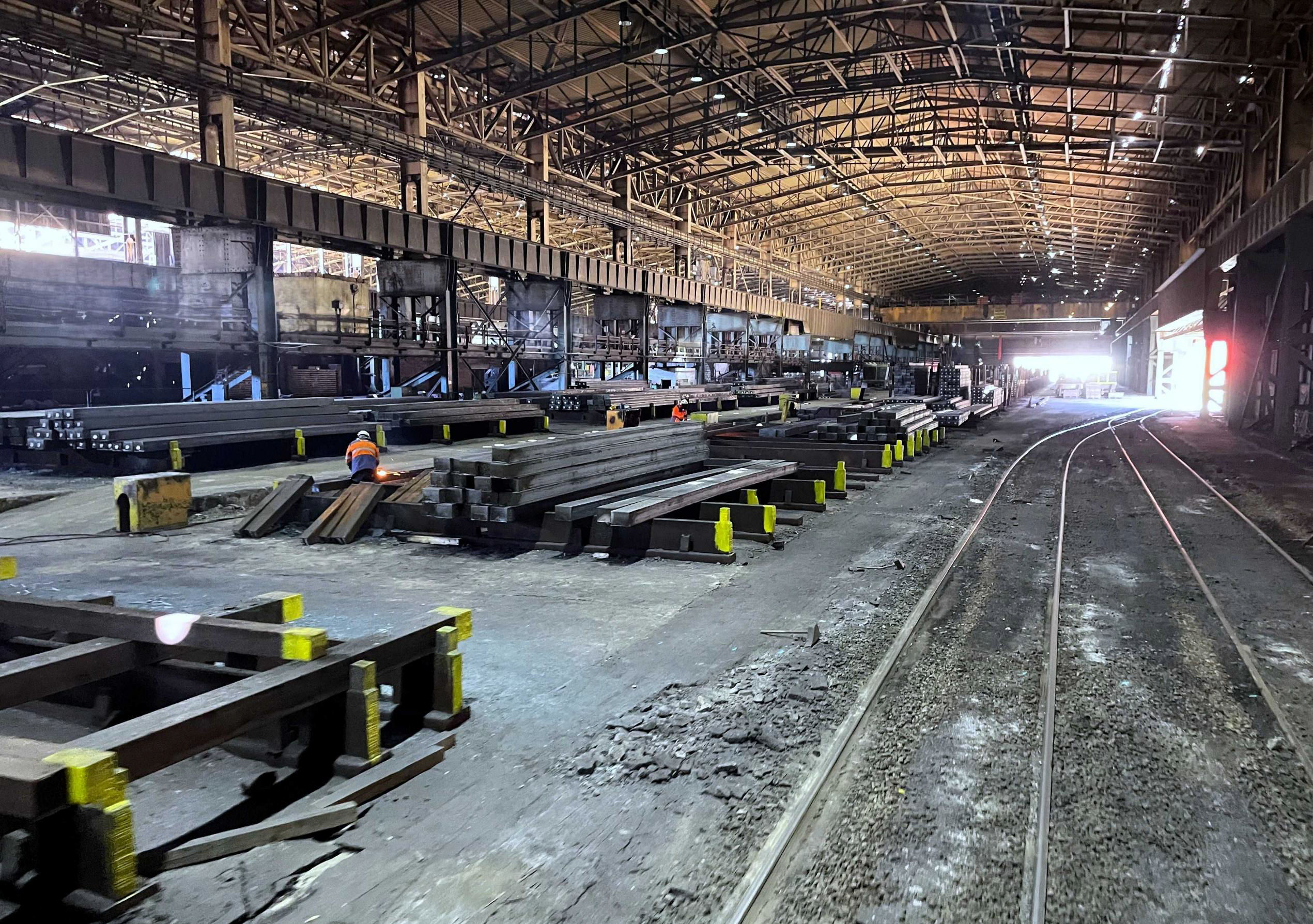
Former Bloom & Billet Mill Entrance 3, inside line; now a giant store, two men are cutting up steel billets.
[© Adam Turner 2026]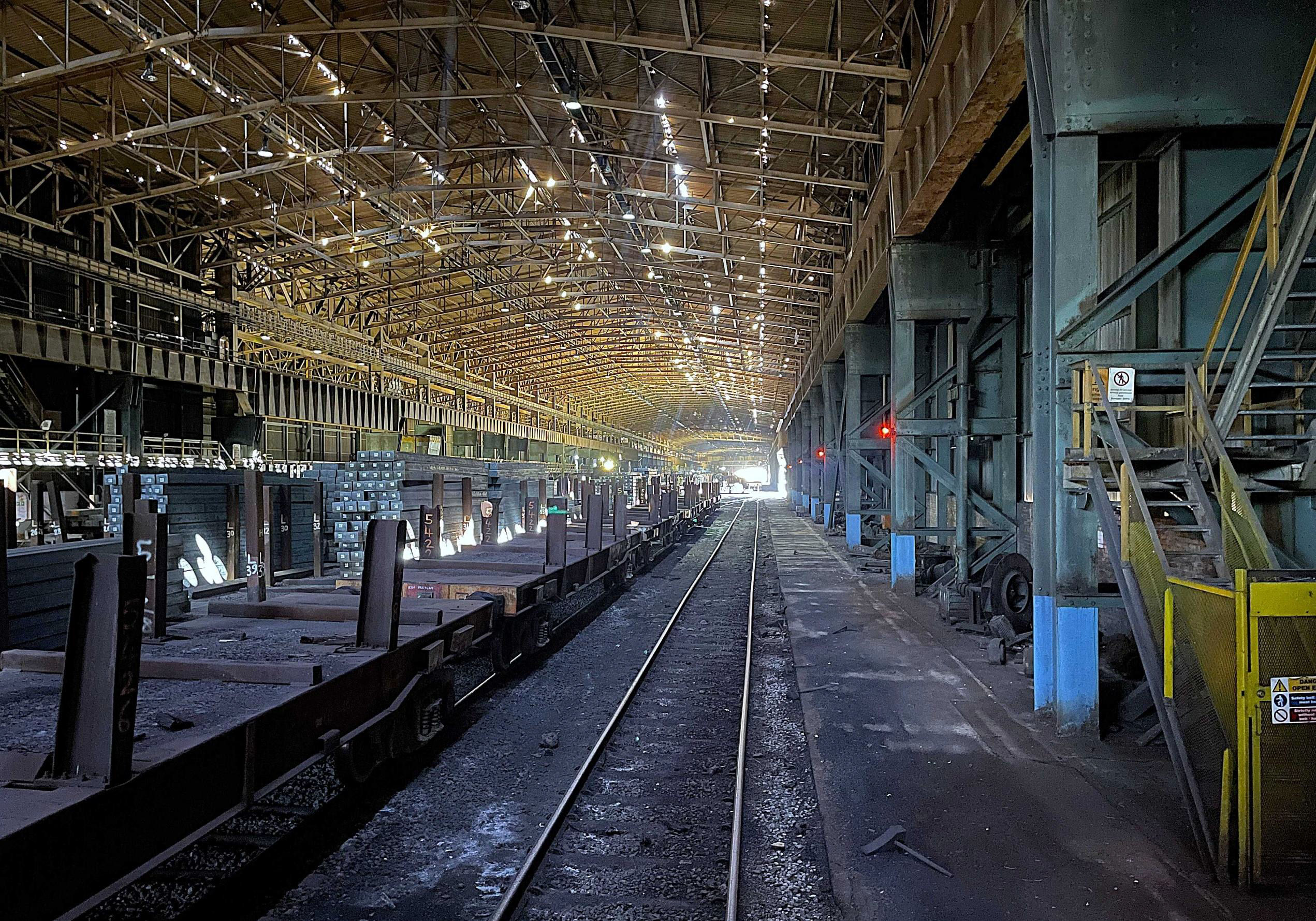
Former Bloom & Billet Mill Entrance Entrance 5, outside line.
[© Adam Turner 2026]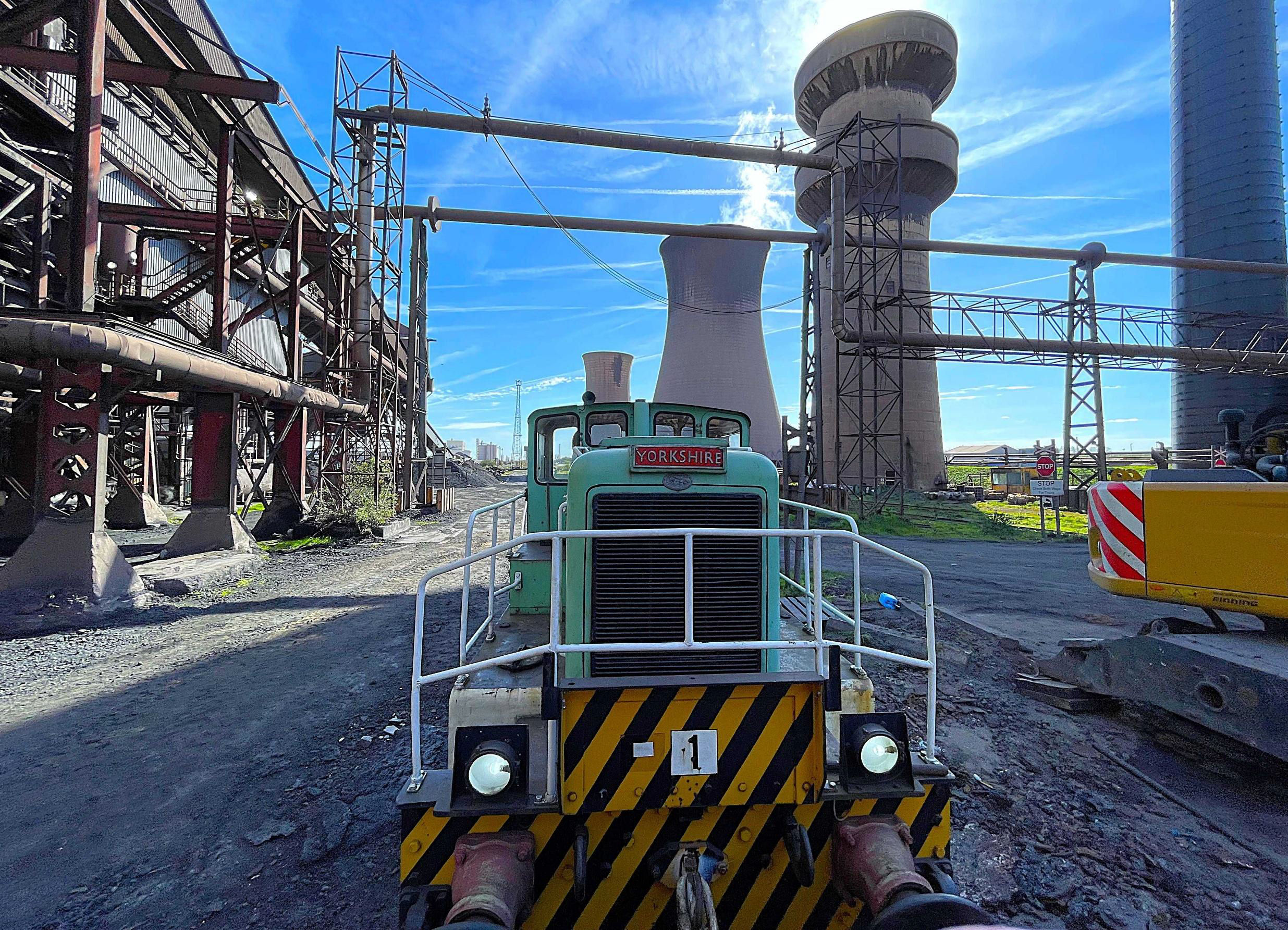
Yorkshire Engine Company 0-6-0DE Janus No1 (works number 2877) leafing our 4 brakevans.
[© Adam Turner 2026]Again never exceeding 10mph, we left the Concast area, past a yard with simmering hot steel bars to make our way along the Soaker Side, past the Former Soakers (where steel was kept hot prior to rolling or milling) on our right. On our left was the Former Mould Shop, now a long storage area complete with a huge gantry crane that was at least a quarter of a mile long. Turning westward, the track rises on Plate Pit Hill with the LKAB calumite plant and yard to our left. (LKAB = Luossavaara-Kiirunavaara Aktiebolag, a state-owned Swedish mining company). Calumite is a calcium-amino-silicate based material made from granulated blast furnace slag and is an essential mineral for the glass industry. To our right, was the massive Seraphim iron ore preparation (sinter) plant, opened in 1954.
At Points 159 / 158, we crossed to No65 Road and saw the Four Queens: Victoria, Anne, Bess and Mary - the blast furnaces to our left. However, lunch (and loos) were calling, so no time to stop before we plunged under the high level line into a maze of conveyors and pipes, past the derelict Appleby Coke Ovens, to emerge back into the sunshine by the main power station cooling tower. A short climb to clear Point 501 and we reversed back along the track to allow us access to the AFR-S yard for lunch.
In the 3½ hrs since leaving Frodingham Platform, we had covered 14½ miles, with a time in motion of 2hrs 30mins at an average speed of 5.8mph (thanks to Keith Wright for these statistics). Lunch was served in the very nicely appointed AFR-S lounge coach and outside tables for those so inclined on this warm sunny day. There were hot and cold drinks, plenty of sandwiches, crisps, nibbly-bits and a wonderful array of cakes. Thanks to the members of the AFR-S and their families for a lovely spread.
During the lunch break, we had a chance to admire the AFP-S 1976 rebuilt Hunslet 0-6-0DH No402 (previously British Steel No58), view their Pacer 144017 (not at Points 144) and the front of ex-Polish steelworks 0-6-0T 'Hutnik'. There was also a small museum to look around and a shop to browse.
Continued in Part 2