Reboarding, we reversed through Loop 227 and returned to the 'hour glass', proceeded forward along the Coke Oven Weighbridge Loop, back along Road 65 then to the south of the LKAB compound towards the main Blast Furnaces to BOS Plant line. At Points 142 there was a minor delay as a British Steel Di8 loco passed, returning to the blast furnaces. We then joined the Down line, crossing to the Up at Points 143 and, with its elevation, participants had great views across the southeastern corner of the works.
At this point, I digress a little but stay with me. To make iron you need iron ore, coke, coal and limestone. In Lincolnshire, an iron ore seam runs very close to the surface and you have (had) an abundance of coal in neighbouring Nottinghamshire and Yorkshire. Add to this good rail and sea communications and you understand why there were so many iron and steel foundries in the area which amalgamated to make the 18,000 acre plant of today. Coal still comes arrives by rail to the coal handling plant on the Up side of the Scunthorpe to Barnetby line. This faced inland, which is where the coal originally came from.
The coal is taken across over the main line by conveyor belts and used to be made into coke (a certain amount is still needed by the blast furnaces). Logistically all very sound. However, over time, UK coal was replaced by imported coal via Immingham (likewise iron ore - foreign ore having a much greater iron content). In Jun 2023 the coke ovens, which were on their last legs, closed so coke is now imported.
This sounds sensible until they discovered that the imported coke was unsuitable - too fine and powdery, aggravated by vibration and handling during road transport. It clogged up the blast furnaces and the iron produced was so poor that it could not be used - even for very low grade steel. So, they had a problem, thousands of tons of absolutely useless poor quality iron (plus millions of pounds down the drain) and nothing to do with it. They had to simply dump it on a spare bit of land to the east of the Scunthorpe site. It will be recycled. That is where we rejoin the tour. There is a veritable hillock of rusting lumps of iron just sitting there to the right of the line. It has to be a quarter of a mile long and is very tall!
Passing this, we headed towards the BOS Plant. This processed its first steel on 31 May 1973; however, the adjoining Concast Plant was not ready until 31 Mar 1974. On 8 May 1974, HM Queen Elizabeth II, accompanied by HRH The Duke of Edinburgh, officially opened the combined facility (which was known as 'The Anchor Project'). At opening, it was the largest of its kind in Europe and the most advanced in the world. We saw some loaded torpedoes by the BOS Plant (where they are gravity unloaded by rotating the torpedo on its two wagon end bearings). Crossing back to the Down Line at Points 147 / 150, we approached slowly. However, for safety considerations, we turned back 50yds before the torpedoes.
BLS fixtures are certainly very educational, I learnt that 'BOS' refers to the method of converting pig iron (from the blast furnaces) into steel by blowing high-purity oxygen through the steel to reduce the carbon content and remove impurities. BOS = Basic Oxygen Steelmaking. Hence the oxygen plant referred to earlier. From here, our loco propelled us back to the blast furnace complex towards Queen Victoria's bottom. It was definitely a 'WOW!' moment, so close to these engineering giants with the supporting infrastructure. We managed to reach Points 127 immediately to the east of Victoria. This blast furnace was decommissioned in 2025 as relining was required - and may well happen. Her adjacent twin furnace Queen Anne is still producing. Both started up in mid-1954, although like Trigger's Broom, have had most components replaced since. Approaching 72 years old, they are spring chickens compared with Queen Bess and the partially dismantled Queen Mary which are museum pieces, both date from the 1930s.
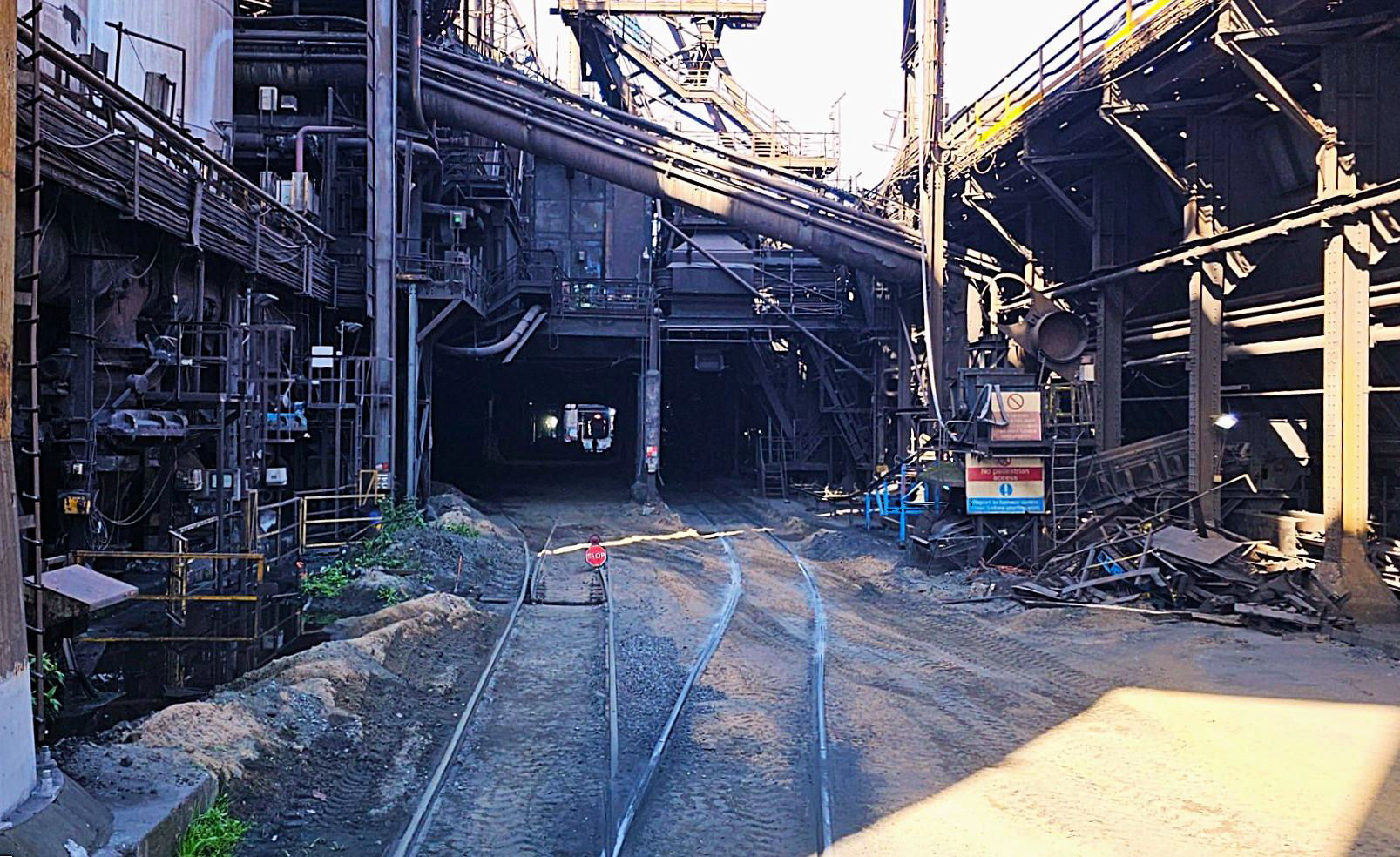
Queen Victoria's bottom (not in blast) on Points 127 looking along the four blast furnaces, the High Line is top right (yellow fencing).
[© Alan Sheppard 2026]From here, the tour moved onto the TRB (Torpedo Ladle Repair Bay). As we approached along Road 5, we could see a torpedo with the upper orifice at a 90° horizontal angle and flames coming out of it. They were burning out solidified pig iron; a common occurrence it seems. We then proceeded onto Road 1 and managed to kiss the buffers (as you would expect from a BLS tour). Then it was back to the main lines from where we were propelled towards the Rod Mill. As we approached, you could see steel rod wound like a giant's cotton reel. As with everything else in this place, it is all on a huge scale.
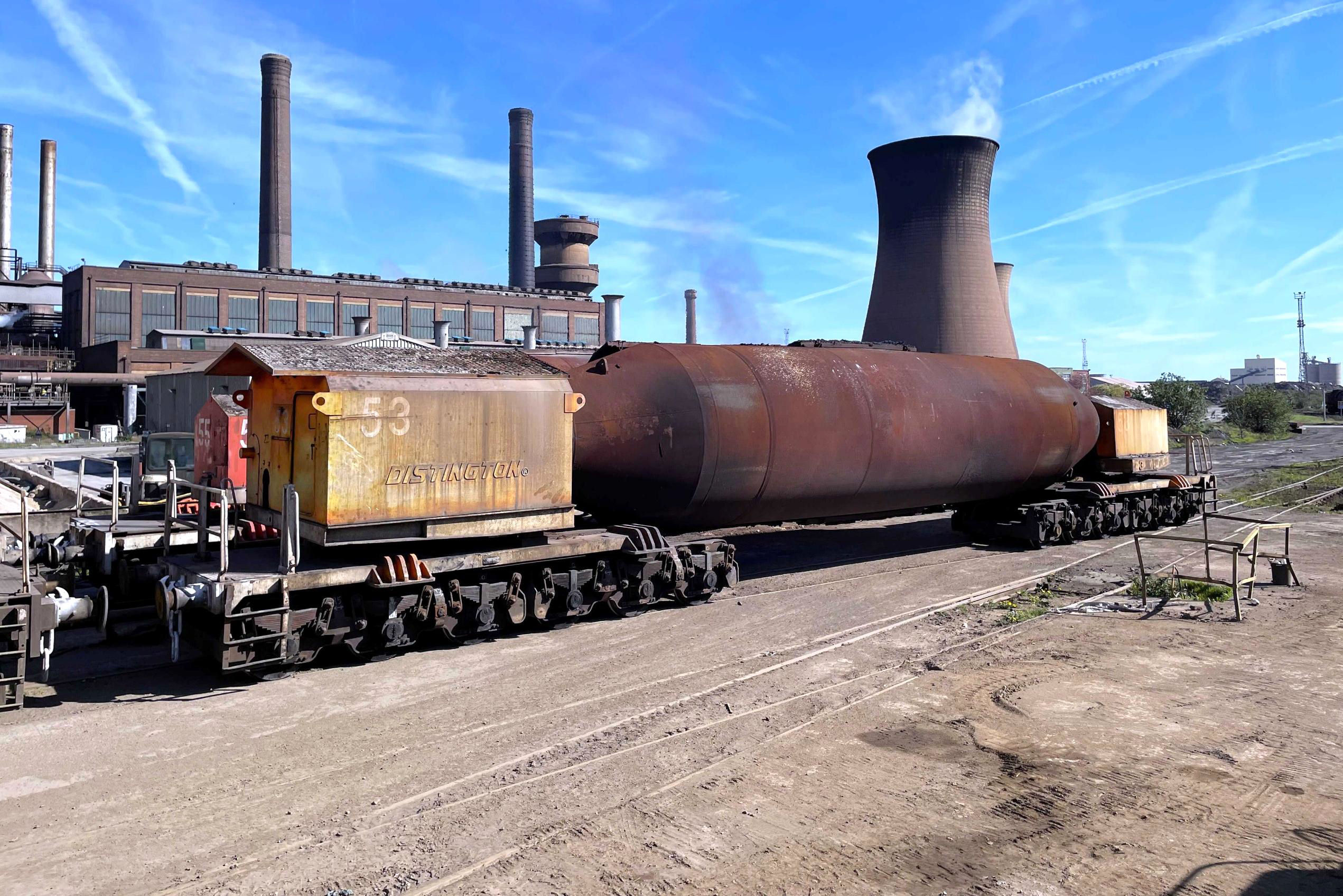
At the Torpedo Ladel Repair Bay with one of the two steelworks internal power stations behind (neither of them burn coal).
[© Adam Turner 2026]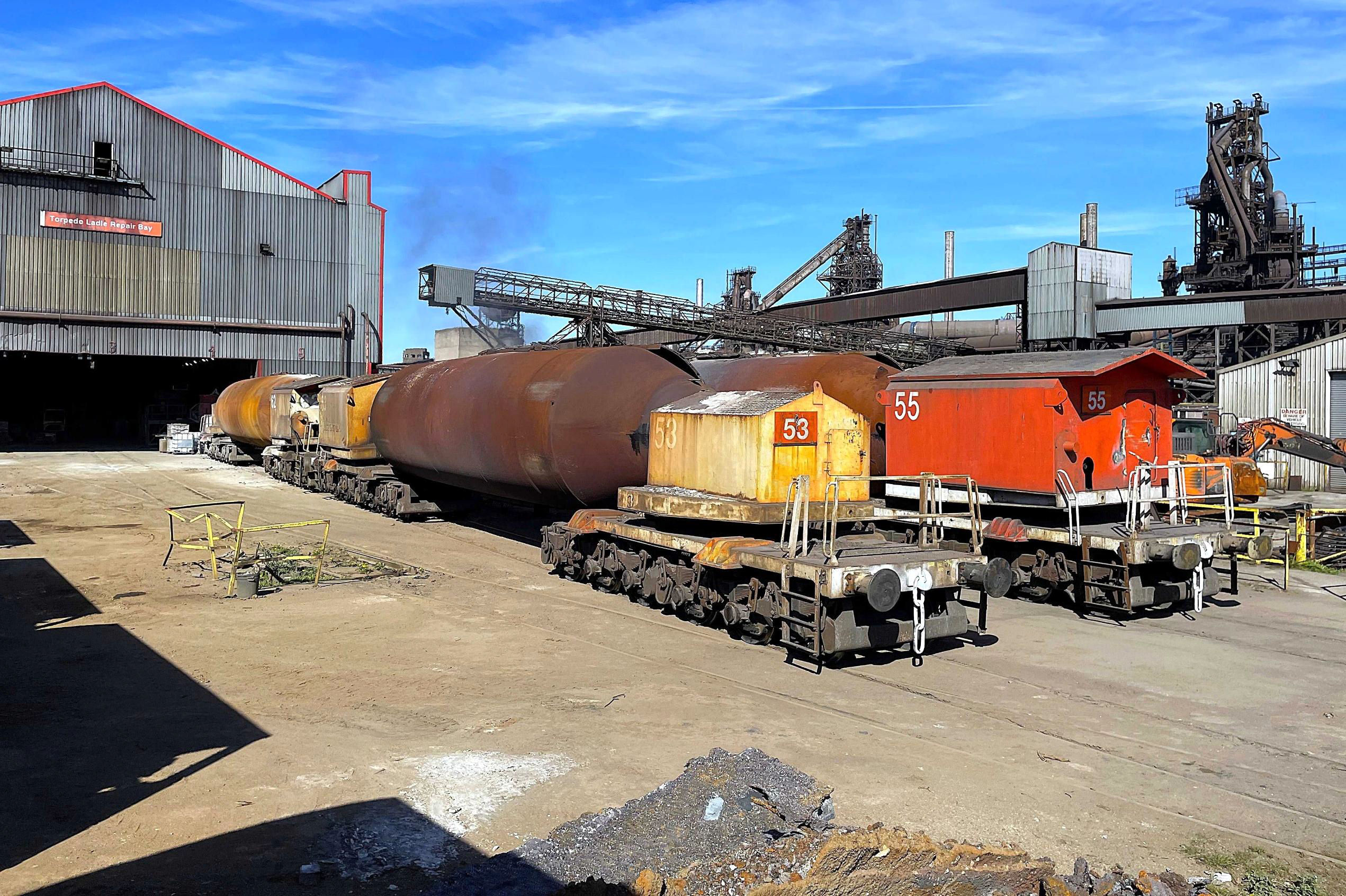
The Torpedo Ladel Repair Bay again, with three of the four blast furnaces in the background (that power station is just off right).
[© Adam Turner 2026]We just managed to not touch the mill door before the loco returned us via Loop 14 to the elevated track. This time we took the perimeter line, with 'Pig Iron Hill' on our left, and immediately past that we had a fantastic panoramic view of the BOS Plant - even now, 60+ years on from opening, it is impressive!
Continuing round the perimeter to the far northeast of the site, our tour passed the Scrap Bay. Rail loads of scrap come into the plant and are transferred to those 30T scrap wagons which bring it into this area. Scrap arriving by lorry comes directly into this area where it is added to the pile, or should I say mountain, of scrap waiting to be cut up and processed. Much of the scrap is internally generated onsite.
Our journey continued along the northern perimeter track to Points 404. Here, with special permission, we reversed and were given access to the Medium Section Mill Road 'C'. This was the reason the tour was on a Bank Holiday Monday (as opposed to a Saturday) when there are people around who could allow access to lines like this. Again, this was a dark and noisy cavern of a building and the inside of which is very rarely seen by visitors. Steel making truly is a mammoth task now, we marvelled at: The numerous 11kV transformer stations that are along the side of each mill. The size and, one can imagine, the weight of the rollers used in the mills to shape the not quite molten metal. The huge cooling plant that keeps the temperature at a level where men can work despite the immense heat of the metal and the gigantic cranes that move the solid, extremely hot, beams and bars, some weighing up to 20 tonnes, around.
We travelled along line T9 past the Mills Exchange Sidings to Points 486. Here, we reversed to the end of the Coke Terminal branch, through the new gravity coke unloading hopper. When a mainline coke train arrives at the works, which they do frequently, the Class 66 hauling separates it into two portions, then works each via British Steel lines through the Coke Terminal. Due to the layout of the site, it was impossible to make this line a circuit, so the loco has to run round each portion once it is unloaded.
The headshunt is long enough for a Class 66 but not for our four brakevans and the loco, so we ran to the end, kissed the buffers, then returned to the terminal to do likewise on the run-round loop, with headshunt overlap for most. Waiting to rejoin the Up perimeter line, the lengthy train of steel slabs we saw being made up earlier - in the Mills Exchange Sidings - was hauled past by Di8 No8.719 to Anchor Exchange Sidings. Again, just a minor wait, maybe a couple of minutes but it gave us a good view of the heavily loaded wagons ready to go out (although a Bank Holiday, the main line was busy with freight).
Once given the right of way, we proceeded round The Angle back to the 'hour glass', before running into the northern approaches of the Heavy Repair Bay. This line is not so well used; the brakevans were brushing aside buddleia bushes, which grow anywhere their roots can take a hold. Look carefully and you'll also see silver birch and other native varieties seeking out sustenance in the industrial landscape. Rabbits and other wildlife were very much in evidence as the late afternoon sun was beginning to lower.
We ran as far as we could along Road 5 and then along Road 3. Beside this road was a torpedo with its barrel at 90°, giving a very clear view of rock solid pig iron inside. We then propelled back towards the 'hour glass', past rows of wheels and other heavy spares. From the 'hour glass', with the required permission from DBC, our tour ran from British Steel lines to DBC infrastructure, then propelled along Road 9, the main through line, of Trent Sidings. This is where the incoming coke trains arrive and are split by their Class 66 loco. There were several Class 66s evident including 66244 & 66021. While we were on Road 9, another load arrived on the mainline from Immingham behind an unidentified DBC Class 66.
It was now time to be making our way back to the AFR-S platform but, before doing so, we had one last treat awaiting us. Taking Barclays Loop between the Heavy Repair Bay and the AFR-S shed, we reached Points 503 which, coincidentally, is opposite the Rod Mill. Here we reversed into the southern approach road for the Heavy Repair Bay. I gather there has been radical devegetation here since the last BLS tour in Aug 2025, avoiding branch scrape and improving the views. We traversed five roads here, seeing a selection of Di8s and various other, smaller, British Steel locos. It was then a quick trip up Basic Hill, quite an incline with tight curves (that once was a through line), prior to returning to Points 503 and finally reaching the AFR-S platform at 18.15. Over the course of the approximately 4 hours afternoon, we had traverse 18.4 miles of track, with a time in motion of 2hrs 50 mins and an average speed of 6.5mph.
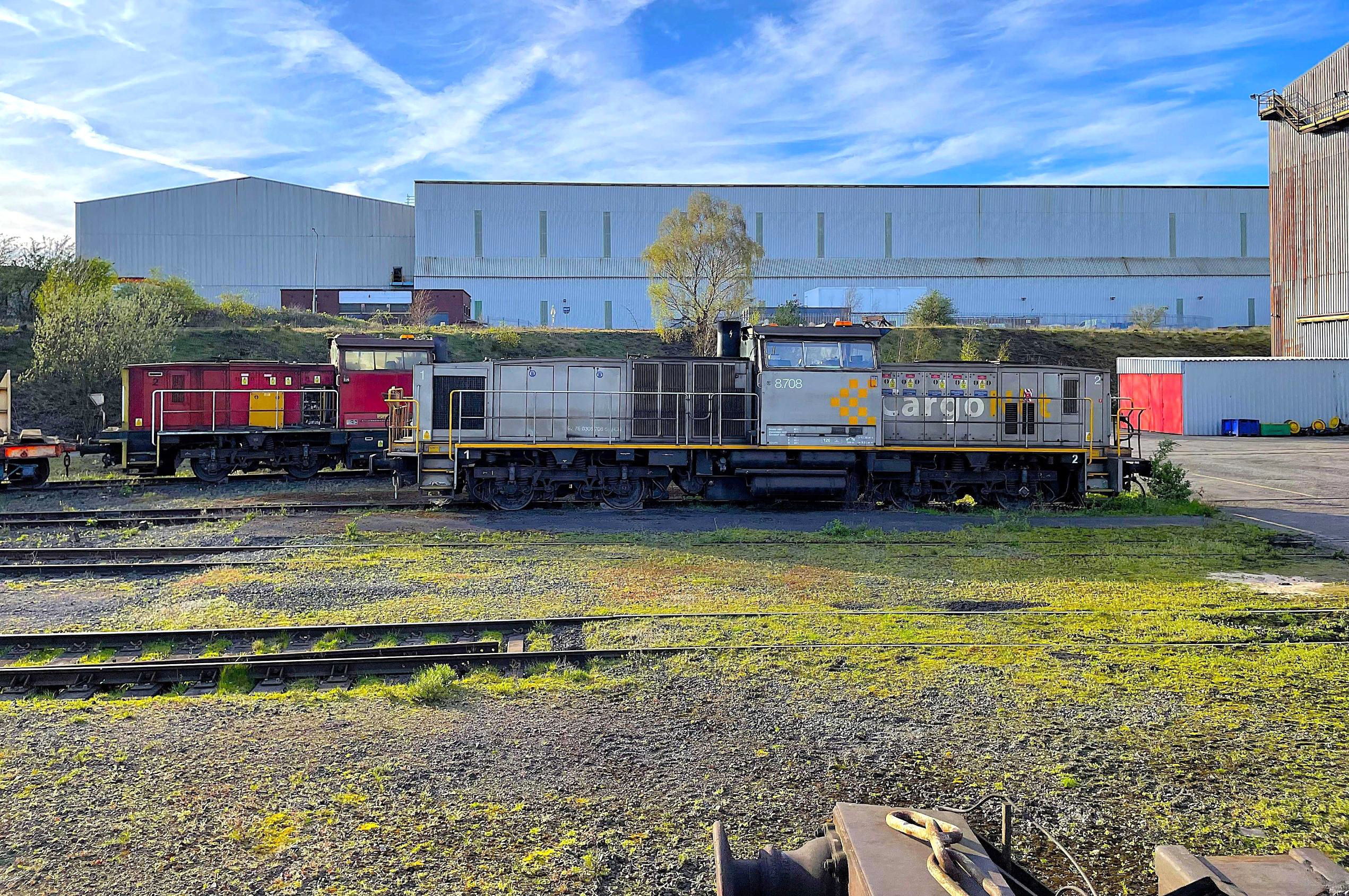
Another Di8 at the Heavy Repair Bay which was visited near the end of our tour.
[© Adam Turner 2026]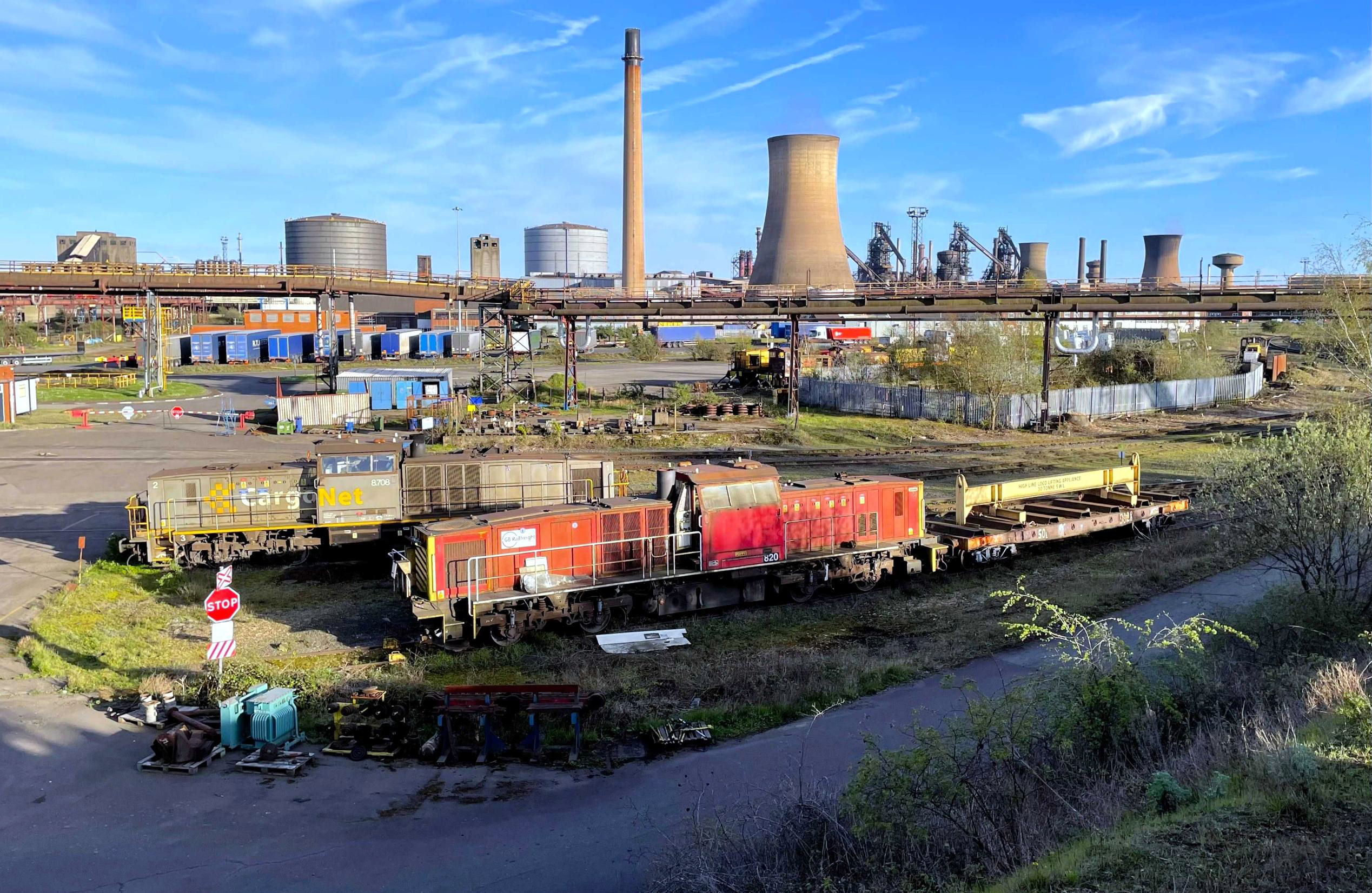
From the top of Basic Hill the other Power Station is upper centre with the blast furnaces behind to the right with their power station further right. In the foreground below is the Heavy Repair Bay, which has recently been radically devegetated, much improving the very scenic view!
[© Adam Turner 2026]As I said at the beginning, this was my first visit to Scunthorpe and so I did not know what to expect. I found myself asking many questions throughout the day. All were answered by either BLS stewards or AFR-S staff very patiently and I came away feeling as if I had taken part in a 3D documentary. I had been truly educated, informed and entertained. I can understand why people do this time and time again.
As we alighted, I asked an experienced BLS member how they felt the day had gone. He replied that we had covered more track than normal, we had visited mills and areas that are very rarely covered and we had experienced no hold ups, engineering works or similar obstacles. The marked up map is impressive. I left the platform at the end of the day in bright evening sun past shrubs and trees in full blossom. My legs and back were aching a bit, I felt tired but I had thoroughly enjoyed my sunny, springtime, Scunthorpe Steeler sojourn. Many thanks to the AFR-S and BLS members involved in making it happen.