Six members, including our organiser, Adam Turner, met at Dumbarton Central station, for a visit to the disused main entrance and Booking Office, led by a member of the local structures engineering team at Network Rail. The first railway at Dumbarton was the Caledonian & Dumbartonshire (sic) Railway, which opened between Bowling and Balloch on 15 Jul 1850. It was completely isolated from other railways until the Glasgow, Dumbarton & Helensburgh Railway opened on 31 May 1858. The present station was built to accommodate the extra traffic generated by the Lanarkshire & Dunbartonshire Railway (L&DR) from Glasgow to Dumbarton. L&DR passenger services started on 1 Oct 1896, worked by the Caledonian Railway, but the old station had to be used at first. The present Down platform (P2 & 3) was opened for use in Nov 1897 and the Up platform (P1) in Jun 1898, when the station was complete. From 1896, the line between Dumbarton East Jn (so including Dumbarton Central station) and Balloch was run as the Dumbarton & Balloch Joint Railway, on behalf of the North British Railway and the Caledonian Railway.
Dumbarton Central station is located above street level, supported by concrete-rendered retaining walls. The Caledonian Railway made substantial use of concrete from the late 19th Century onwards. As at Dumbarton, the concrete was often coloured pink, in an attempt to make it look like sandstone. The main entrance to the station was at the east (Glasgow) end, with a substantial Booking Office fronting Church St, where it passes below the railway. That closed in 1992, since when there has been a much smaller Booking Office within a room on the Up platform. A subway towards the west end of the station, which had been out of use since the 1950s, was opened up to provide the new street access.
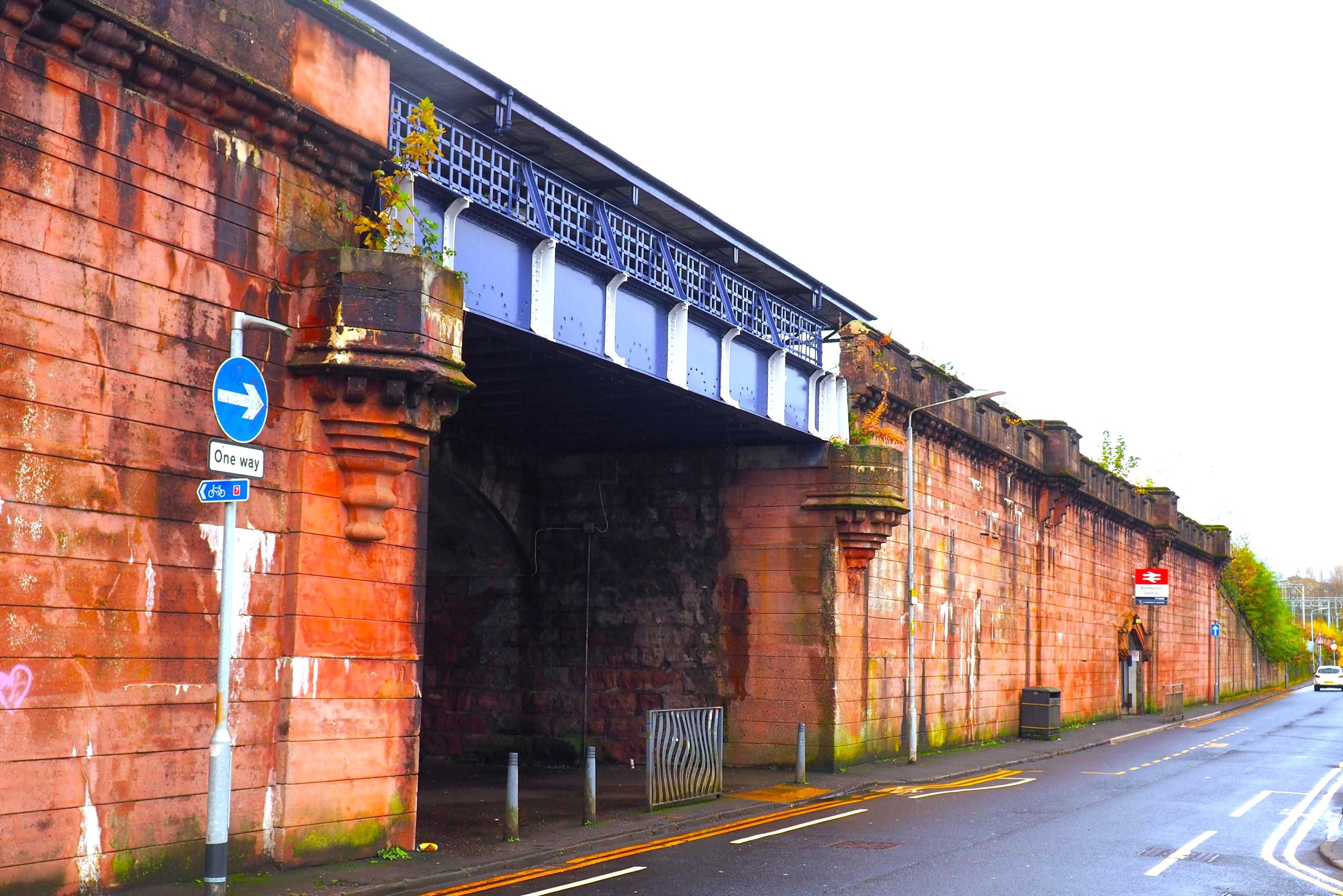
Dumbarton Central north side, one of the entrances is ahead to the right.
[© Greg Beecroft and Adam Turner 2026]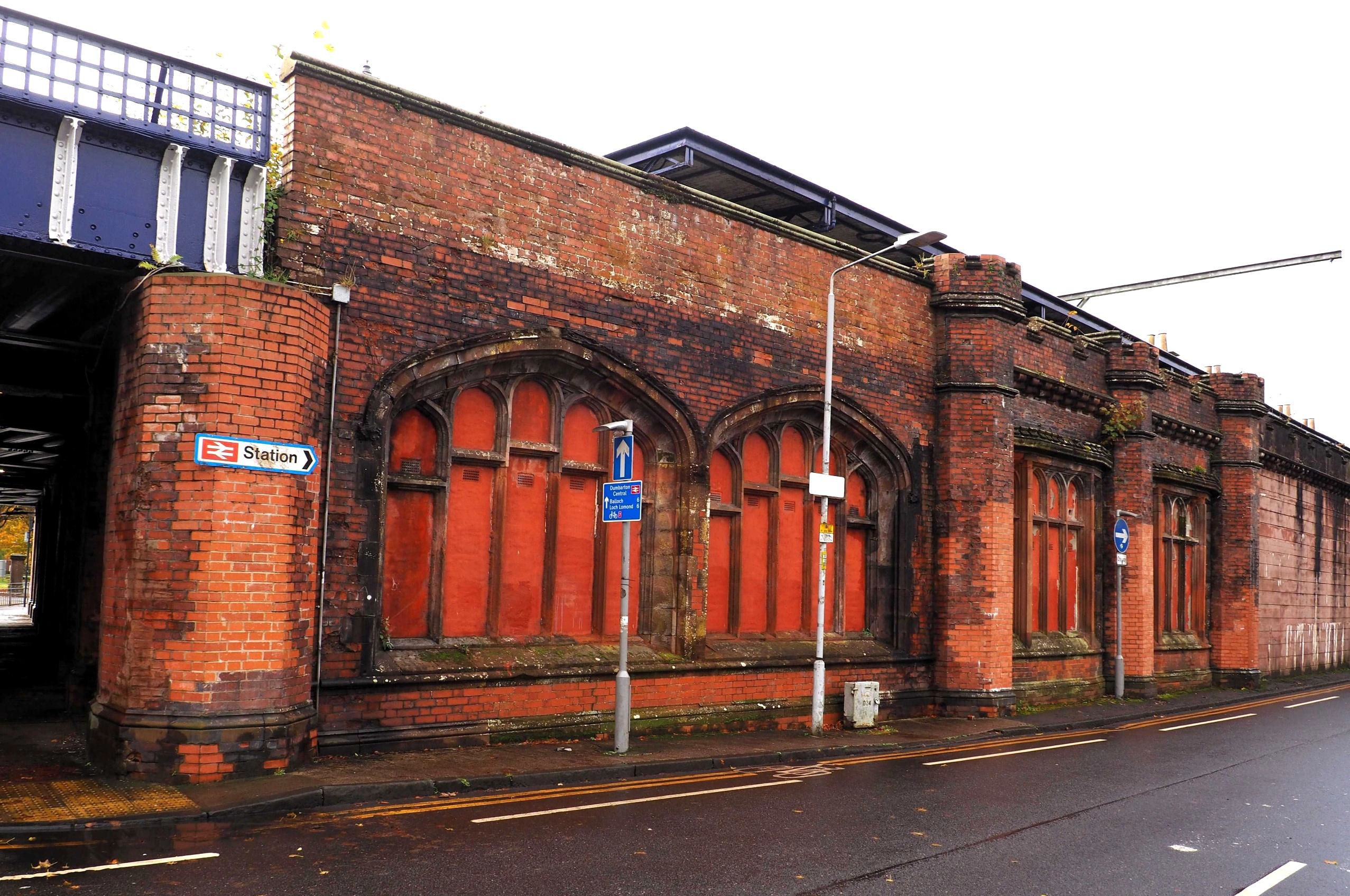
The north frontage to the former main entrance.
[© Greg Beecroft and Adam Turner 2026]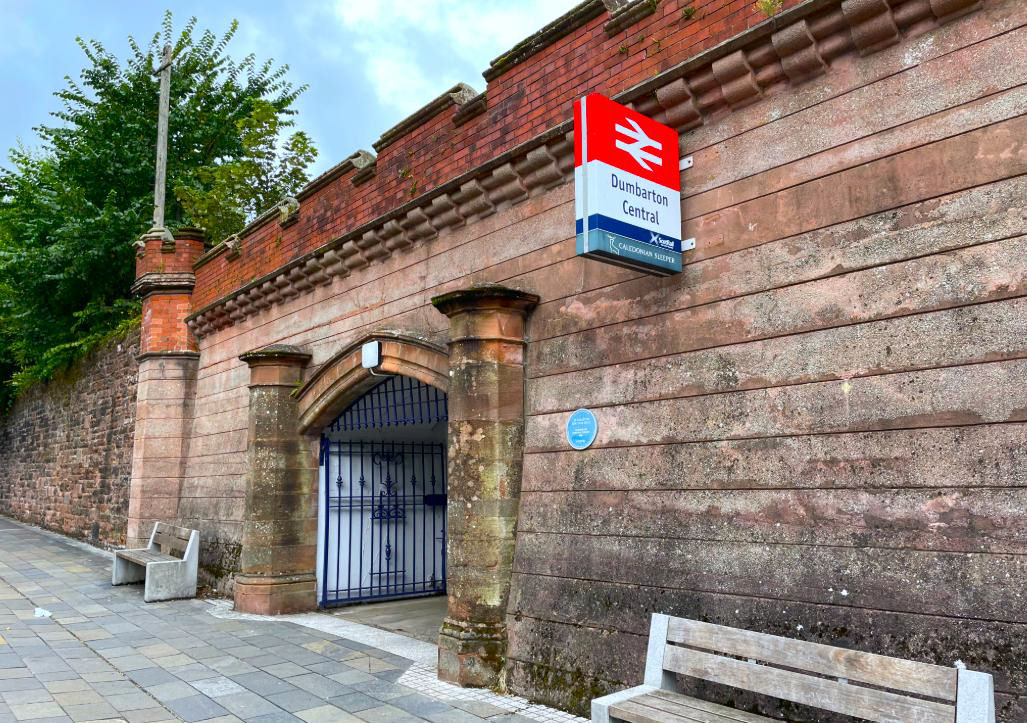
The south side entrance, was that blue plaque fixed by a local dentist?
[© Greg Beecroft and Adam Turner 2026]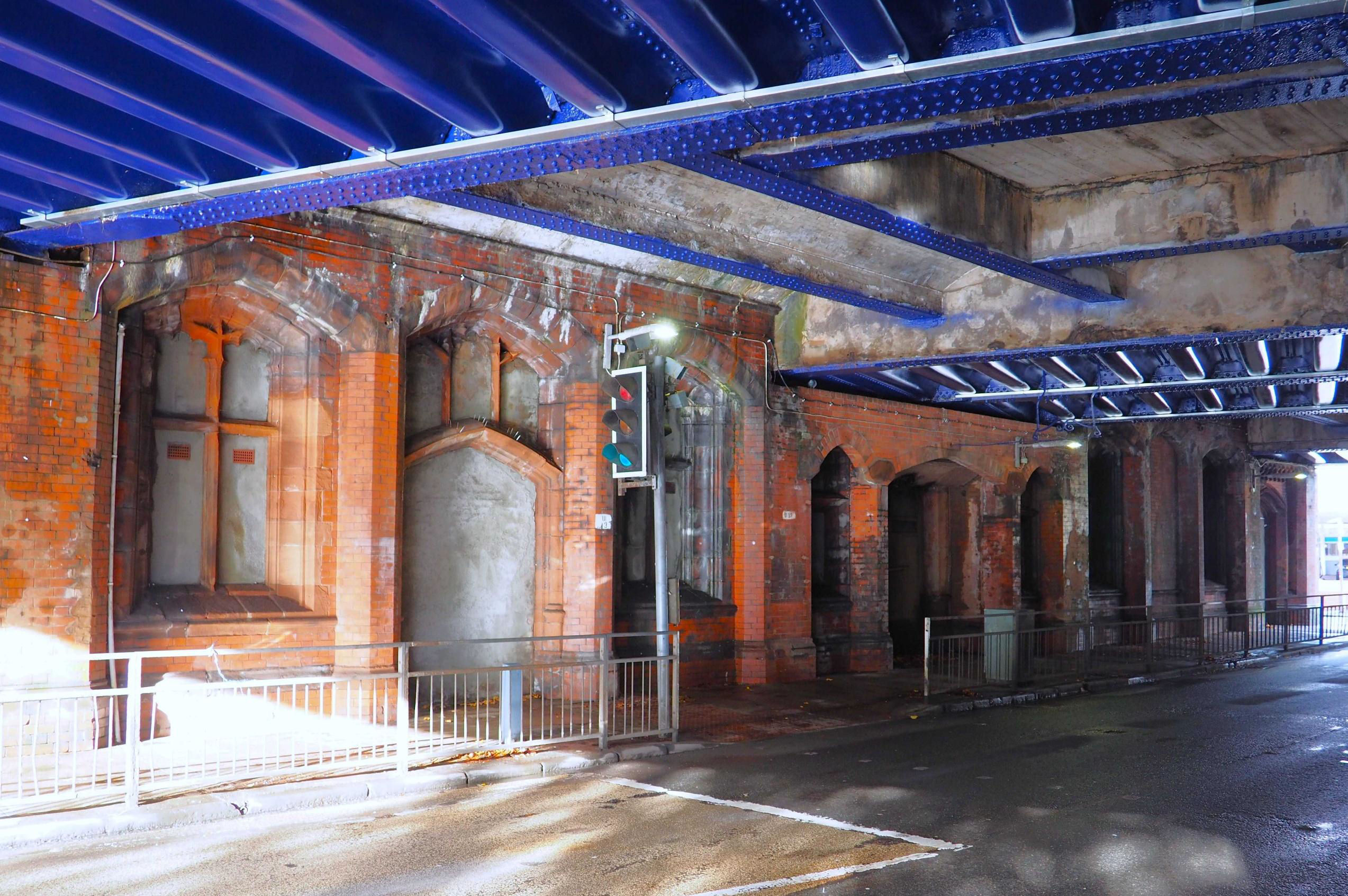
From the east frontage to the former the main entrance.
[© Greg Beecroft and Adam Turner 2026]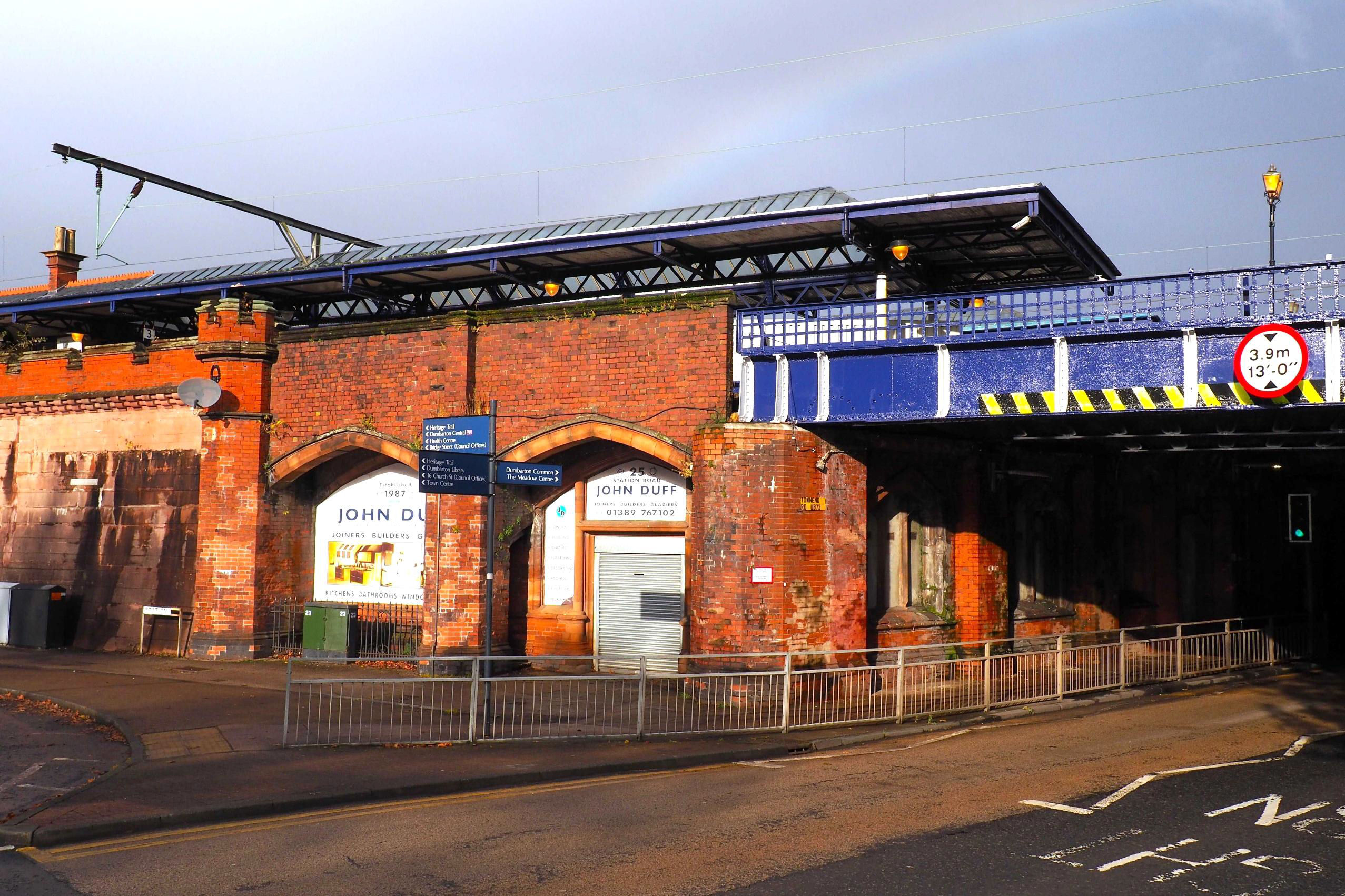
The south frontage to the former main entrance.
[© Greg Beecroft and Adam Turner 2026]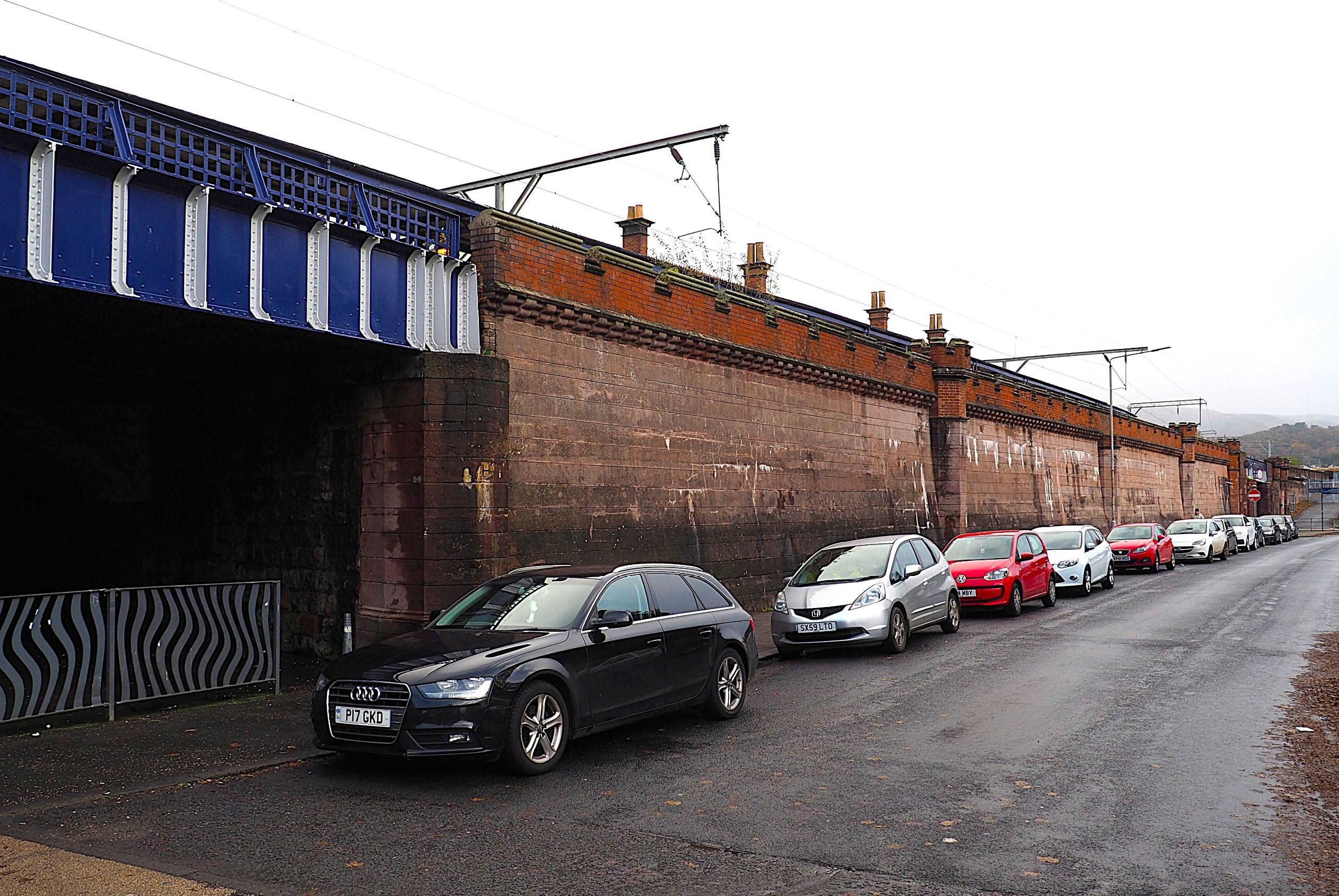
Dumbarton Central south side.
[© Greg Beecroft and Adam Turner 2026]Before descending to the old Booking Office, we observed the attractive red brick buildings on the two island platforms. The roofs were re-slated in 2019-20, with new ridge tiles made especially to match the originals. The Down side buildings are largely occupied by the Armed Forces Veterans Association.
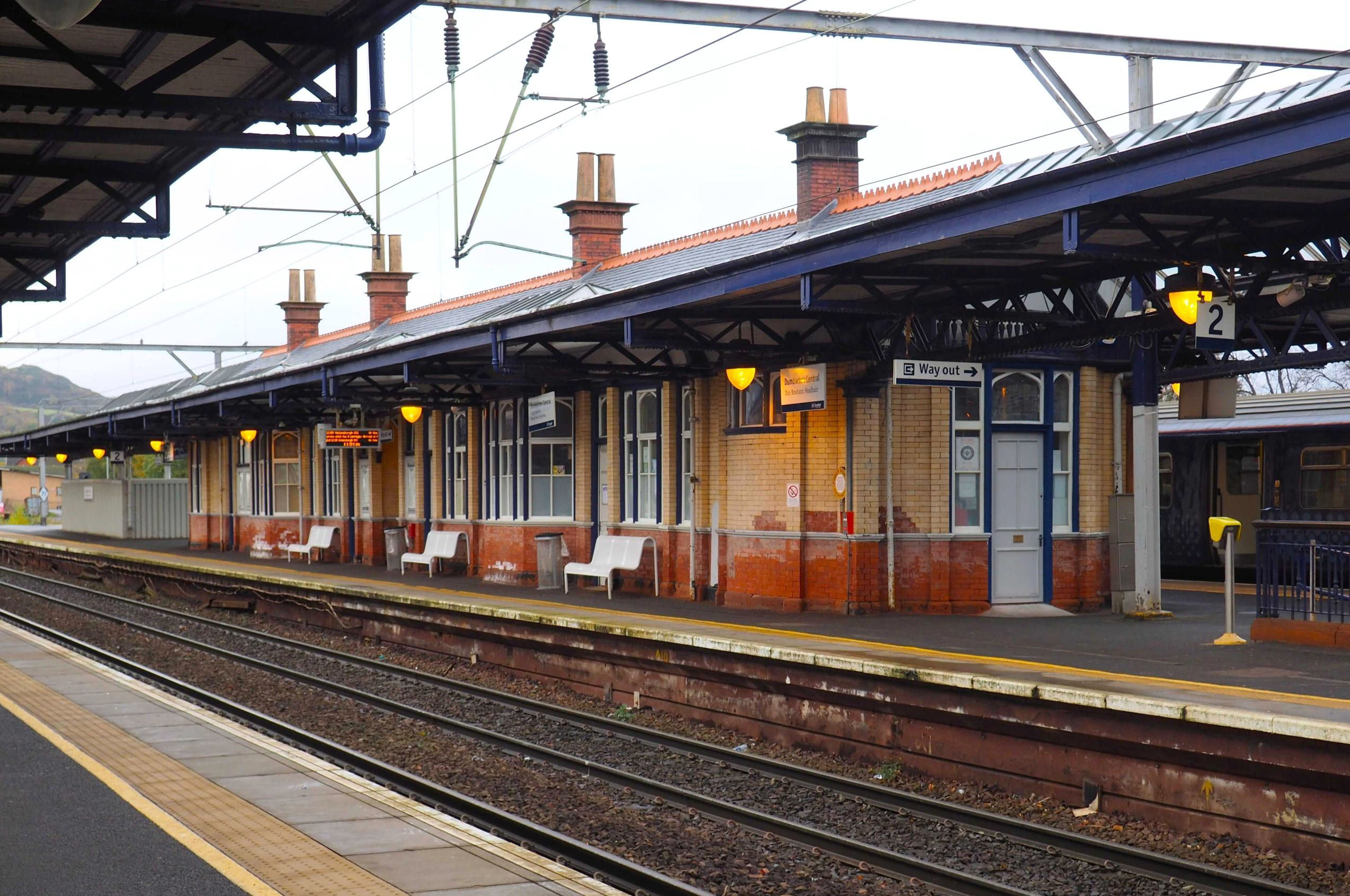
Dumbarton Central Down platform building (Glasgow to the left).
[© Greg Beecroft and Adam Turner 2026]Our NR host led us down the stairs from the Up platform to the former entrance and Booking Office. This is a sizable area, split into a variety of rooms but completely disused. It was interesting to note that, although the station is essentially symmetrical at platform level, it is not at ground level, mainly because Church Street passes below the railway at an angle. The stairs from the Up platform are straight but those from the Down platform have a change of direction. A large space at the southeast corner of the building had previously been let out as a joiner's workshop but was originally the Left Luggage Office.
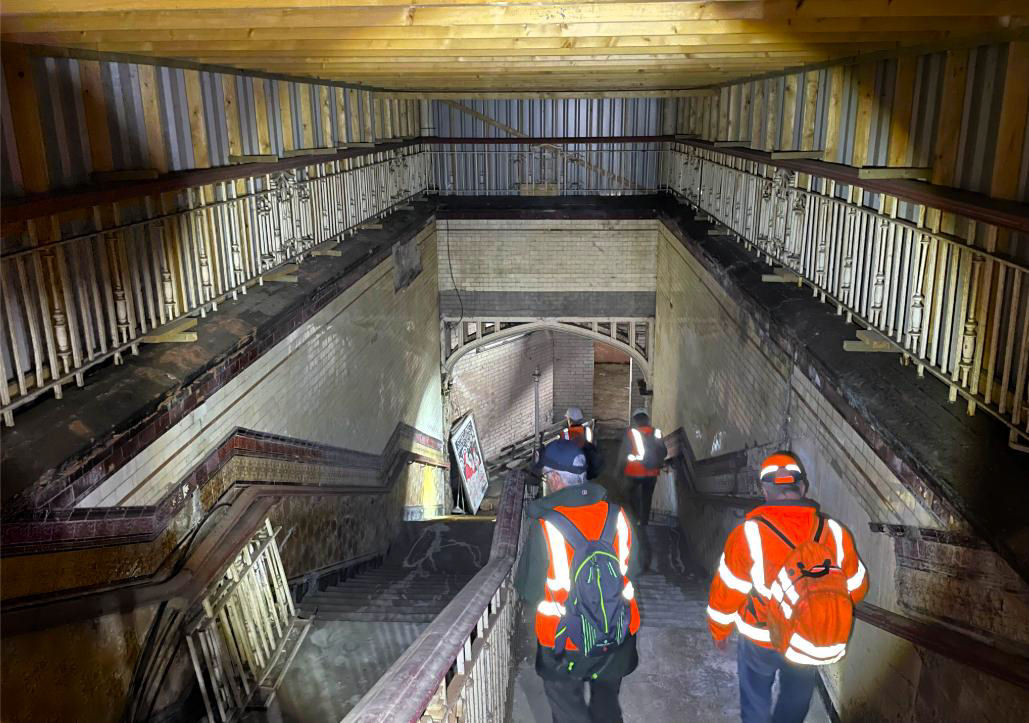
The pièce de résistance of the tour - the now non-public section. The stairs from the Up platform to the former entrance and Booking Office.
[© Greg Beecroft and Adam Turner 2026]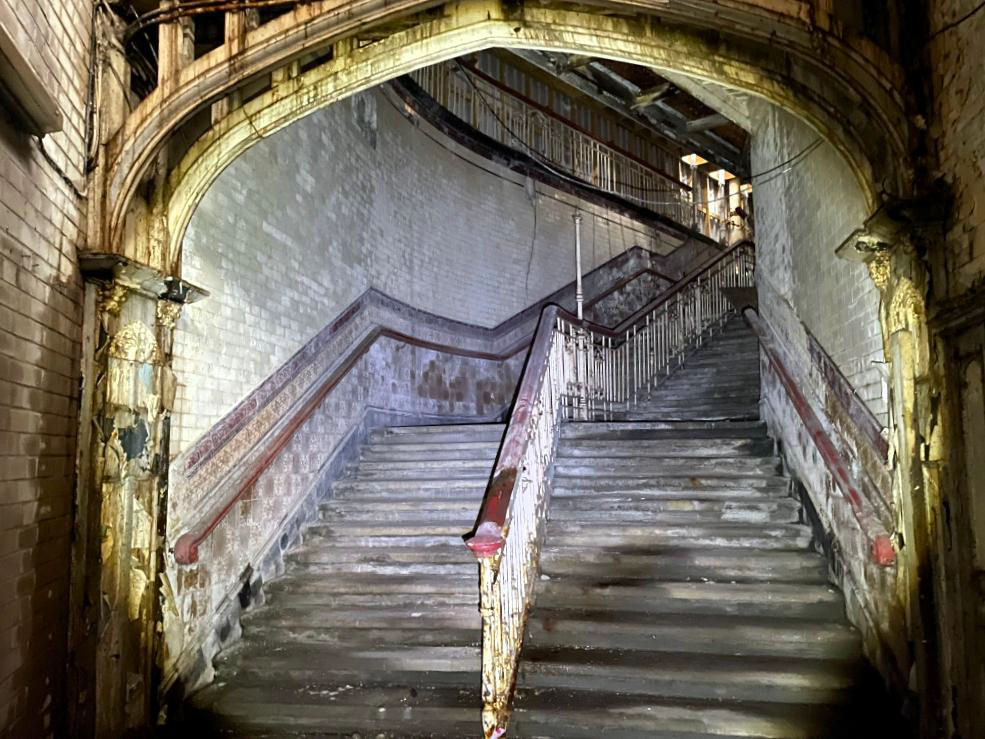
The stairs up to the Down platform from the former entrance and Booking Office.
[© Greg Beecroft and Adam Turner 2026]Consideration is being given to an Access for All scheme for Dumbarton Central, because the ramps up to the platforms from the subway are too steep to meet modern standards. The main entrance might possibly return to use if lifts are provided to the platforms but significant work will be required.
Having thanked our host, we travelled one stop to Dumbarton East. When the Airdrie to Helensburgh line was electrified, the former North British Railway line was diverted for 2½ miles via the L&DR to serve Dumbarton East. BR installed a new connection at Dunglass Jn to rejoin the North British Railway line before the present Bowling station and closed the North British Railway section from Dumbarton East Jn. However, a short section of that line remained in use at the Bowling end for Bowling Oil Terminal. Dumbarton East building was demolished in 1984 but a similar one survives at Muirend. The three-arch station entrance, below Glasgow Road underbridge, has a typical Caledonian pink concrete frontage.
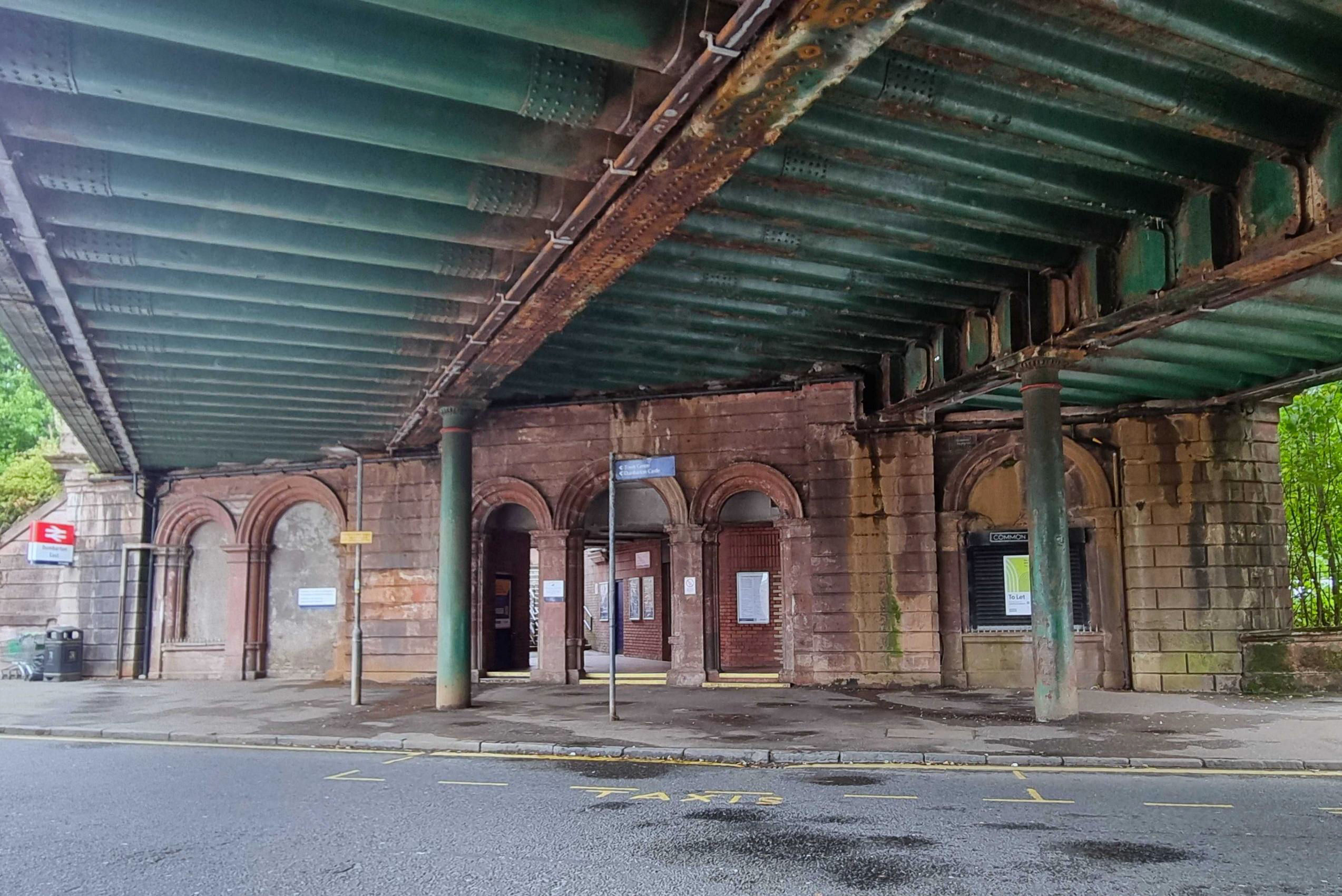
The entrance to Dumbarton East station.
[© Greg Beecroft and Adam Turner 2026]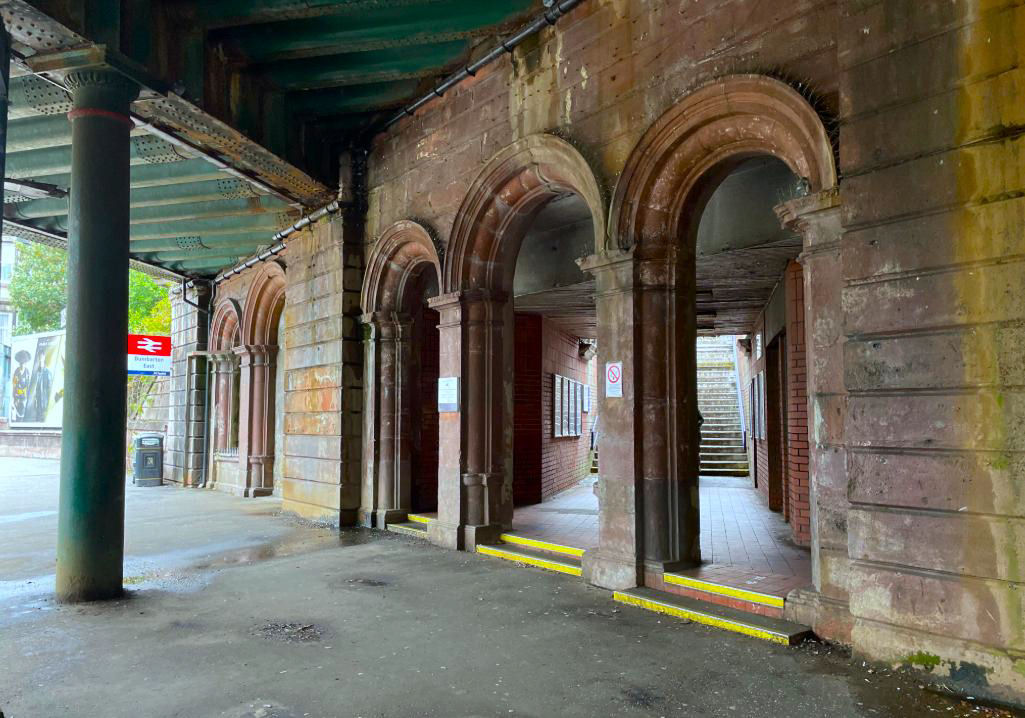
A closer view of the entrance to Dumbarton East station
[© Greg Beecroft and Adam Turner 2026]Before the onset of rain forced a retreat into the small waiting shelter, there was a fine view from the station platform to Dumbarton Castle, on its volcanic plug. A defensive site since ancient times, this was the seat of the Kings of Strathclyde, whose rule extended south into Cumbria. We then continued eastwards, noting the L&DR viaduct at Bowling (more pink concrete). The swing bridge that carried the L&DR over the Forth & Clyde Canal at Bowling has been renovated in recent years but remains fixed.
We alighted at Hyndland [the second station of that name*] for a short walk to view the exterior of Kelvinside station building on Great Western Road. The station, on the former L&DR line from Partick West to Maryhill, opened 1 Apr 1897, was closed from 1 Jan 1917 until 2 Jun 1919 and finally closed on 1 Jul 1942. This part of Great Western Road is a broad avenue lined with fine stone terraces and the station building had to fit in that setting. Designed by the noted architect John James Burnet, it is an Italianate villa in cream sandstone, located over the south portal of Balgray Tunnel. It was noted that the tunnel portal is securely gated off. The building currently functions as the Duck 'n' Doc public house but was until quite recently a restaurant called '1051 GWR', from its postal address, 1051 Great Western Road. Extensive use was made of the Great Western Railway 'button' design in its corporate image.
[*The original was terminus of a 48ch branch CP 5 Nov 1960, then an EMU depot closed 4 May 1987.]
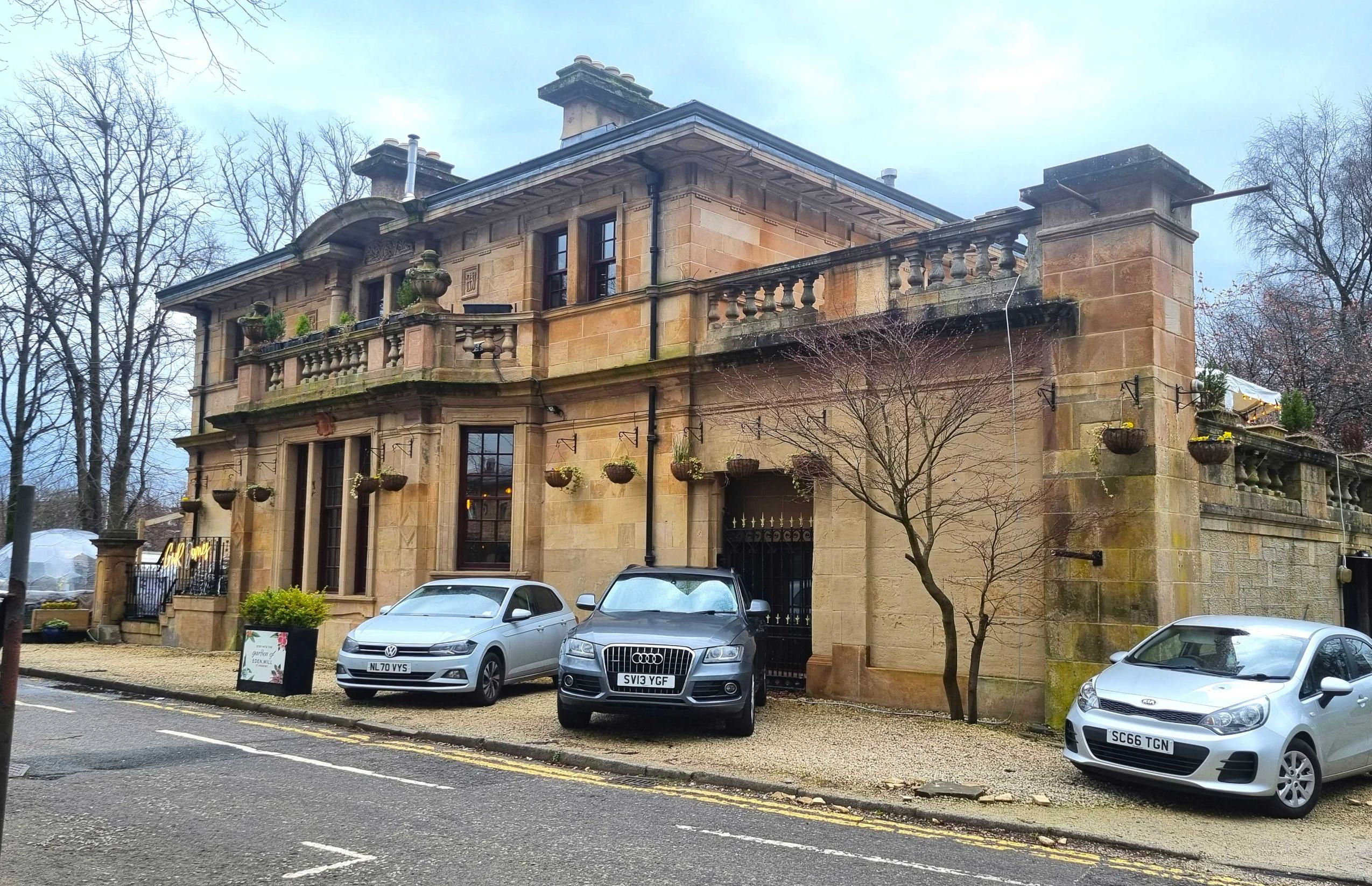
The Category 'B' listed Kelvinside station building at 1051 Great Western Road, Glasgow was designed in 1897 by Sir John James Burnet. The Beaux-Arts stone structure features the carved Caledonian Railway 'CR' monogram. It was formerly the '1051 GWR' restaurant and bar.
[© Greg Beecroft and Adam Turner 2026]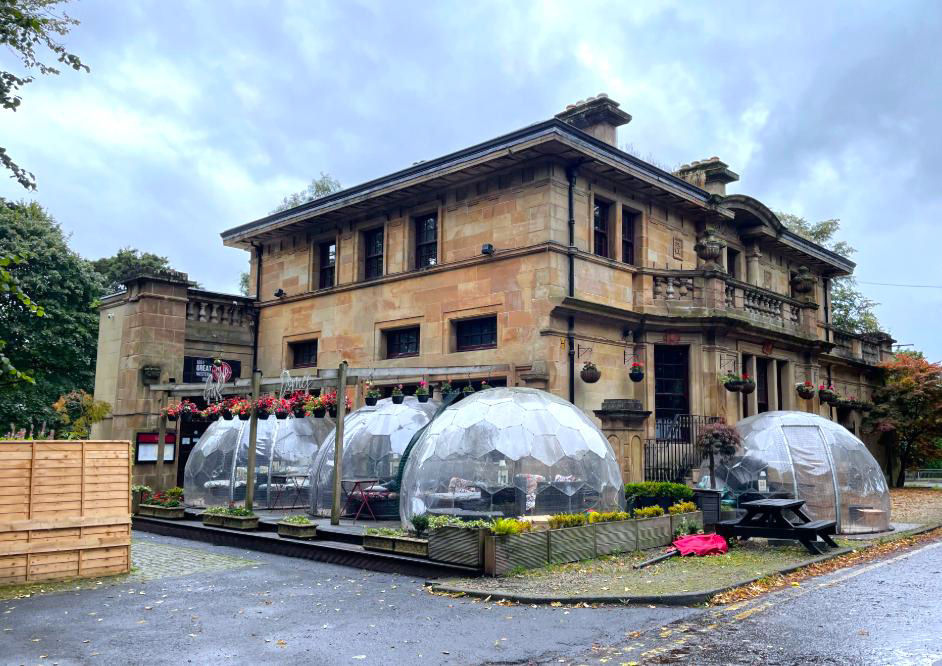
A rear view of the '1051 GWR' restaurant and bar.
[© Greg Beecroft and Adam Turner 2026]A short bus ride along Great Western Road took us to the site of Botanic Gardens station, on the Caledonian line from Stobcross to Maryhill. The station opened on 10 Aug 1896, closed from 1 Jan 1917 until 2 Jun 1919 and finally closed 6 Feb 1939. The domestic revival building, designed by James Miller, had two turrets topped by onion domes. It was later used as a café but sadly burned down in 1970. In the botanical garden, we could peer down an airshaft to observe a platform and the trackbed below.
A walk of less than half a mile further along Great Western Road took us to Kelvin Bridge, to see Caledonian Mansions. It is another James Miller building, completed in 1898, and intended for use as an annexe to the Central Hotel at Glasgow Central. It seems that guests did not take kindly to having to catch a train to reach the main hotel and the building was converted to mansion flats. It is pleasing that most of the ground floor shop fronts are to period design but a pity that a few are not. Nothing remains of Kelvin Bridge station building but the bridge over the River Kelvin is in situ, with public access over it.
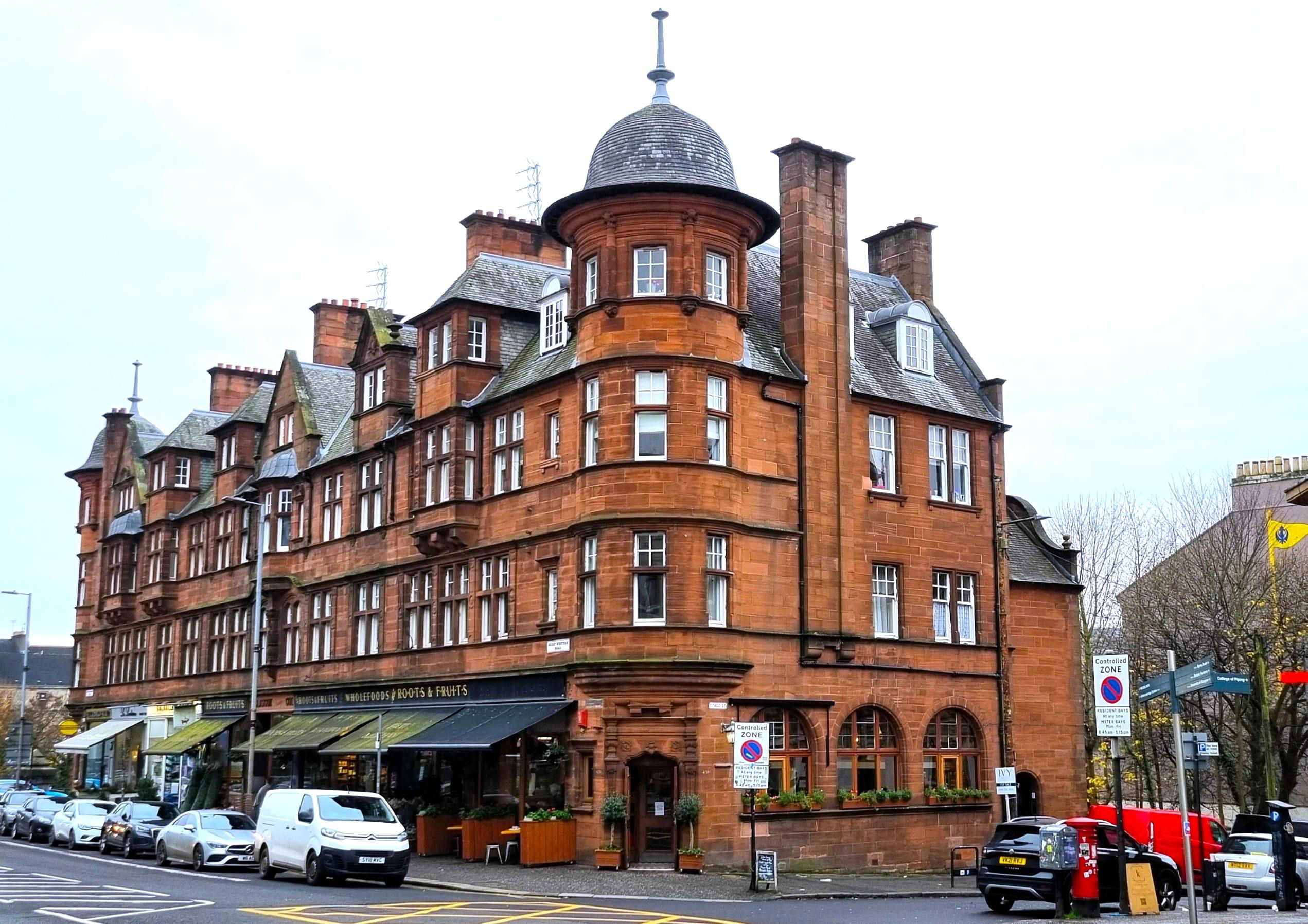
Kelvin Bridge, Caledonian Mansions.
[© Greg Beecroft and Adam Turner 2026]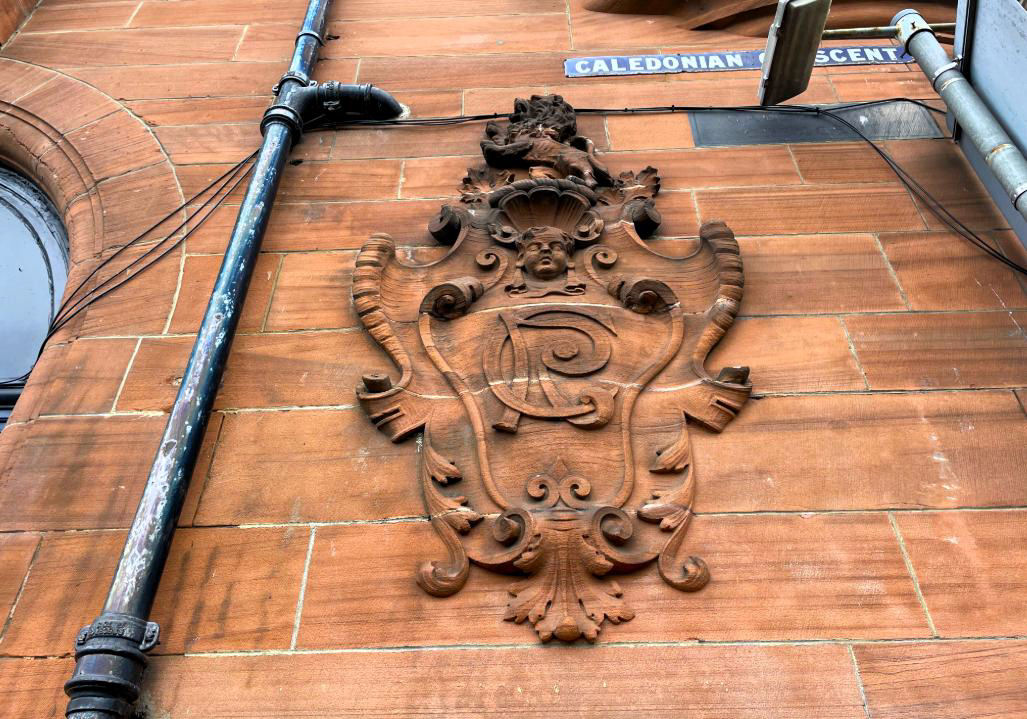
The crest on Caledonian Mansions.
[© Greg Beecroft and Adam Turner 2026]We then took a short ride on the Subway from Kelvinbridge (one word) to Buchanan Street, where the moving walkway took us most of the way to Glasgow Queen Street. Before catching a Coatbridge train, we observed the ornate columns supporting the station roof. These had been screened off, in an effort by British Railways to make the station look modern but were returned to view with the scheme to extend the platforms and provide a new concourse. We noted the plaque for opening of the Glasgow Suburban Electrification on 5 Nov 1960, by Sir Brian Robertson, British Transport Commission Chairman.
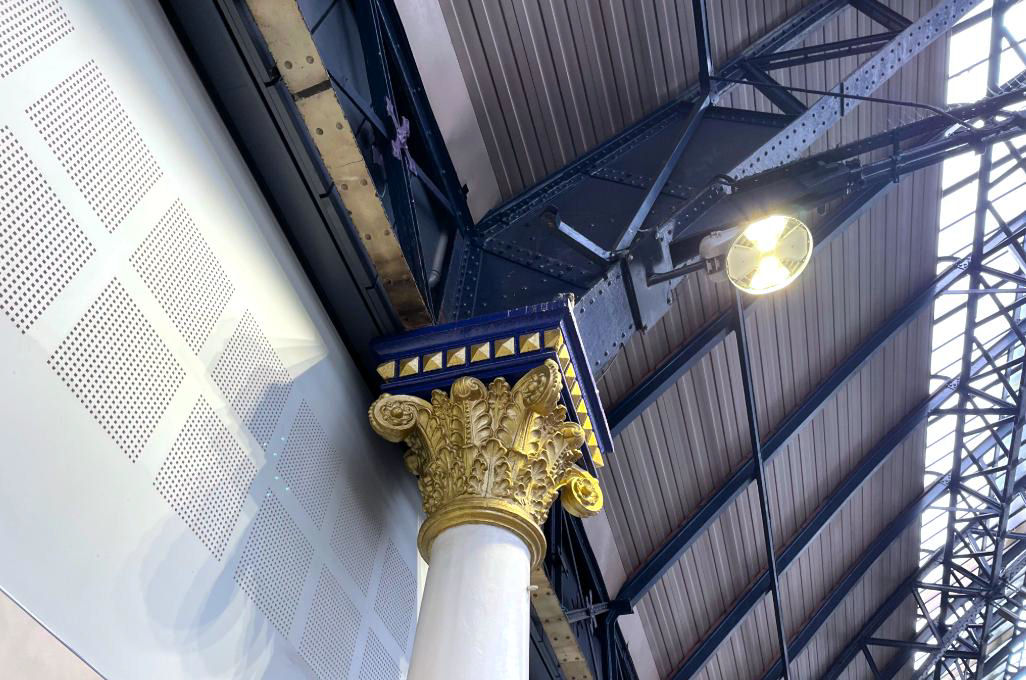
Roof support detail at Glasgow Queen Street.
[© Greg Beecroft and Adam Turner 2026]Our group then continued to Coatbridge Sunnyside. The railway passes adjacent to the Summerlee Museum of Scottish Industrial Life but it is a half mile walk from Sunnyside station. The Museum would love to have a more direct access but that would require a completely new footbridge over the railway from Sunnyside Jn to Whifflet - not a cheap or easy job. John-Paul, Heritage Outreach Officer, met us at the Museum and explained that it is located on the site of a former iron works. It houses a wide range of exhibits illustrating Scotland's industrial heritage. A pit head winding engine was operating inside the main building while we were present, more than justifying the claim that this is the noisiest Museum.
Outdoor exhibits include miners' cottages, a passenger barge on a section of the Gartsherrie, Hornock & Summerlee Branch of the Monkland Canal, a narrow gauge Garrett locomotive and, of course, the tramway. We were very pleased to hear that an individual who can undertake technical management of the tramway has recently started work at the museum, so it is hoped trams will be operating in 2027.
We were shown the Museum workshop by Justin, Industrial History Curator, where renovation of Glasgow Corporation tramcar 1245 is nearing completion. This is one of the Coronation type, introduced in 1938; a particularly fine design. By special arrangement, James and Alistair, from Glasgow Electric Group, were present to show us their preserved Class 311 EMU. The nineteen Class 311 units were provided for the Gourock and Wemyss Bay lines in 1967. They were similar to the earlier Class 303 Blue Trains but with more powerful motors, to cope with the gradients on the Wemyss Bay branch.
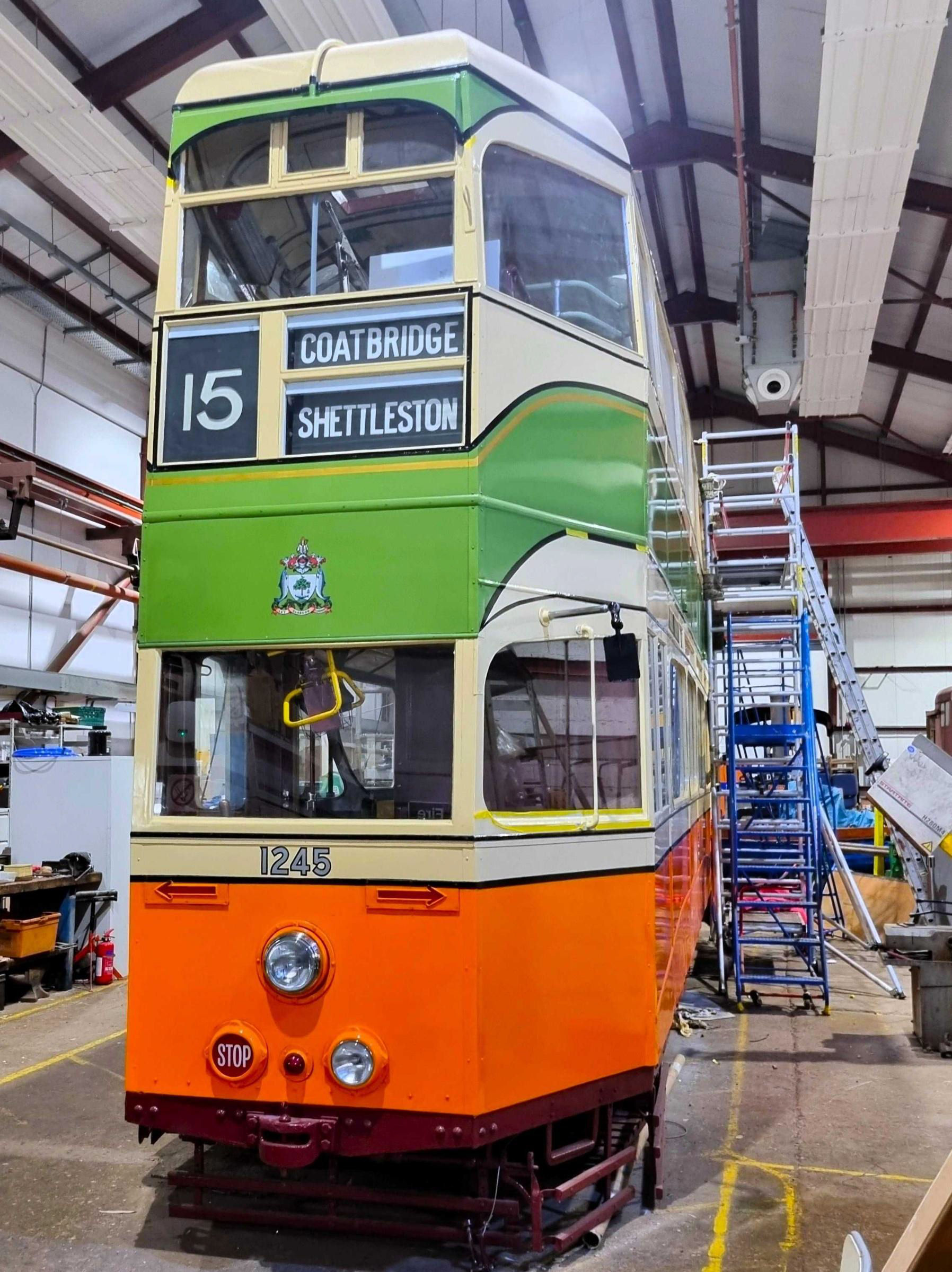
Glasgow tram 1245 at Summerlee Museum of Scottish Industrial Life;
[© Greg Beecroft and Adam Turner 2026]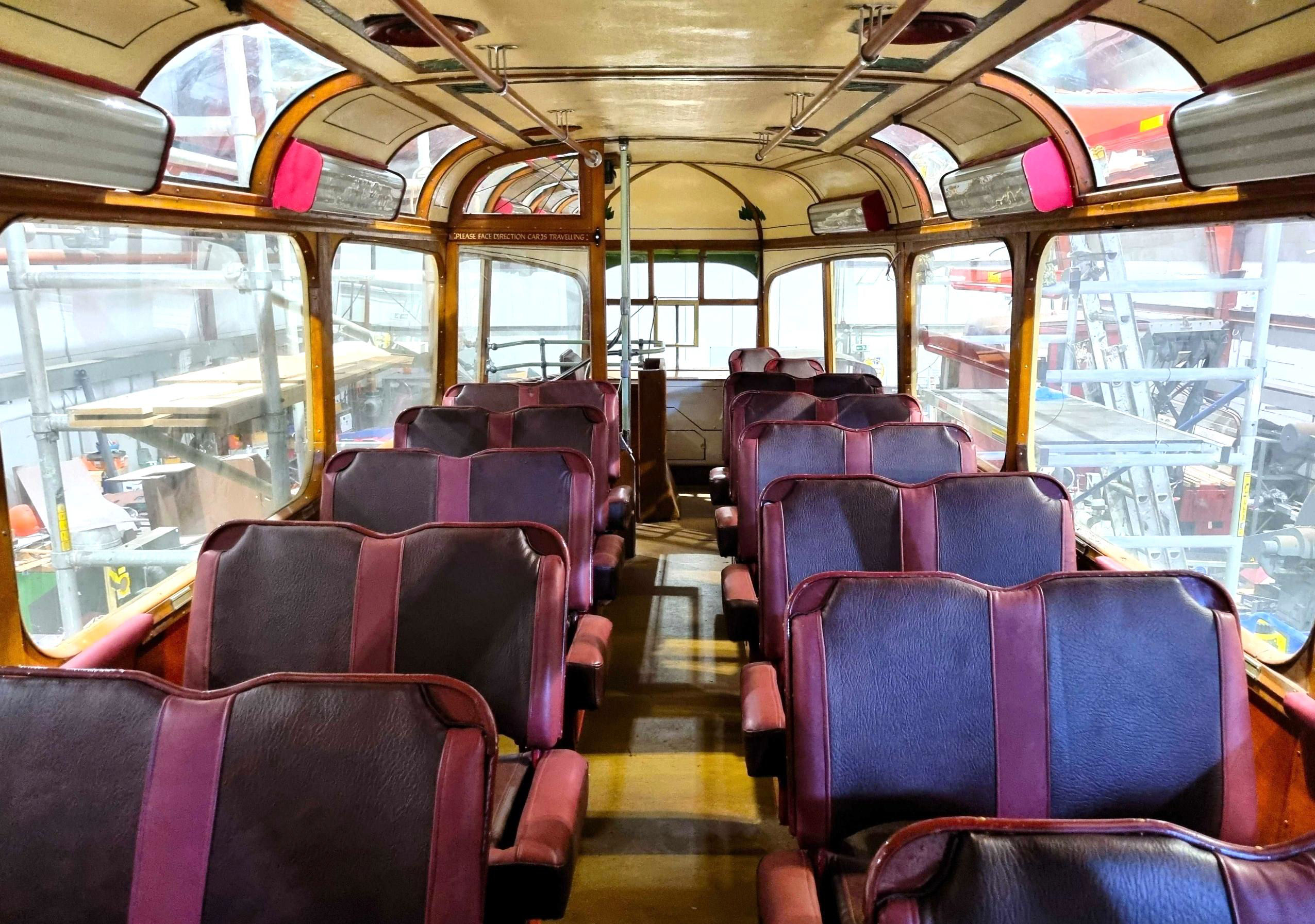
the seats are reversible and, as the sign says, passengers were asked to face the direction of travel.
[© Greg Beecroft and Adam Turner 2026]In practice, Classes 303 and 311 were used in common, particularly after the north- and south-side electric lines were linked in 1979. Unit 311103 was one of two that were converted for Sandite duties and, following withdrawal, it was scheduled for preservation. This was because it retains its original interior, unlike the other Class 303 units which were refurbished. Unfortunately, one of the driving coaches had to be scrapped, because of serious fire damage.
It had been hoped that the protective tarpaulins could be entirely removed so we could fully see the two remaining vehicles but strong winds prevented that. However, we did have a good look at the cab end of the driving trailer. Preserving EMUs is a challenge, we wish Glasgow Electric Group every success.
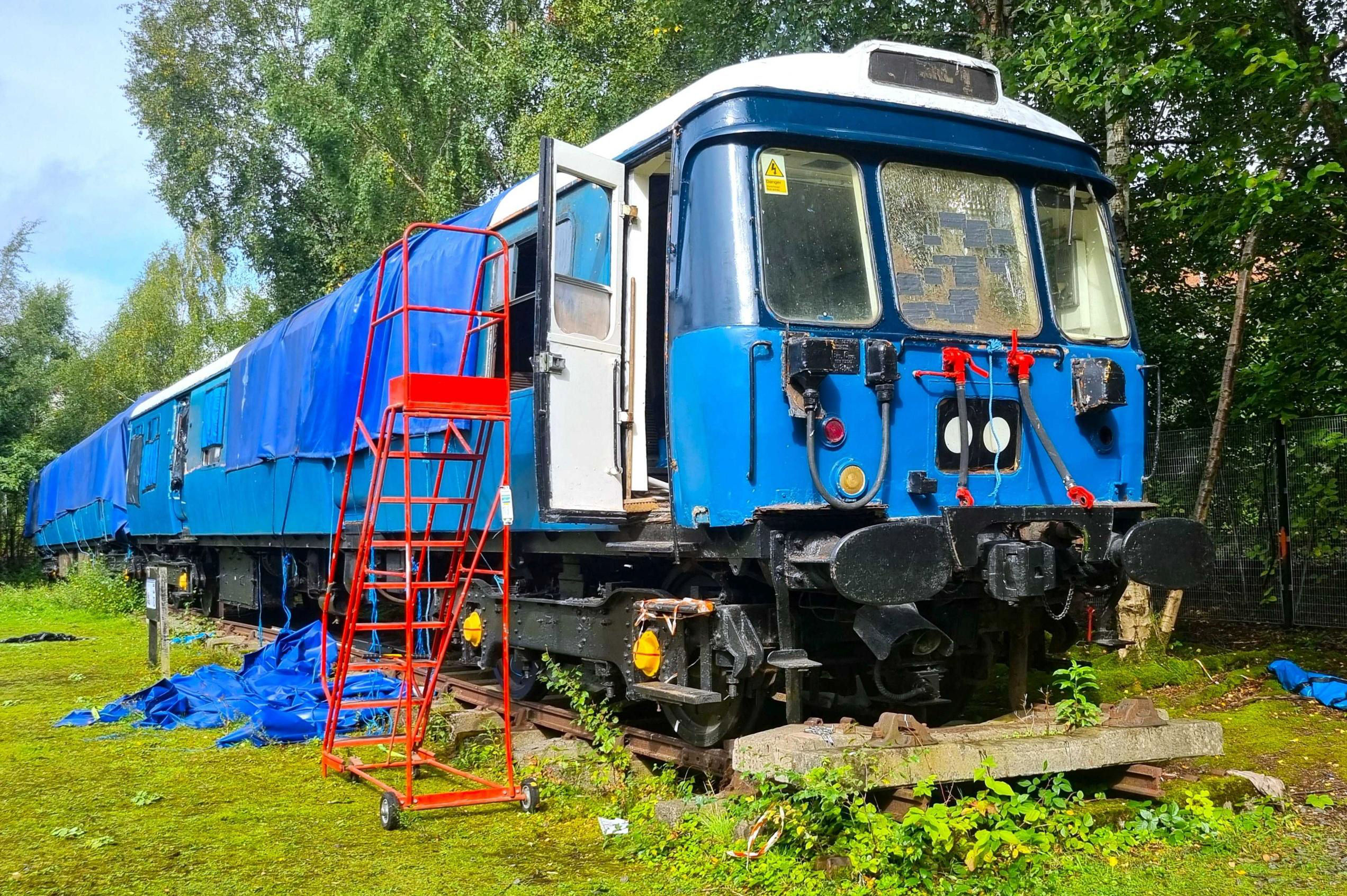
The preserved 1967-built 'Blue Train' EMU 311103 at Summerlee.
[© Greg Beecroft and Adam Turner 2026]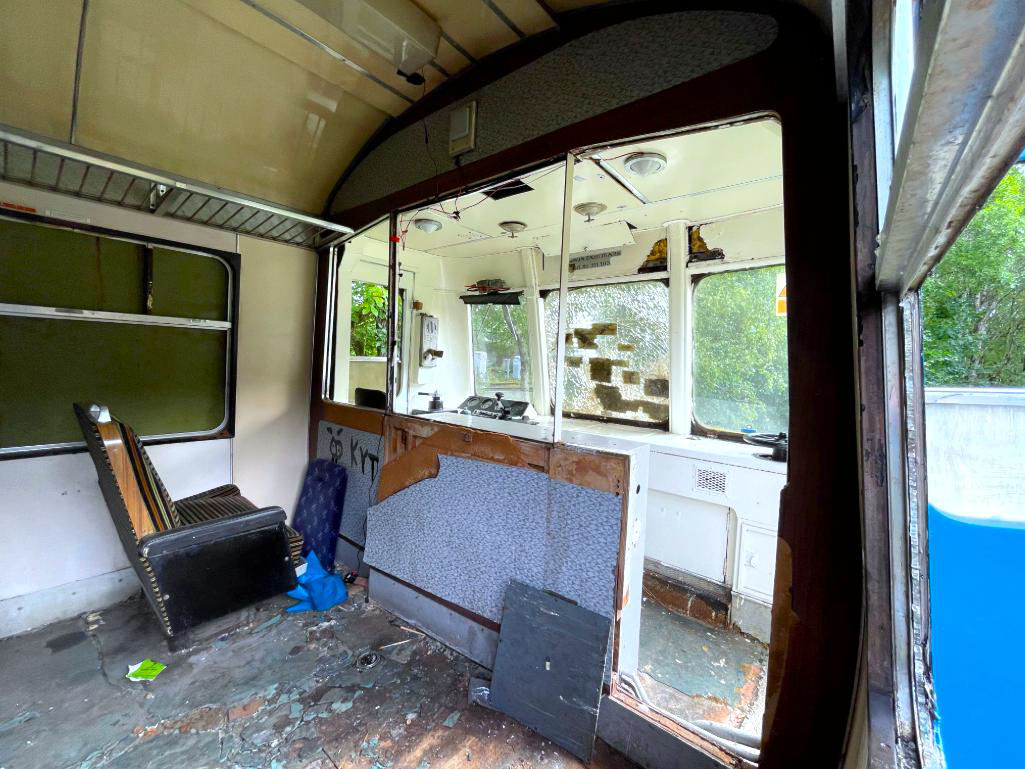
Inside the preserved 1967-built 'Blue Train' EMU 311103.
[© Greg Beecroft and Adam Turner 2026]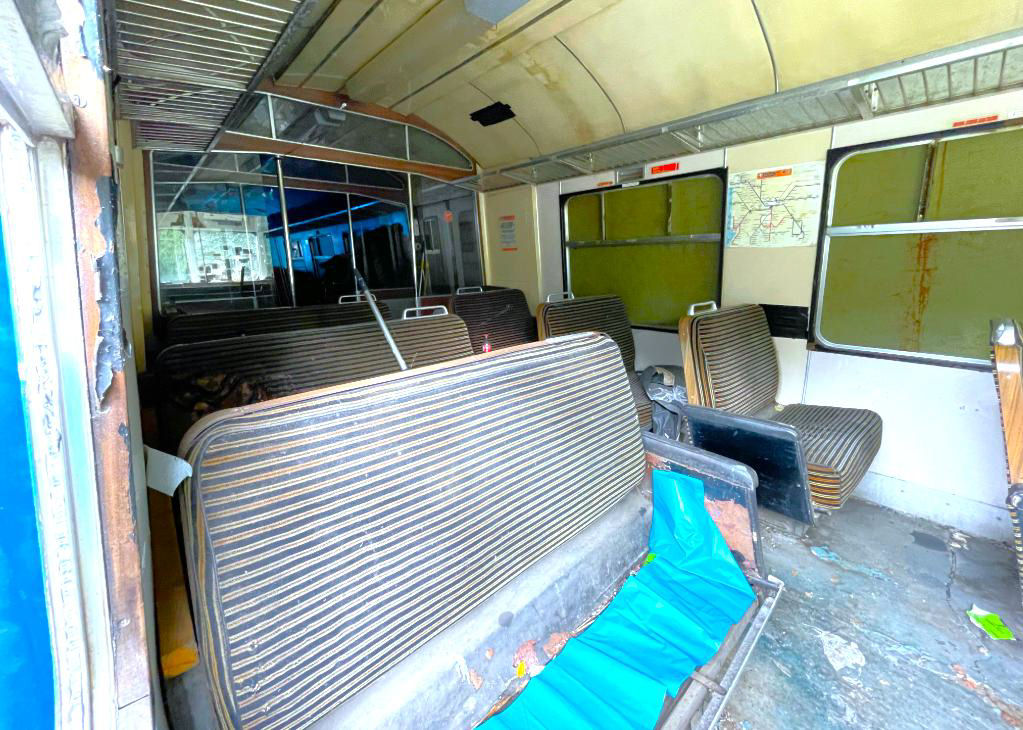
Inside the preserved 1967-built 'Blue Train' EMU 311103 with some of its original (comfortable) seats.
[© Greg Beecroft and Adam Turner 2026]We dispersed from Summerlee, with most catching the train south from Coatbridge Central, where the former station building, dating from 1899, was observed. No longer in railway ownership, it now accommodates a copy shop. Thanks go to Adam Turner for organising the trip and to our hosts at Dumbarton and Summerlee. £130 was raised, which was donated to Glasgow Electric Group.
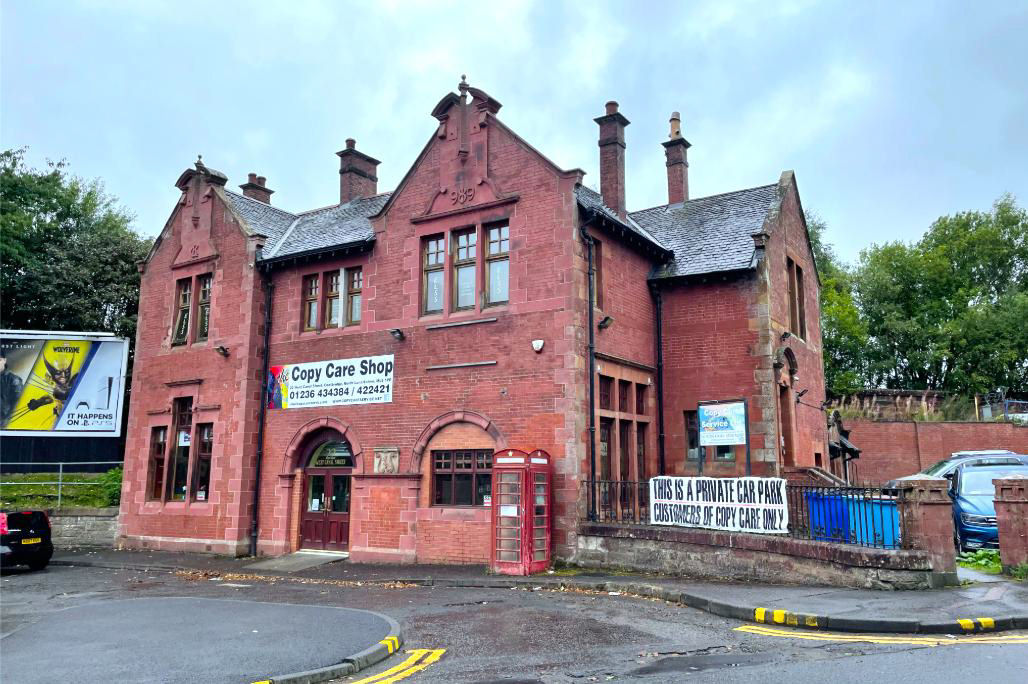
The original station building at Coatbridge Central; now in commercial use - these days the station is unstaffed.
[© Greg Beecroft and Adam Turner 2026] (conservation management plan) has information about the station.