It was back in Feb (09.23 on Mon 16 Feb, to be precise!) that the writer received an email from the organiser, Paul Griffin: ''Greetings from Sri Lanka. All the pieces of the Braunschweig & Hannover Explorer are coming together nicely. It looks like we will be back from the Moorbahn (Moor Railway) about 17.00-18.00. I shall approach the tram people in Braunschweig and find if they are willing to run an evening tram tour. If they are, then I will need a route to include as many non-passenger curves and loops as possible before dark and preferably finishing early enough for people to have a late evening meal. Perhaps the two of you could put your heads together and come up with a plan?''
The email had also been sent to fellow tram gricer, Ian Hutton; both of us have an interest in 'TSULs' (Tram Services Over Unusual Lines) - doing connections with no regular passenger workings over them.
https://www.egtre.info/wiki/Category:Tram_services_over_obscure_routes is the link to TSUL.
Having not previously visited Braunschweig, I wasn't at all familiar with its tram network. However, before I'd even managed to even look at a map, Ian had answered the question and even shown his workings out in detail! His response reached our inboxes at 15.55 the same day. Going to the ends of routes was not included unless necessary to cover a 'rare' connection but the itinerary covered all non-passenger routes bar three very short connections. Two saw limited 'TSUL' use, the third was heading south off the loop at the northern end of Route 10 (Carl-Miele-Straße) [straße = street], technically used by empty trams between the set down and pickup stops but could probably be ridden if you found a friendly driver. Missing this was to do the much rarer curve off the loop, heading the other way (north).
A 'TSUL' curve also appeared to be unavailable. It connected the southern branches of Routes 1 and 2 but Route 1 to Stöckheim was closed for track renewal, with no indication of a reopening date (it was also thought that going all the way to both those termini would take a disproportionate amount of time for the amount of rare track). There was also the question of whether a circuit of the Depot would be permitted but Ian's route ended with a trip down the Depot branch as far as a public stop beside the Depot gates. Start time would be about 18.00, with the finish about 21.35 (sunset would be at 21.41).
Devising a route was, apparently, the easy bit... Paul Griffin then tried to contact BSVG [Braunschweiger Verkehrs-GmbH (BSVG - Braunschweig Transport Company Ltd), operator of the municipal trams and buses], and had no response. A phone call was obviously needed and preferably by a German speaker.
Paul contacted Urs Kramer of IBSE* (the German equivalent of the BLS), who found a contact and took over negotiations. It soon became obvious that they didn't like the complexity of our proposed route. Firstly, they claimed concern about interfering with scheduled services, then that an internal review was needed. A lot of time was then lost. Finally, BSVG pointed Urs in the direction of the Braunschweiger Interessengemeinschaft Nahrverkehr e.V. (BIN = the Braunschweig Local Transport Interest Group), which owns some historic trams and uses them on occasional tours. They were very positive and said they would discuss it at their forthcoming AGM. More delay but grounds for optimism, realised when they came up with a slightly adapted itinerary and timings plus the all-important quote. That did the trick and, with some further input from Urs Kramer and Peter Lehnhart, the route was finalised.
[*IBSE = Interessengemeinschaft zur Bereisung von Straßenbahn- und Eisenbahnstrecken e.V. = Interest Group for the Study of Tram and Railway Routes Registered Association; e.V. = non-profit making.]
When the tram tour opened for bookings, the route on our website differed slightly from Ian's. However, it would cover almost everything he'd included plus all three connections his route missed, one because the line to Stöckheim was due to reopen just before our visit (6 Jun, according to a poster I saw). The one connection lost was off the loop at Carl-Miele-Straße heading north, as the points were broken and the curve was out of use; it would be replaced by the curve heading south (one of Ian's missing three). The tour would start at 17.55 from Hauptbahnhof (Main Station) stop and finish there at 21.42.
The first Braunschweig horse-drawn tram line opened on 11 Oct 1879 but using an unusual system (being tested for use in London). The rails were hollow with 4cm diameter holes on the upper surface, spaced 5cm apart. Pins on the wheel rims of the trams then engaged in these holes. The system was unreliable; there were frequent derailments and the service was discontinued at the start of 1881.
The rails were replaced with the conventional grooved rails; trams resuming on 1 Jul 1881. Track gauge is the unusual 1,100mm (3' 7⅓") - subsequently used only in Lübeck and Kiel. However, in the late 1990s there were proposals for a RegioStadtBahn (= Regional City Train) network. This would have seen tram-trains run through from the DB network and several sections were relaid as dual gauge as a result; these proposals were abandoned in 2010 but many dual gauge sections retain their third running rail.
And so it came to the evening of Mon 15 Jun 2026, the fifth and final part of the weekend's events. Everything had gone according to plan so far, much to the organiser's relief.
Despite the advertised departure time of 17.55, a few German enthusiasts 'in the know' claimed that the tour was actually scheduled to leave at 17.52... but from which platform at Hauptbahnhof tram stop? It was assumed that the tram would approach from the east and run round the balloon loop. Would it run non-stop through the westbound platform, or stop to pick up before going onto the balloon loop? So, hopefully, we all gathered on the westbound platform ('D') in plenty of time. What was obviously our tram (Braunschweig Tram 41) appeared shortly after 17.45 but ran slowly past us and on round the loop without stopping.
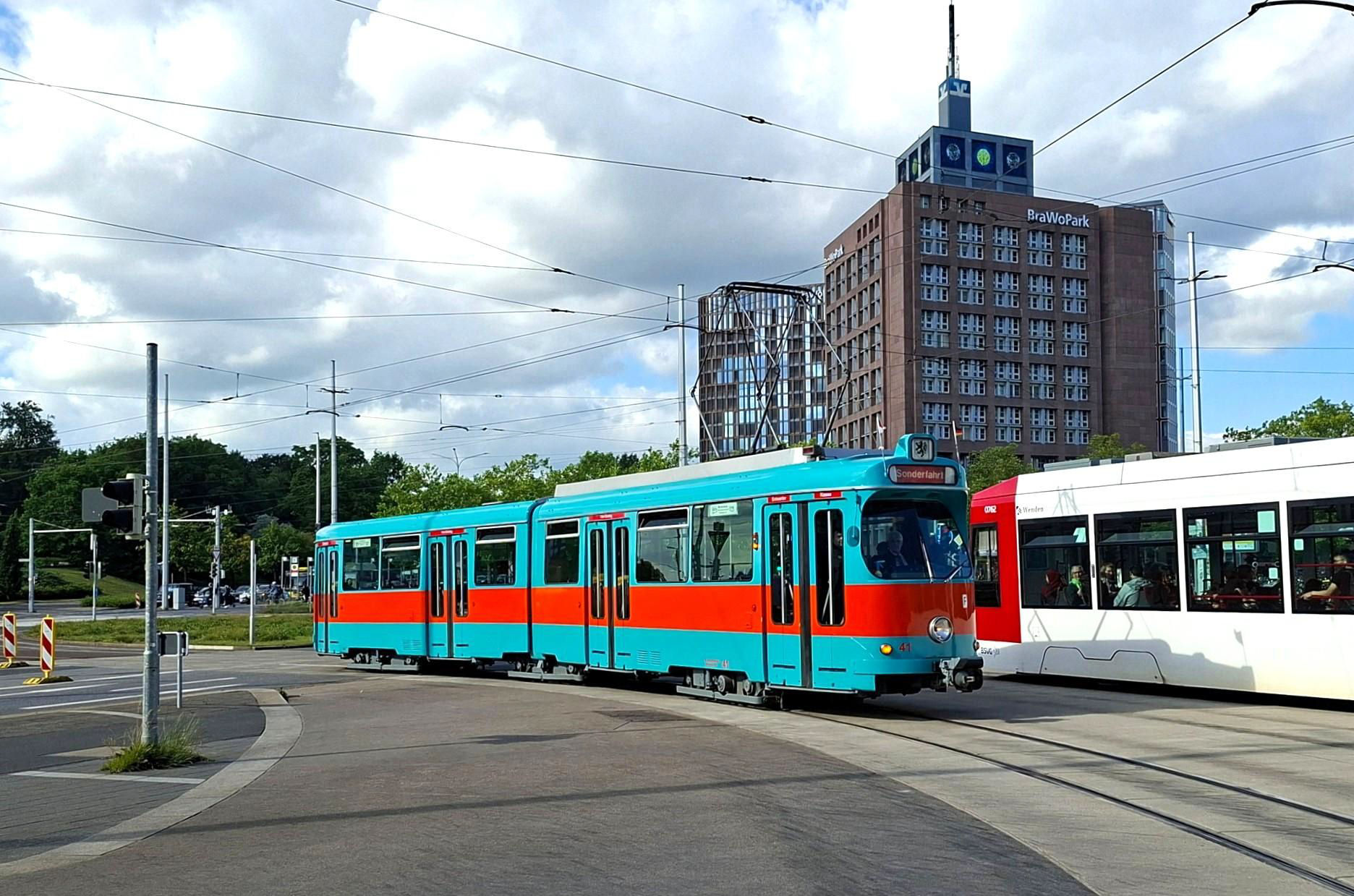
BSVG Tram 41 at Braunschweig Hauptbahnhof (Main Station) stop for our tram tour.
[© Hans-Peter Gladtfeld 2026]So, we all crossed to the other platform ('C') and, just after a service tram arrived and departed, the special ran off the loop and to the stop. Perhaps 17.52 was its booked arrival, or maybe its departure time from the loop. We all boarded, the writer managed to grab a seat near the front (on the grounds he had been asked to write the report) and, after waiting for several minutes, we set off at exactly 17.55.
We were welcomed on board by David Köhler of BIN, who gave us a commentary at various times during the tour, including the history of the tram we were riding in and snippets about the history of the system. It turned out that this was the first time the group had run an excursion for another organisation. At the end, David seemed to be impressed by how attentive and genuinely interested we were - presumably quite different from members of the general public that they are accustomed to taking on tours.
Tram 41 was a Duewag GT6 (six-axle articulated tram) 'Mannheim' (referring to the operator which this type was first ordered by), built in 1973 by Waggonfabrik Uerdingen AG (it said inside). [Waggonfabrik = wagon factory; Uerdingen is a district of the city of Krefeld in Germany and AG is Aktiengesellschaft = a company owned by shareholders.] In 1975, the Tram was renumbered 7356, the initial two digits of the numbering system indicating when the first of the type was built. It remained in service until 2007, when the 07 series of trams arrived. The tram was restored to original condition and reappeared as Tram 41 again in Jul 2008. However, its mandatory eight-year inspection had expired, so it could no longer run on the network. It was 2023 before BIN members suggested running it again, an inspection by BSVG took place in Nov 2024 and it made its debut on 15 Mar 2025. The writer gained the impression that this was the only one of the museum trams that was currently operational. It looked very smart though.
The route of the tour was almost exactly as advertised, the exception being a bonus... but more later. We initially followed the course of Route 5 via Willy-Brandt-Platz and Am Magnitor but then turned right to follow Route 1 to Stadion to do the loop here. This loop is only used on event days and, even then, trams set down before going onto the loop and pick up at a stop on it leaving a gap. We had a short photo stop, setting off south again behind a normal service.
At John-F.-Kennedy-Platz we paused while a crew member manually changed the points, so we could turn right onto the rare line to Friedrich-Wilhelm-Platz where we joined the course of Routes 3 and 5, continuing to the end of Route 3 at Weststadt (the stop is called Weserstraße). This terminus is unique in being the only end-of-line balloon loop with its set-down and pick-up stops over a tram length apart and it was therefore the only end of line that we had to visit to do rare track. A brief photo stop here was followed by a run on the track bypassing the southern end of the set-down stop and then we followed a Route 3 tram back towards the city centre.
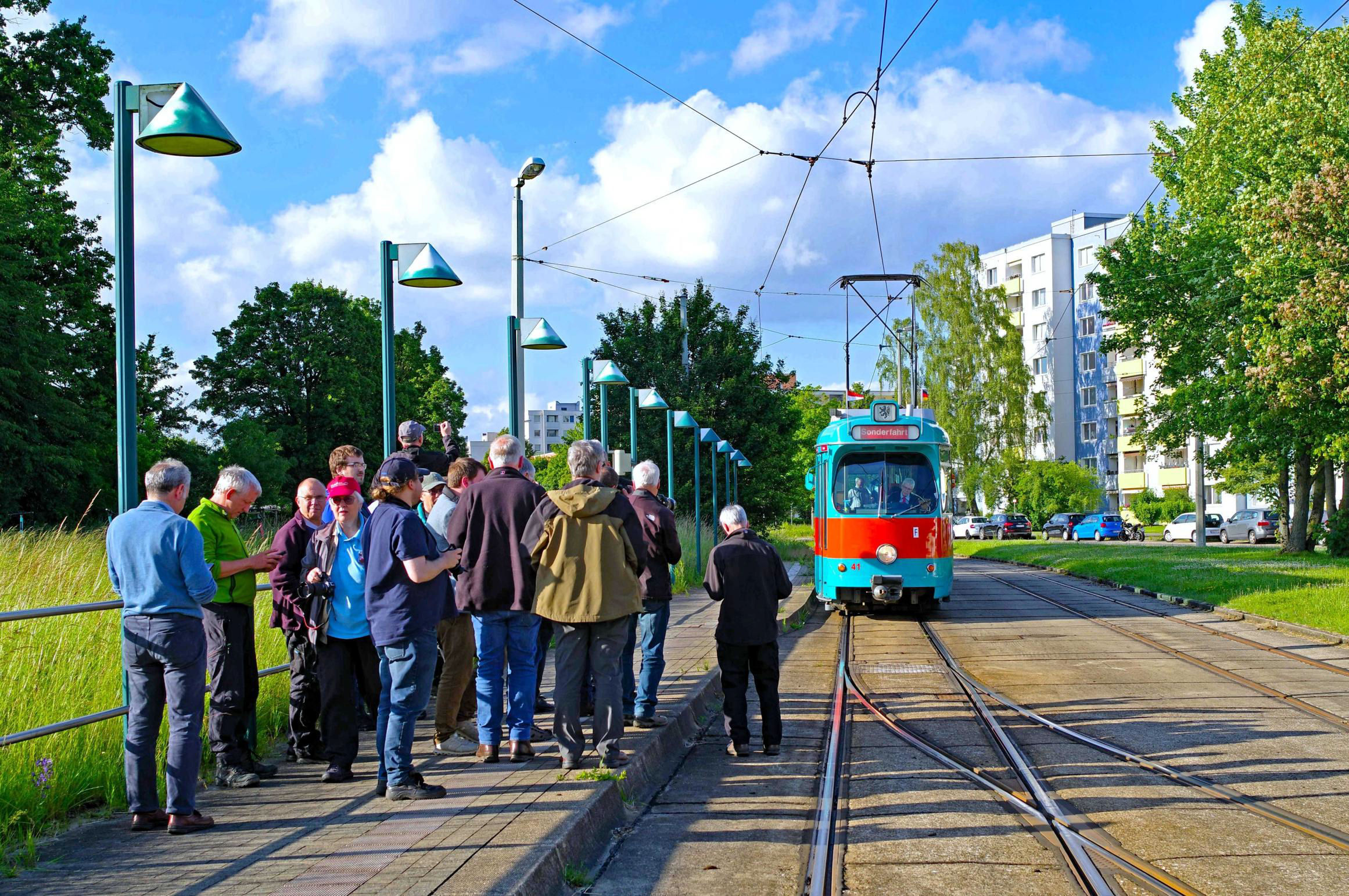
BSVG tram 41 at Weststadt (Route 3 terminus) with some familiar faces on the platform.
[© Brian Carter 2026]Just before Friedrich-Wilhelm-Platz we continued straight ahead along the TSUL route via Augusttorwall (two trams on schooldays, in this direction only). At the end of it, we headed through the main street (Bohlweg) and on northwards, past Stadion loop. The tram route crosses two railways on the level. The first, just before the site of the former tram depot. (Its last occupant was our tram, after the tracks had been disconnected - it was lifted out by the fire brigade!) The railway is still officially operational but has not seen a train for 10-15 years, while the second railway usually has four freight trains a day. Next stop was on Carl-Miele-Straße loop (stopping on the non-platform track beside the Betriebshalt = 'operational stop') for a group photo and the staff toilets were opened for those who needed them.
This was where our route deviated. The broken point had been fixed so, knowing we had requested the very rare curve heading north, that was what we did. We continued to the Route 1 terminus at Wenden (the stop is Heideblick and we used the inner track), costing about 10 minutes. Full marks to BIN!
We were still left with much to do. It was back towards the city centre, turning right after Schloss towards Friedrich-Wilhelm-Platz, to do the eastern side of the triangle there (rare curve), passing the original Braunschweig Hbf (= main station, a terminus) for the third time. The tour also passed the only crossover on the whole tram system (very rusty, a relic from the early days with double-ended trams) to run via Campestraße to Hauptbahnhof and then onwards to the end of Route 1 at Stöckheim (Salzdahlumer Weg). This was the newest tram line in Braunschweig, completed in 2006 and the first stretch (in the central reservation of a dual carriageway) has the highest speed section on the system (60km/h). The reason for the recent closure of the line past where Routes 1 and 2 split was revealed; investigations following a derailment found the concrete base of the track was breaking up, so it all had to be replaced.
Returning immediately from Stöckheim, the south side of the triangle at Sachsendamm (used very late at night or early on Sunday mornings) was traversed to reach Heidberg (Anklamstraße). We took the inner track to overtake a waiting Route 2 departure. At Bürgerpark (no McDonald's in sight), we continued straight ahead to follow the former course of Route 2. It was diverted via Hauptbahnhof from Mar 2024 but two workings each way still run this way on schooldays, as Route 2E. Turning right just before John-F.-Kennedy-Platz, (rare curve, although already traversed) we ran back to Hauptbahnhof and then round the balloon loop there (on the inner track, overtaking a Route 5 tram during its layover).
We next headed for the Depot (opened in 2009), doing a rare curve on the way in addition to the Depot access line. Once inside the gate, we completed a loop using the outermost track (Tracks 40, 41 & 43 - the 'high speed' track used for brake testing - speed restriction 50km/hr). Then it was Track 44, inside the shed, passing the row of withdrawn trams we had seen from the train on Day 1. It was proving tricky to find someone prepared to scrap them. This was followed by a second loop, the second side of the entrance triangle, then through the shed (on Track 21) and past the museum trams stabled on Track 20.
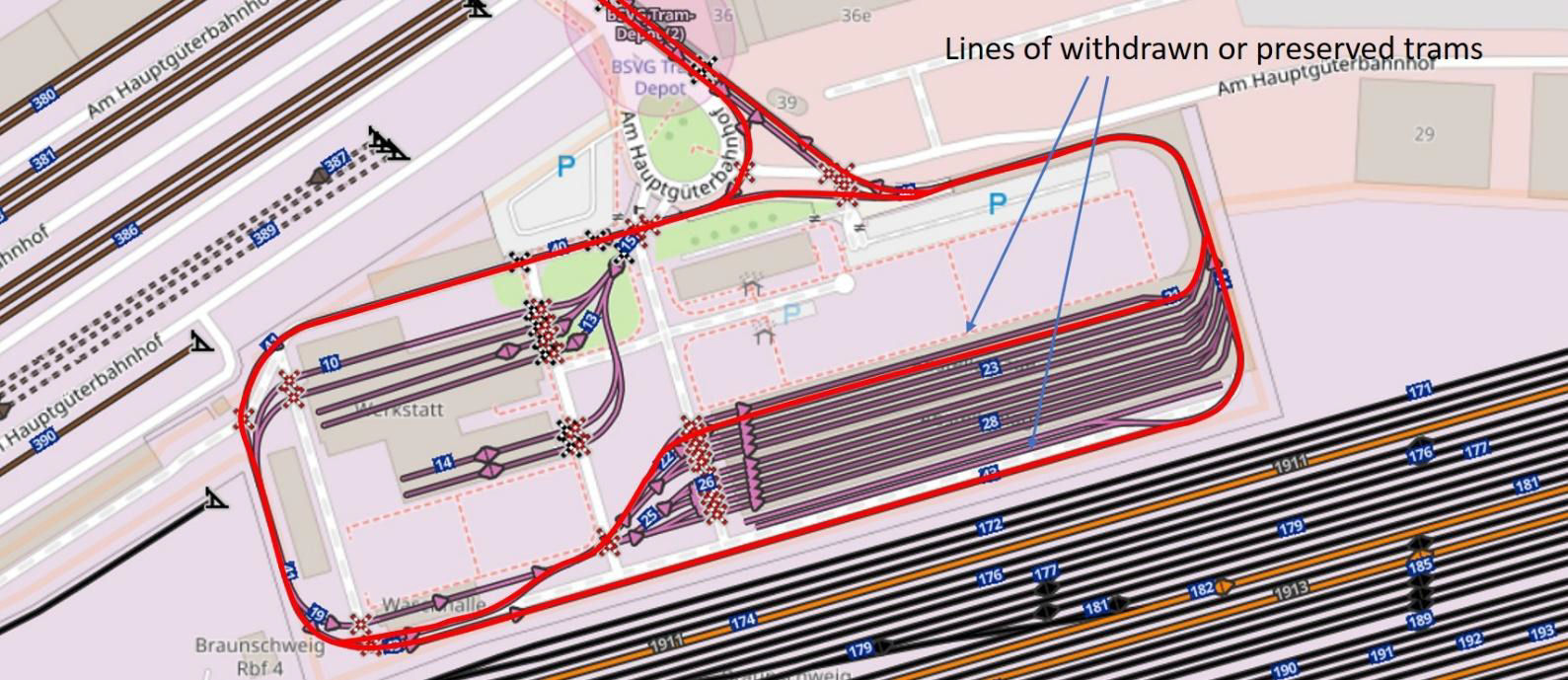
The red lines are the tour route around the depot; the railway used on Day 1 is at bottom.There were still a few curves left to do, so, from the Depot, we headed back towards Hauptbahnhof, turning right just before there (rare curve) towards John-F. -Kennedy-Platz but going straight ahead (very rare connection), rather than turning right. A rare curve that we did earlier then trailed in right, so we had done the next bit already. At Friedrich-Wilhelm-Platz we turned right (rare curve, already done in the opposite direction). Next was the rare west-to-south curve at Schloss towards John-F. -Kennedy-Platz, continuing south via the old course of Route 2. This time we turned left after Leisewitzstraße (rare curve), back to Hauptbahnhof - with the tram facing east, ready to run empty back to the Depot.
During the last leg of the tour, David Köhler of BIN gave various thanks and especially to our driver, BSVG employee Peter Niemann, as this was the last time he would be driving one of the museum tram trips. He was turning 70 in a few days and therefore retiring. He was given a small present. Then our Treasurer, Ian Mortimer, used the microphone and proposed a vote of thanks to Paul Griffin for his hard work in organising the three days - which had been very enjoyable. This was seconded by everyone on board.
And so, nearly four hours after setting off and only ten minutes or so later than advertised (for a pleasing reason), we found ourselves back at Hauptbahnhof. The sun had officially set but it wasn't yet properly dark and we had met the requirement set out in Paul's original email of finishing in time for a meal. (In my case it was the Italian restaurant which closed at 23.00 next to the BraWoPark beside Hauptbahnhof.) This had been an excellent evening tour and a great end to the fantastic three-day exploration of Braunschweig and Hannover. Roll on the next PGT (Paul Griffin Tour)!