Ten members (fully booked) met at 10.00 beside the gigantic 'Ozzy', the mechanical bull on Birmingham New Street concourse on a glorious summer day. Our objective was to explore as many of the horse artworks as possible along the 12m 75ch of the New Street to Wolverhampton Stour Valley, ex-London & North Western Railway (L&NWR), through the heart of The Black Country. 'Oss' is local dialect for 'horse'. It was also an excuse for members to explore the busy Stour Valley Railway and its history.
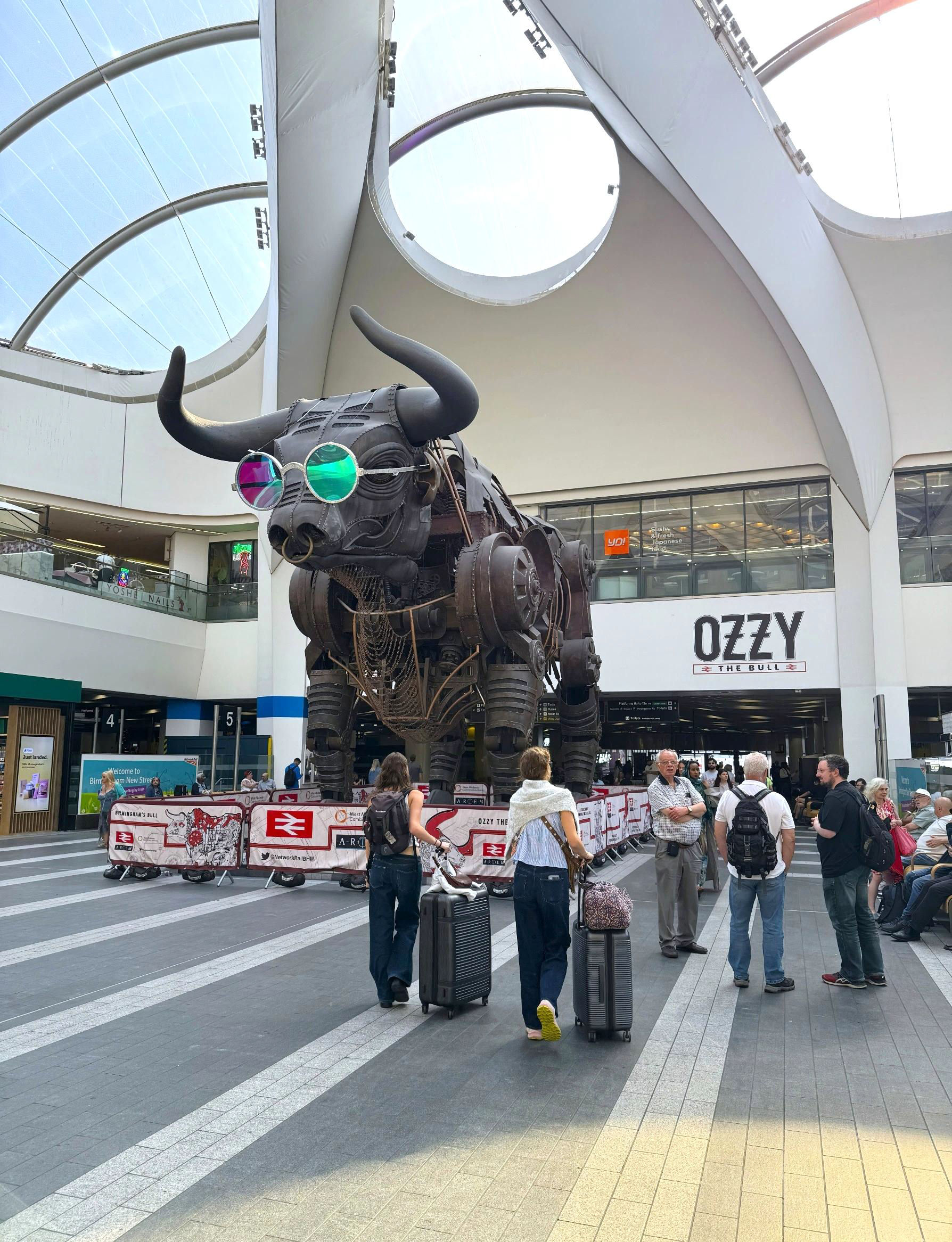
Birmingham New Street concourse. To be clear, Adam is the one with glasses on the right and Oƶƶy (the bull) is the one with glasses ahead, left.
[© Robert Hope 2026]We were led by Adam Turner with his trusty iPad which contained a treasure trove of archive photos and movies which we enjoyed throughout the day. Some local members of our group had an intimate knowledge of the area, pointing out features as we progressed. Including a couple of recent tours of Adam's in Birmingham City Centre, over £350 was raised for Birmingham Hospice.
In 1987, BR and West Midlands Arts engaged visual artist Kevin Atherton to install 12 'Iron Horses', black metal silhouette horse sculptures, along the Stour Valley line from Birmingham to Wolverhampton. They were designed to be seen from trains as the journey of one horse galloping along with the train.
The horses are all in different galloping poses. They were inspired by the work of American artist Eadweard Muybridge who produced a primitive movie in 1878 entitled 'the horse in motion', to settle a longstanding debate over whether horses lifted all their hooves from the ground simultaneously when galloping. His movie proved that they do. Muybridge's movie showed the horse galloping in black silhouette, so all our railway horses are in silhouette, painted black. The renowned 18th Century horse artist, George Stubbs, had previously shown horses galloping in a rocking horse motion which is incorrect but he didn't have access to a primitive movie camera.
The horses were cut from 8mm mild steel plate by a firm in Digbeth and are held upright by steel posts. After 39 years, the surviving horses are in remarkably good condition, enhanced by weathering, although some have become engulfed by lineside trees and vegetation, obscuring them from passing trains.
Adam played us a video recorded by their creator, Kevin Atherton, in which he described feeling inspired by the story that, when Queen Victoria travelled the Stour Valley Line, she had the curtains in her coach drawn down so as not to see the grimy lineside industries and canals. The original 12 horses were positioned six on each side of the line on railway and private land, at varying distances from the track.
In the 39 years since installation, two horses have been lost and one gained. The first loss was from close to the north entrance of New Street North Tunnel (Monument Lane Tunnel), near the site of Monument Lane engine shed, around ¾ mile west of New Street. In 1990-91, the Birmingham Arena was built over the tracks here, creating the new Arena Tunnel (176 yards), an extension of New Street North Tunnel.
What happened to the horse under the Arena is a mystery but the artist replaced it with a new horse on New Street P6 & 7, our first destination of the day. To find the surviving horses, our day required jumping on and off trains, trams and buses, combined with much walking and strenuous stair climbing. We caught the 10.11 New Street to Smethwick Rolfe Street (10.17) a journey of 3m 30ch. There are two horses on the Wolverhampton side of Rolfe Street station, yards from the station, almost diagonally opposite each other on opposite sides of the line. The first is by a tree now hidden from the railway by branches when the leaves are on them. The second is on the North Western Road side of the line, partially hidden by a boundary wall and dense undergrowth. The station has been adopted by the local Sikh community and is opposite the impressive Guru Nanak Gurdwara. This is the largest Sikh place of worship in the UK.
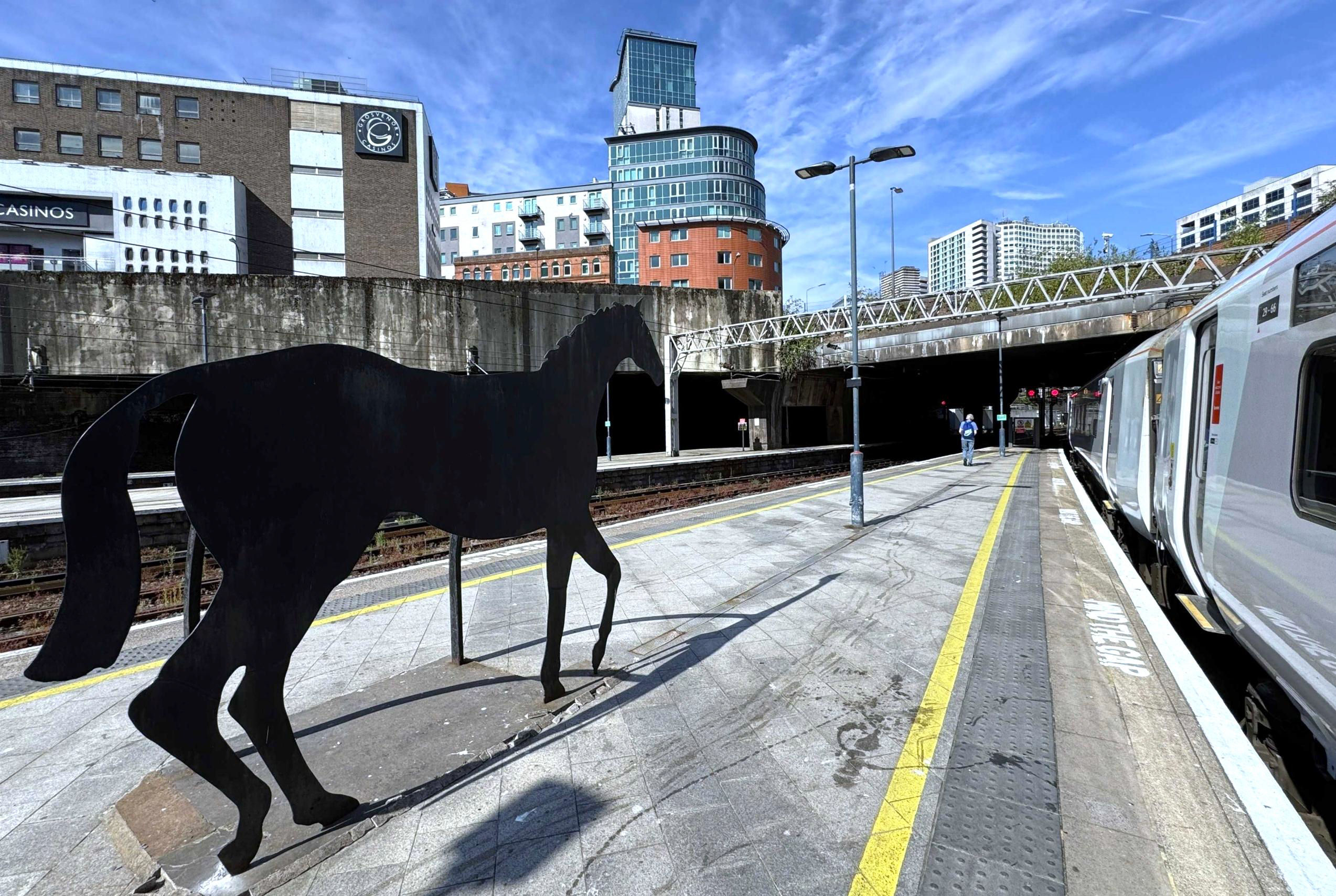
A 'new' horse on P6a & 7a (London end) replacing the one lost beneath Birmingham Arena when the North Tunnel was lengthened in 1990-91.
[© Robert Hope 2026]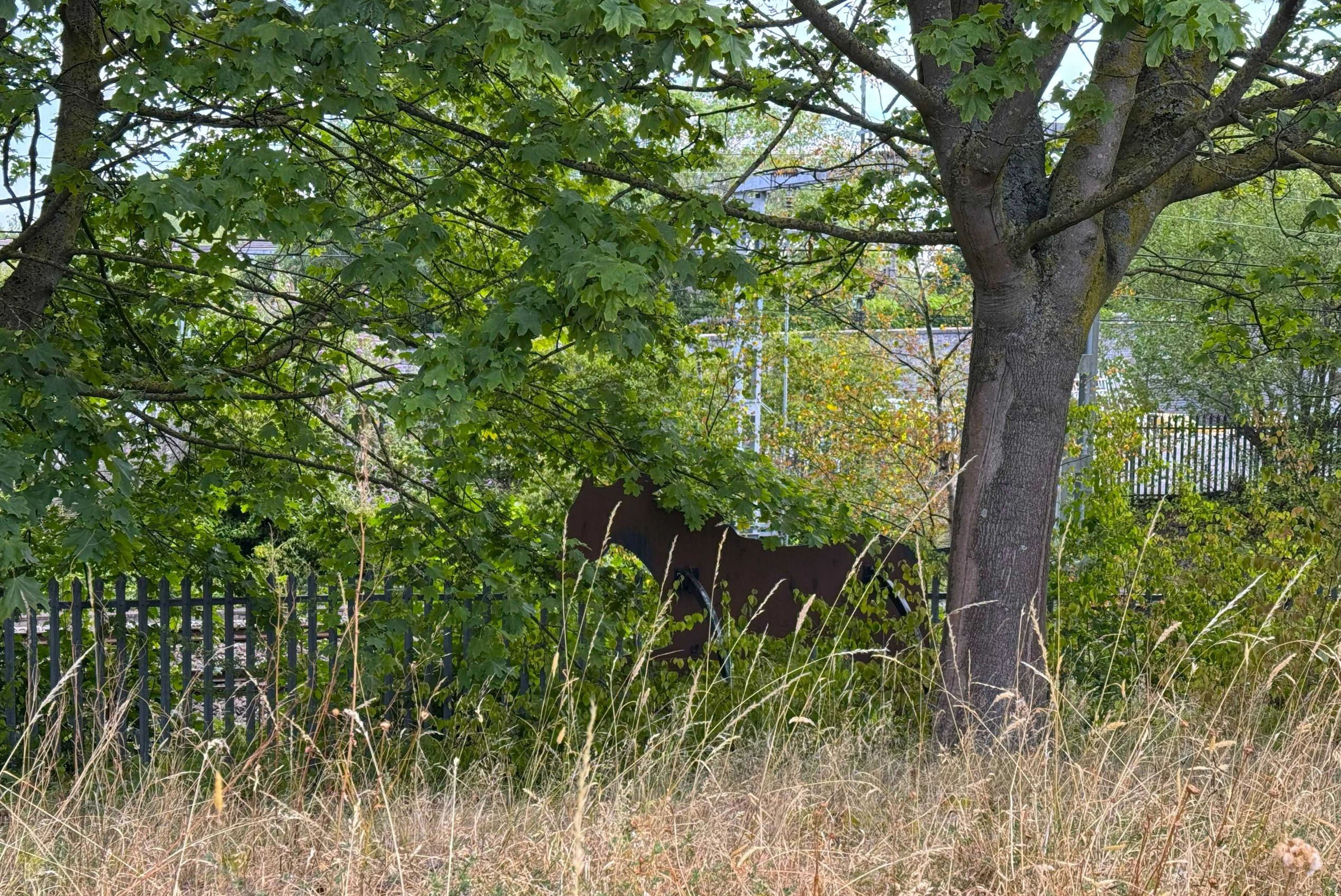
The first of two horses on the Wolverhampton side of Smethwick Rolfe Street station just yards from the station by this tree.
[© Robert Hope 2026]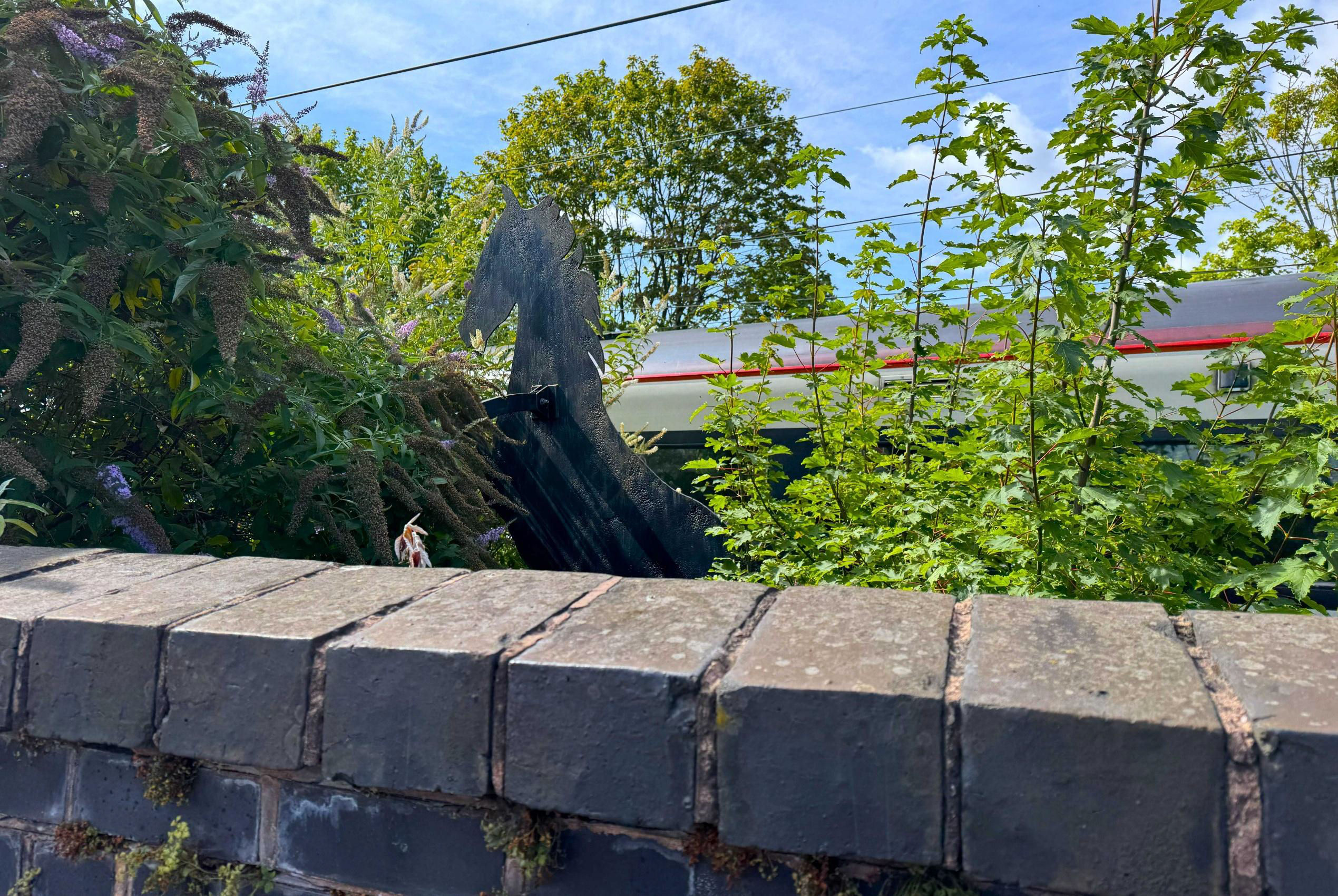
Not Aintree but the other (North Western Road) side of the line near Rolfe Street, diagonally opposite the previous one, in dense undergrowth.
[© Robert Hope 2026]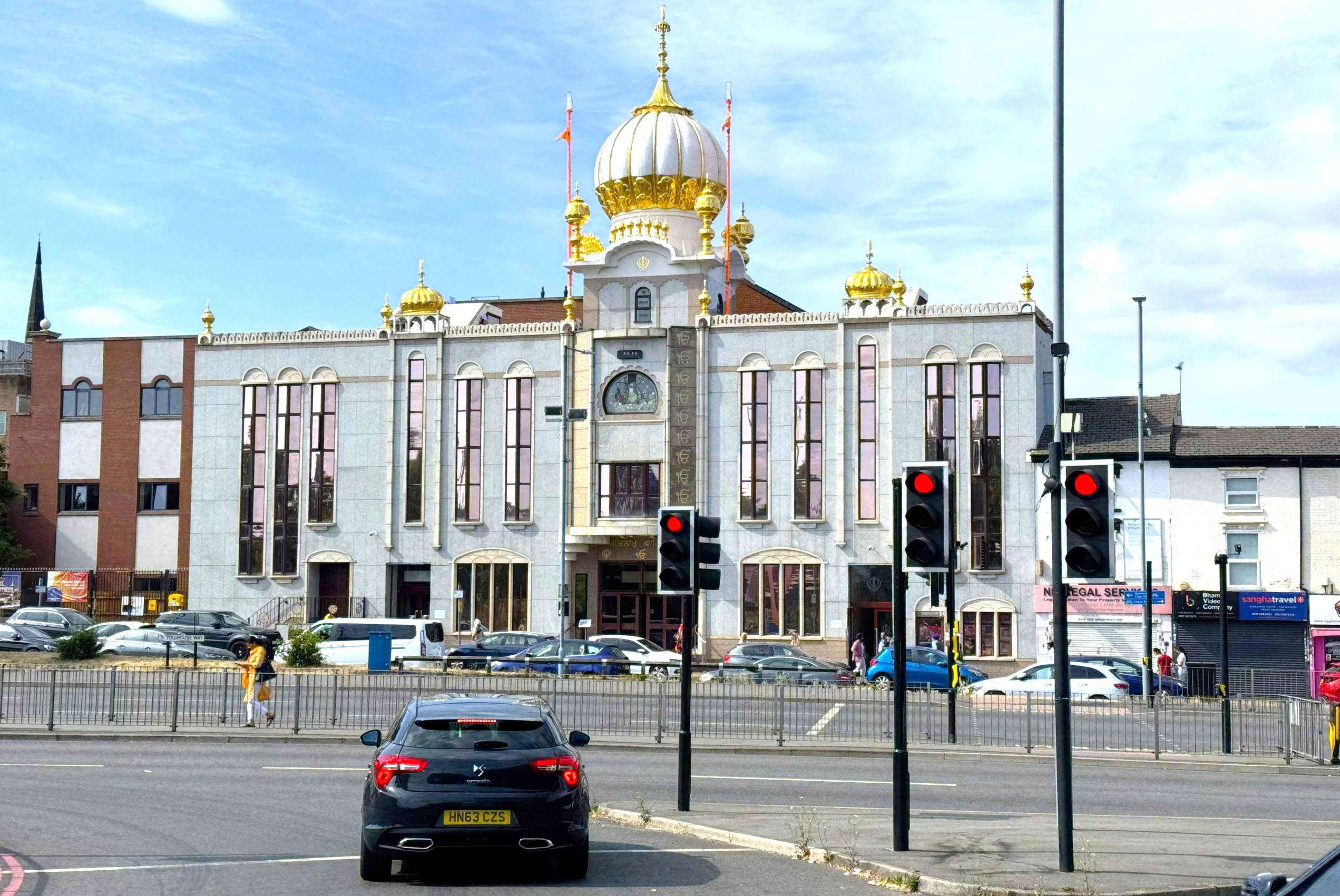
Smethwick Rolfe Street station has been adopted by the local Sikh community and is opposite the impressive Guru Nanak Gurdwara temple...
[© Robert Hope 2026]Our group then caught the 10.47 train to Dudley Port (10.55) - 3m 79ch. Between Sandwell & Dudley and Dudley Port there is a horse each side, which Adam tried to point out from the train. He showed a photo of one being ridden by a jockey which some local jokers had added. The second horse is where the railway runs parallel with the Birmingham Canal Navigations (BCN) New Main Line, at the junction with the BCN Gower Branch Canal. Outside Dudley Port station, we walked along John's Lane to see a horse on private land, in the middle of a field used to keep real horses. 39 years ago, the lady who owned the field was happy to host the horse and promised to maintain it in good condition - she has kept her promise. Unfortunately, the railway has not kept its side of the bargain, as the horse is now hidden from passing trains by trees and dense foliage on the railway embankment which has grown unchecked.
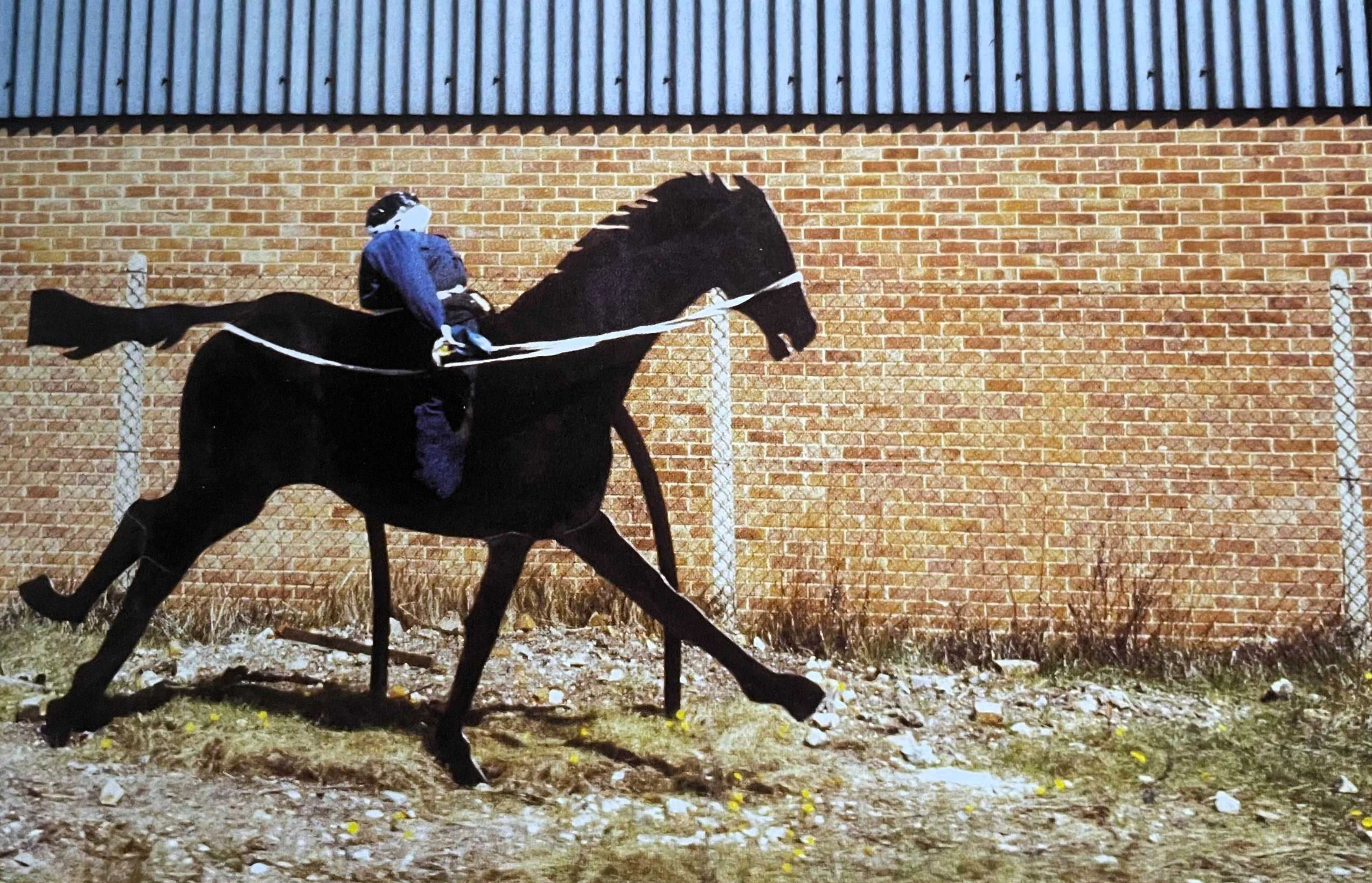
Historical photo (no vegetation) of a horse with a jockey added by a local wag (Adam Turner, who was not the local wag, supplied the photo).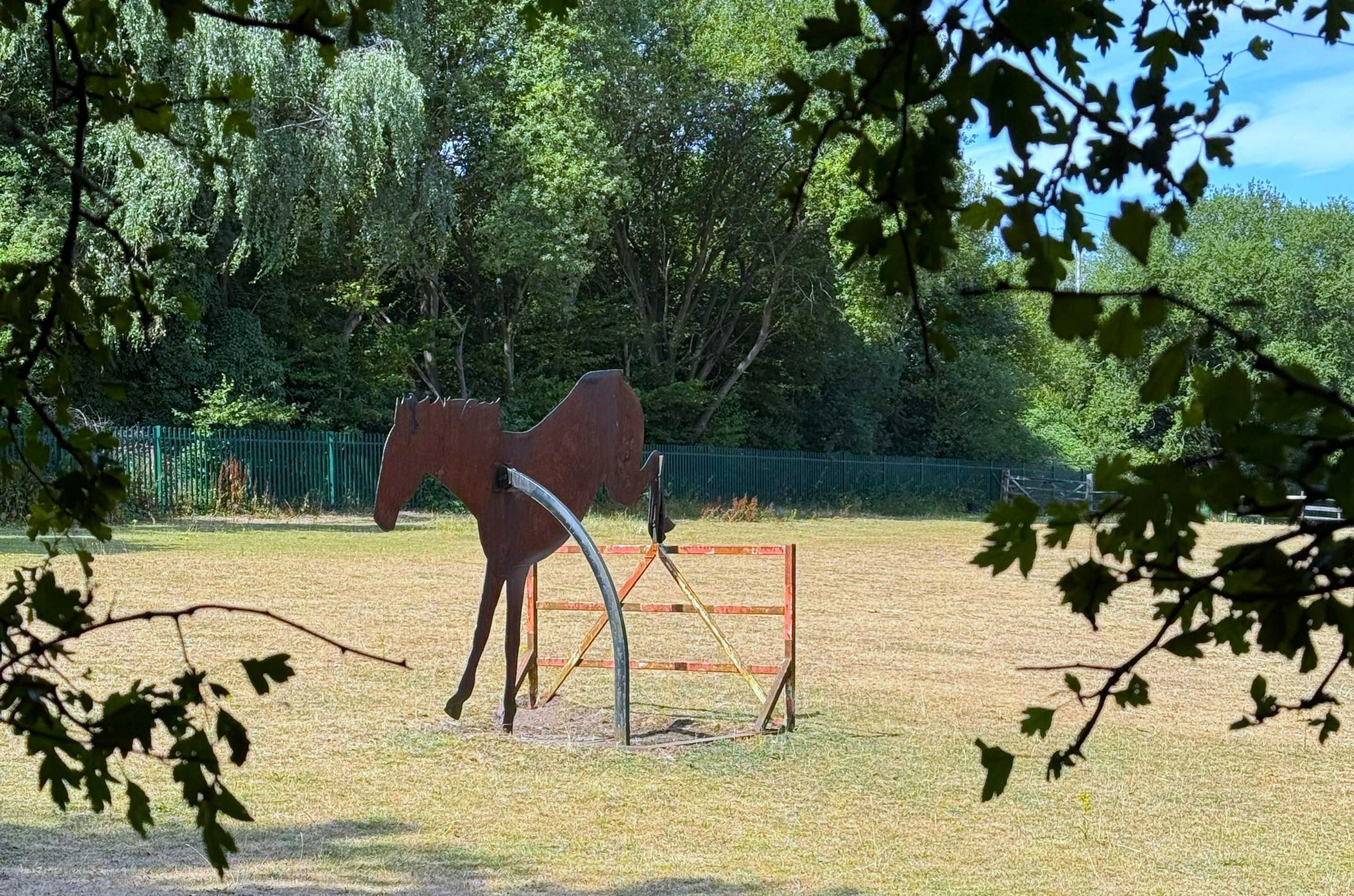
The next horse is on private land reached from Dudley Port station but is no longer visible from trains due to vegetation
[© Robert Hope 2026]Back at Dudley Port (High Level), we looked down at the new West Midlands Metro tram stop on the site of Dudley Port Low Level station. The new tramway extension passes beneath the Stour Valley Line and the BCN New Main Line on part of the trackbed of the former L&NWR South Staffs line from Walsall, Great Bridge and Wednesbury, which had a GWR connection to Snow Hill. This line closed in 1964 to passengers and 1993 to freight. For many years, Dudley Port High Level was connected to the South Staffs line at the north end by Sedgley Loop, which crossed over the BCN New Main Line. Although Dudley Port is now an island platform, when Sedgley Loop existed, High Level had three platform faces, an island with a staggered platform for Birmingham trains. All three could serve Sedgley Loop trains.
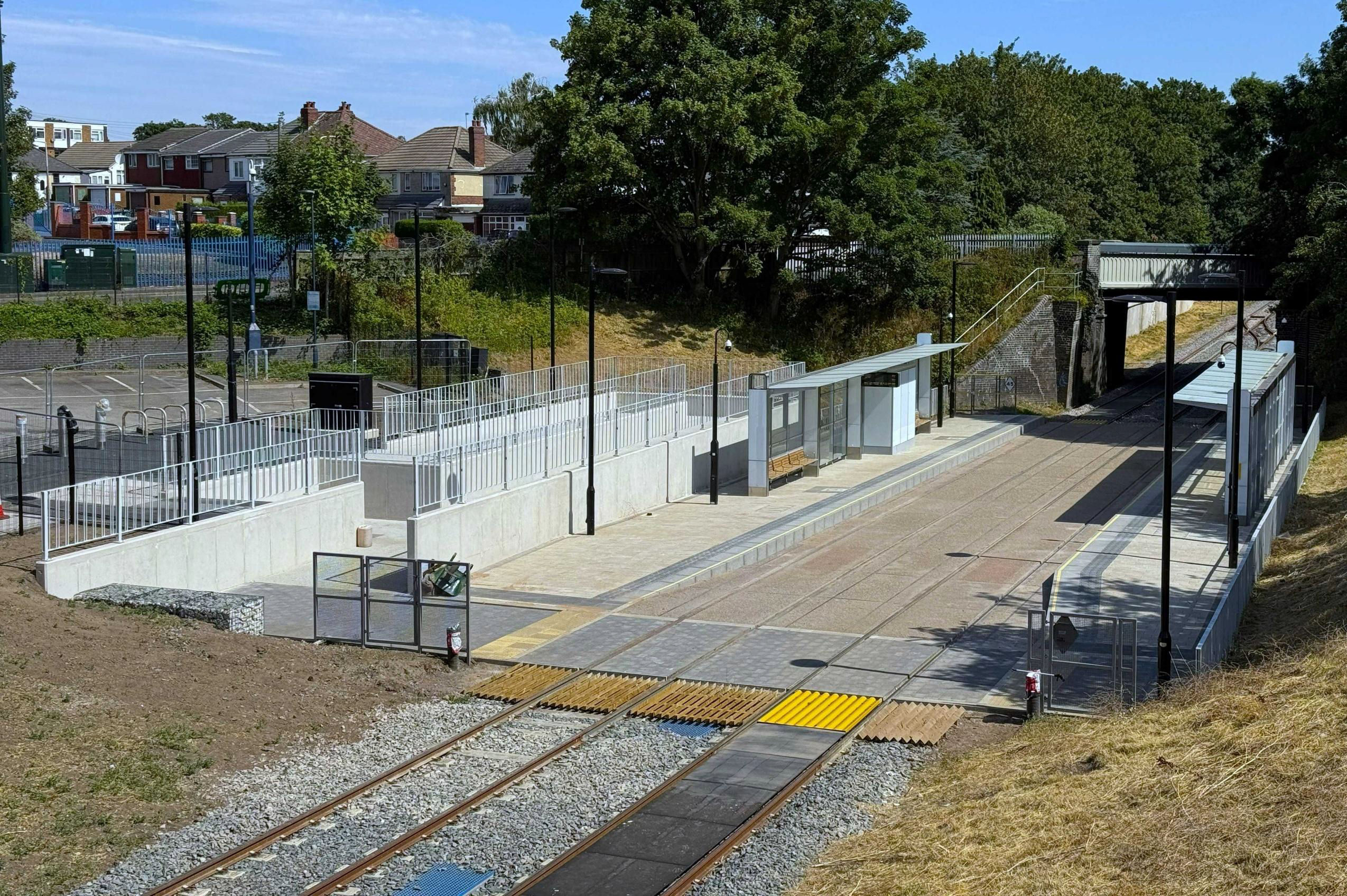
Dudley Port, West Midlands Metro, looked complete with a working tram display panel but opening is delayed by 'technical problems' (signalling).
[© Robert Hope 2026]A Palethorpe Sausage factory was located beside Sedgley Jn (shown on
https://tinyurl.com/yeypr9au as 'Model Sausage Factory') but does not appear to have been rail connected. The map is a 1901 revision. The West Midlands Metro extension looked complete and ready to open, including a working tram passenger information display but opening has been delayed by technical problems. Our members then travelled 67ch on the 11.27 from Dudley Port to Tipton (11.29).
Outside the station we walked northwest, following the mainline, to the site of Bloomfield Jn / Tipton Jn, where the L&NWR line from Walsall and Wednesbury joined the Stour Valley line via the Princes End Branch. Passenger services ceased from 1 Jan 1916 but the line survived for freight until 3 Apr 1981. We found our 'oss' in the middle of the former junction triangle. Unfortunately, in the brutally hot sunshine, we lost one of our party amongst the dense network of undergrowth and cinder paths covering the triangle but, after a few phone calls, we met up again at our next stop. Thankfully, he was not ossified.
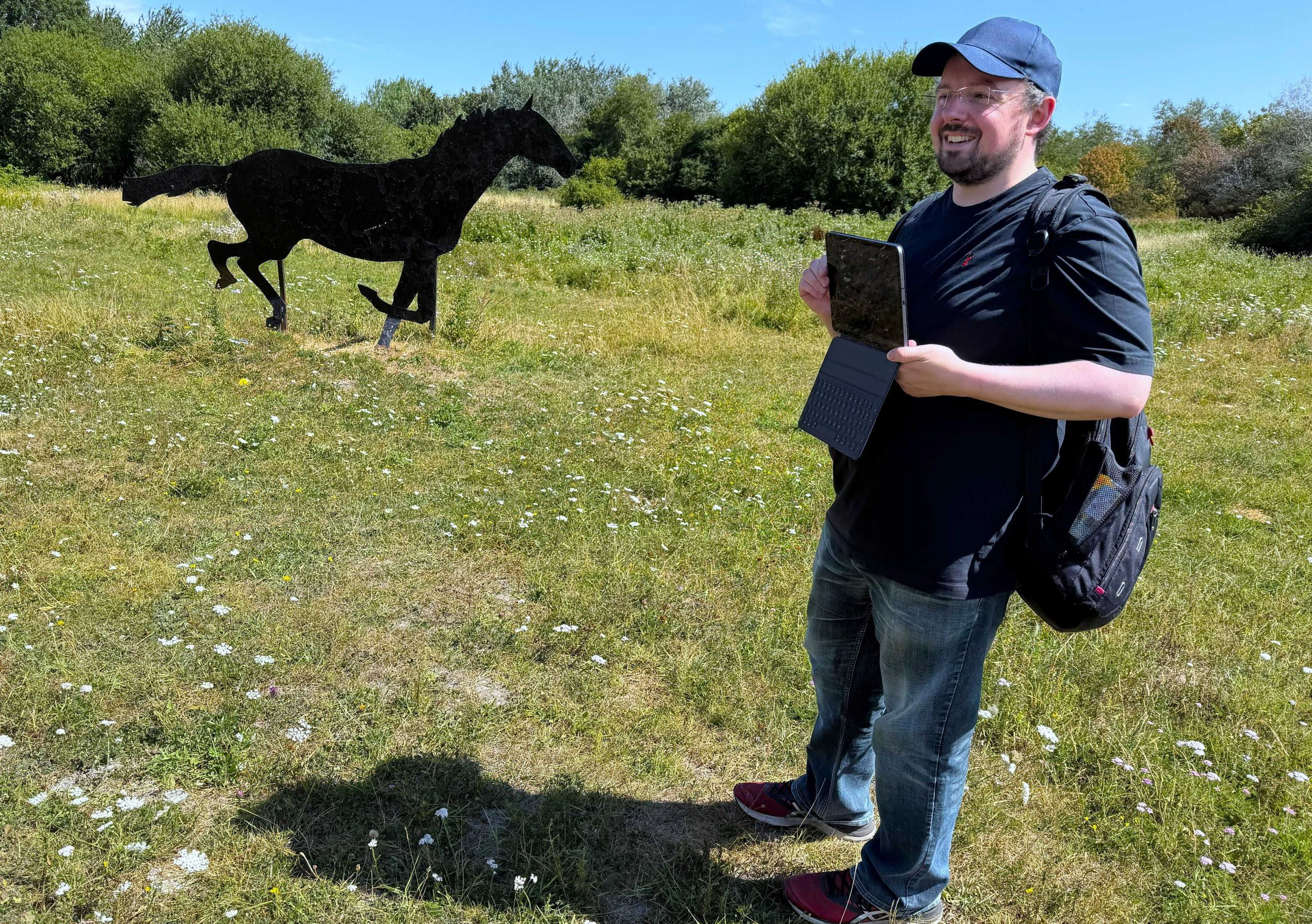
In the middle of the former Tipton Triangle where the Ocker Hill Line once joined the Stour Valley Line with our beloved fixture organiser.
[© Robert Hope 2026]The next train (1m 30ch) was 11.58 Tipton to Coseley (12.02), where there are two horses. 'Rosie' was originally around 500m towards Wolverhampton in Deepfields but, after being damaged by vandals, was saved. The rescued horse was installed by the local Bayer Street Allotments group on Coseley P1 (to Birmingham), with the help of a £15,000 restoration grant from NR and West Midlands Railway.
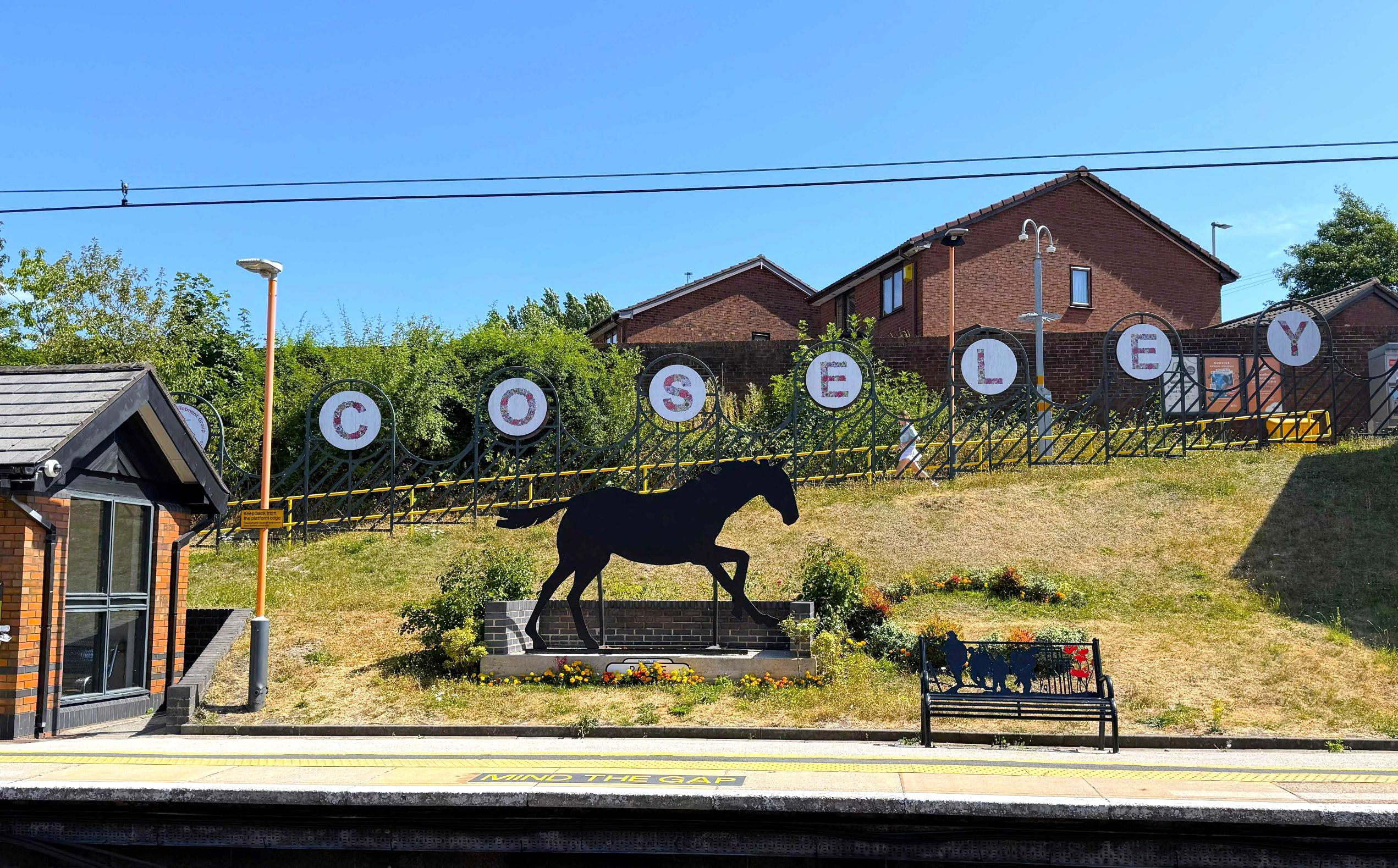
On Up P1 at a top secret location is 'Rosie' the rescued horse, relocated after previously being damaged by vandals.
[© Robert Hope 2026]The second horse is still in its original location at the Wolverhampton end of Coseley P2, now shrouded in vegetation - we should have brought some pruners! In 1987, this horse faced opposition from residents who feared that it would reduce their house prices! 39 years on, this NIMBY horse looks forlorn, mostly hidden by fencing and vegetation, with no sign that it has crashed the local housing market … yet.
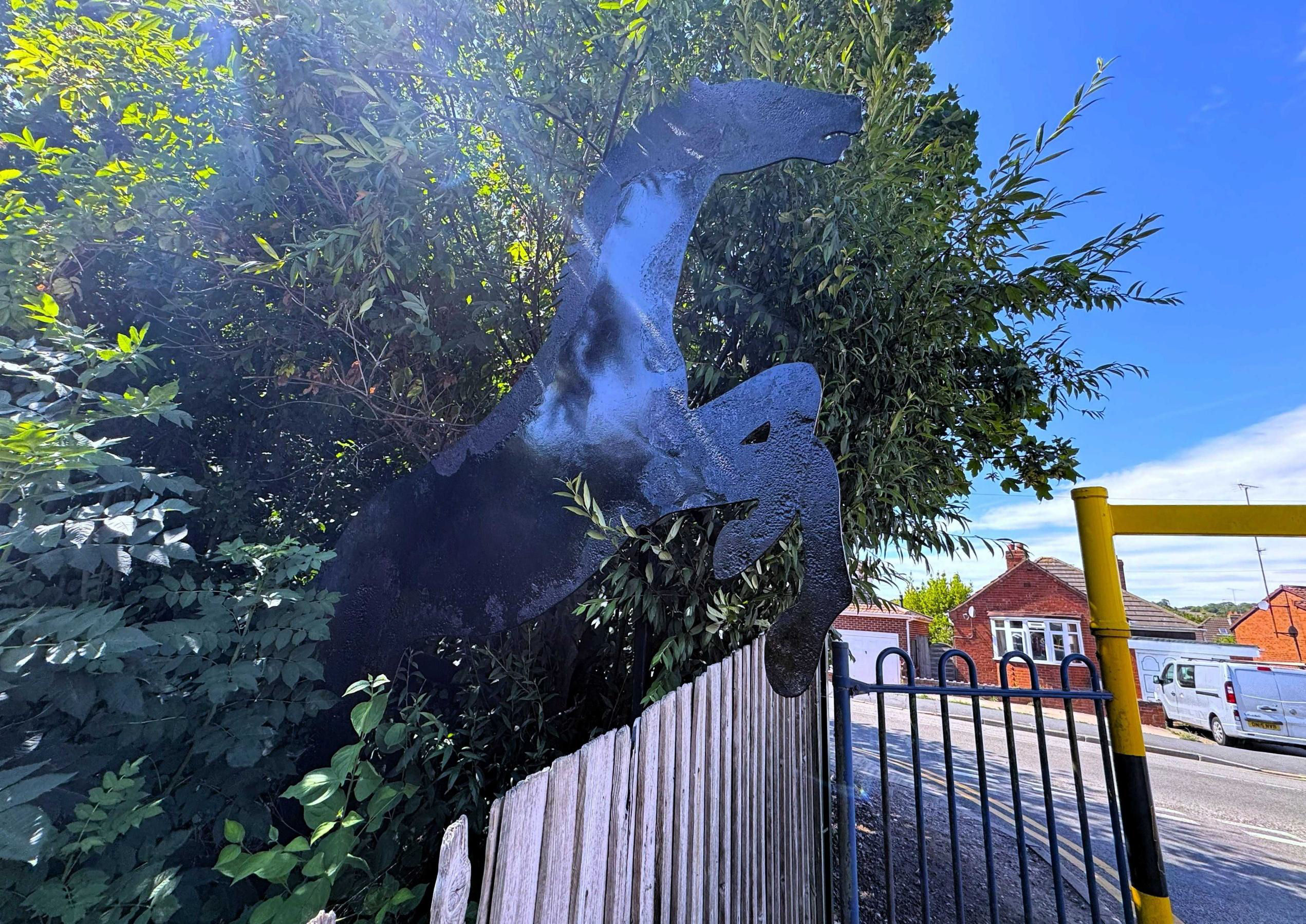
At the Wolverhampton end of Down P2 is the NIMBY horse (for those who just look at the photos, all is explained in the text, Jill).
[© Robert Hope 2026]Our group caught the 12.18 to Wolverhampton P2 (12.25) (3m 26ch). There was once a horse on the station approach but it is now missing - fate unknown. The artist has appealed for funding to replace it with a new gilded horse but there is no sign of this yet. We detrained in P2 alongside our final horse, still in its original prominent position on that platform. On the station concourse was an immaculately maintained brass WWI memorial to fallen members of the L&NWR Wolverhampton goods department.
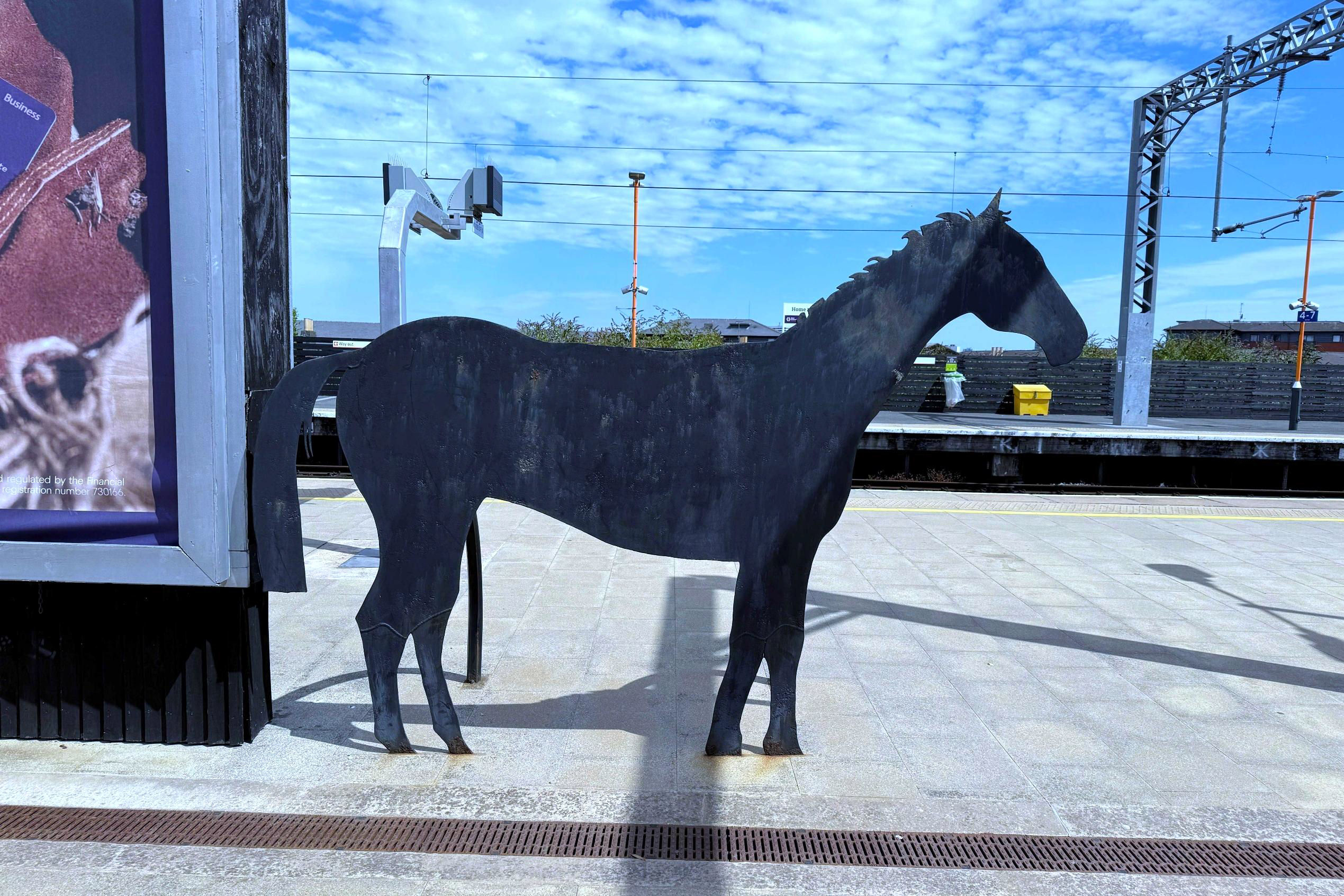
Wolverhampton station horse, the final one, is at the Birmingham end of the P2 & 3 buildings and poster board.
[© Robert Hope 2026]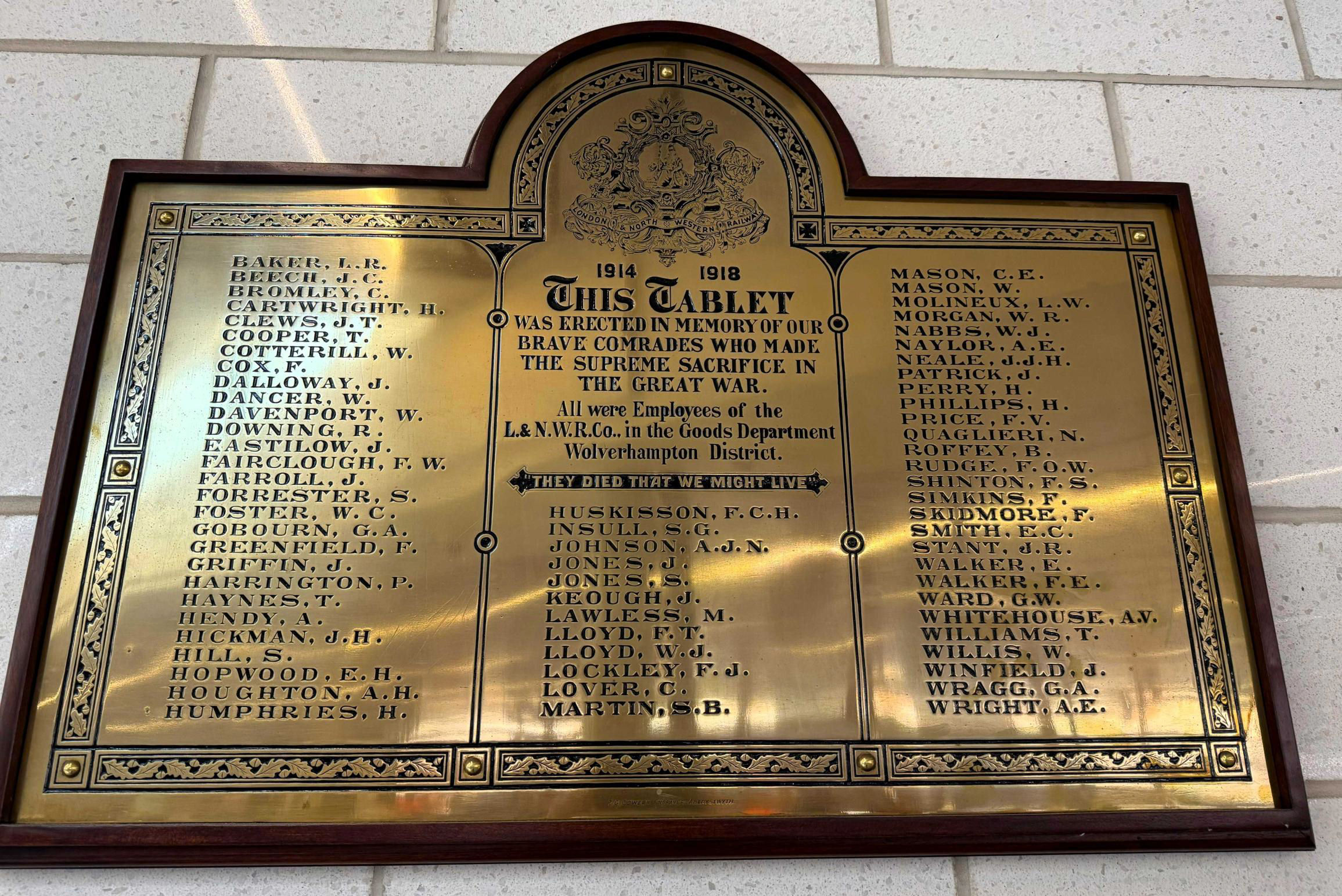
On the station concourse is the immaculately maintained brass memorial to the L&NWR Wolverhampton Goods Department staff killed in WWI.
[© Robert Hope 2026]Adam took us down the recently reopened subway beneath the station leading to the site of the GWR Wolverhampton Low Level station, CP 6 Mar 1972. At the subway exit is a Grade II listed retaining wall and arcade. We strolled through what is left of the GWR station, now part a wedding venue, part apartments and part Premier Inn. We were surprised at how much remains, including the old footbridge with attached signal mechanism, all Grade II listed. By now, we were all tired (except the indefatigable Adam) and dehydrated, so retired to the nearby Great Western Pub (also Grade II listed) between the stations for a break. It is packed with railway memorabilia and photographs, well worth a visit.
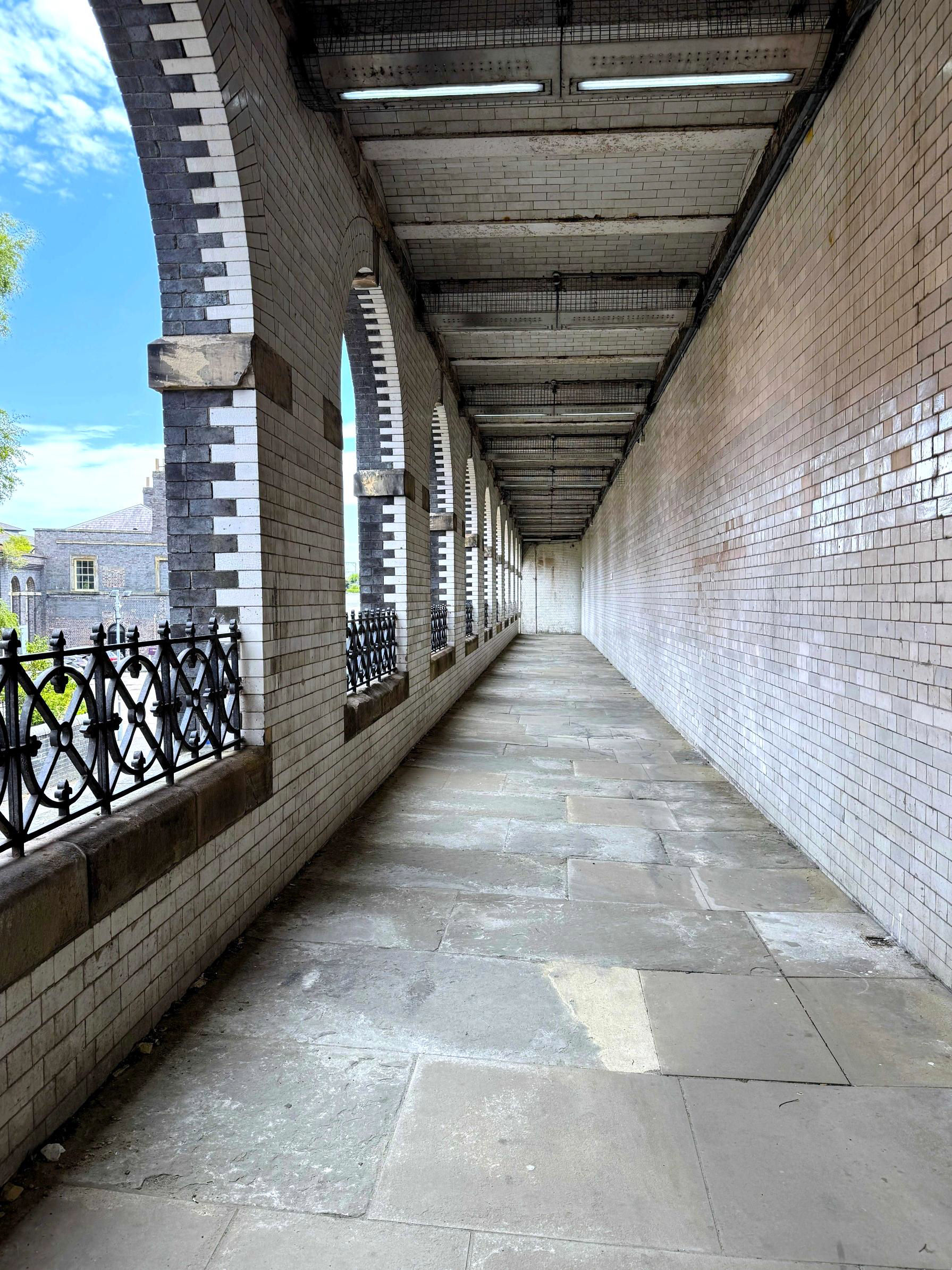
The Grade II listed arcade, part of the pedestrian link between High and Low Level stations here.
[© Robert Hope 2026]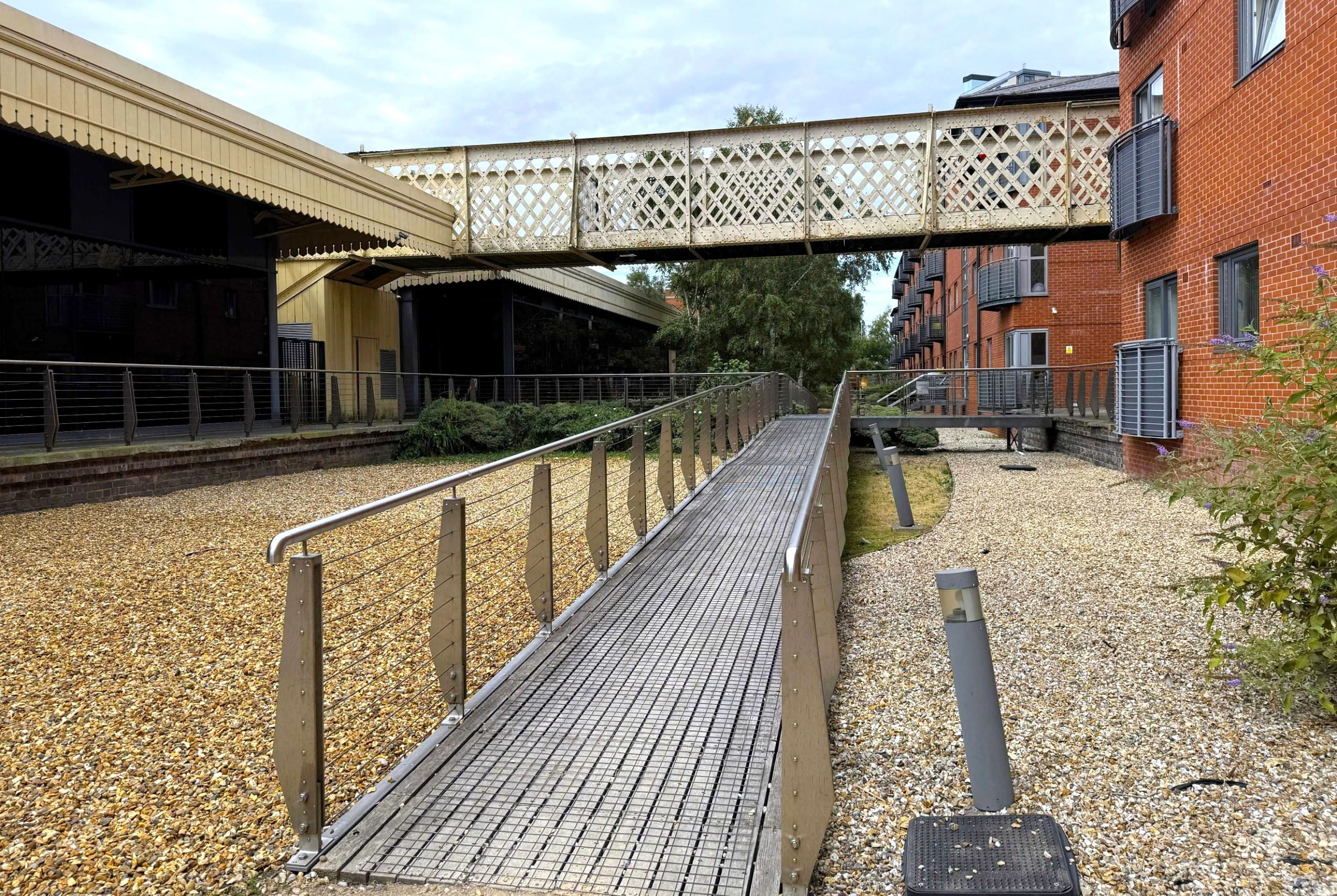
The GWR Wolverhampton (Low Level) station, platforms (left & right) and footbridge, looking towards Shrewsbury. There used to be four tracks.
[© Robert Hope 2026]After a refreshing drink at The Great Western, we boarded a tram at 13.30 outside High Level station to ride 9m 46ch to The Hawthorns (14.02). After meandering through Wolverhampton, the tramway joins the old GWR line to Snow Hill at Priestfield, 1½ miles from Low Level station by rail. En route the line passes Wednesbury Depot, the Dudley extension junction and through Swan Village Tunnel (412yd).
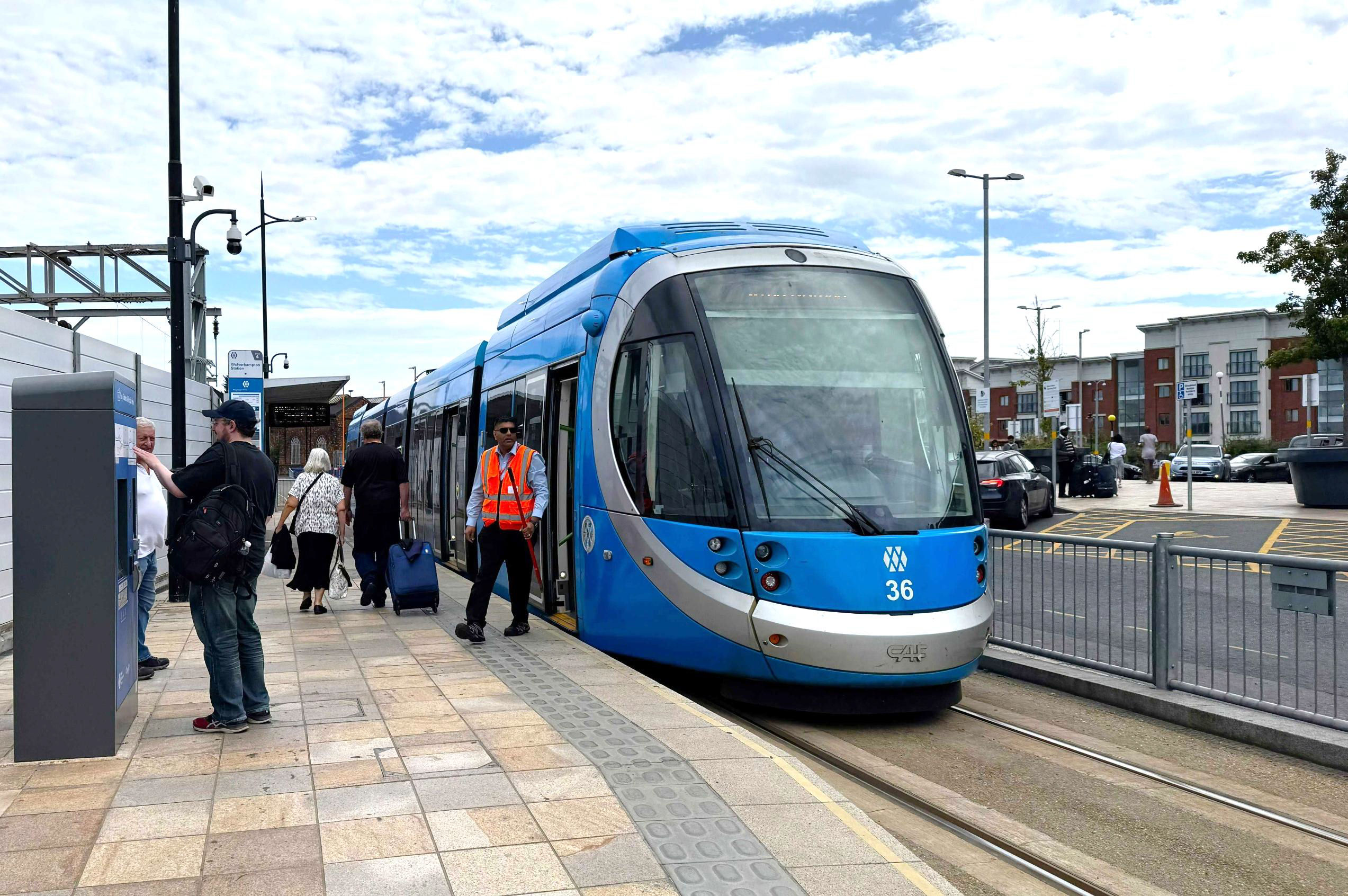
West Midlands Metro, Wolverhampton Station terminus, looking towards the end of line.
[© Robert Hope 2026]Some took the opportunity of this prolonged tram ride to eat lunch. At The Hawthorns, we transferred to the adjacent West Midlands Railway station on the non-electrified former GWR Birmingham Snow Hill to Stourbridge Junction line to await our next train. This was the 14.08 to Smethwick Galton Bridge (14.10) - exactly ¾ mile. This station opened in 1995 as an interchange between the Stour Valley line and the Snow Hill to Worcester line. It replaced the ex-GWR Smethwick West station 17ch to the west. There was no previous station on the Stour Valley line here and it was a last minute addition to the 1995 line reopening scheme. In 2025-26, the station recorded 698,000 passengers plus 494,000 interchanges.
The high level P1 & 2 were partially built on the GWR viaduct over the Birmingham Canal, using clever engineering to allow them to cantilever over the edge. From P1, we had an excellent view of Thomas Telford's Galton Bridge, built 1827-29 of cast iron to carry road traffic across the 'new' (1820's) alignment of the BCN New Main Line Canal in a deep cutting here. The iron components for Galton Bridge were fabricated at the nearby Horseley Ironworks. A young Isambard Kingdom Brunel visited Galton Bridge in 1830 and described it as 'prodigious'. It was named after Samuel Tertius Galton, a local businessman and major investor in the Birmingham Canal Co. Adam guided us from to Galton Bridge, to see the platform built hanging over the edge of the GWR railway viaduct (adds new meaning to hanging about for a train).
In the 1840s, an adjacent bridge was built over the new Stour Valley Railway using an abutment of the 1829 Galton Bridge. The 1840's span is a masonry arch with an iron parapet matching the original Galton Bridge. The 1829 Galton canal bridge and adjacent 1840's railway bridge are Grade I listed. For 150 years Galton Bridge was used by increasingly heavy vehicles, until a bypass was built.
Both bridges are now only used by pedestrians and cyclists. Recent surveys show that the 1829 bridge is in excellent condition. Next was a bus at 14.36 for almost a mile to Smethwick High Street, to buy Samosas at the highly recommended Desi Sweets. We walked to Smethwick Rolfe Street, past the 'Lions of the Great War' memorial statue celebrating the Sikh regiment, for trains home. Many thanks to Adam for the excellent organisation, research and guiding of another most interesting and enjoyable tour.
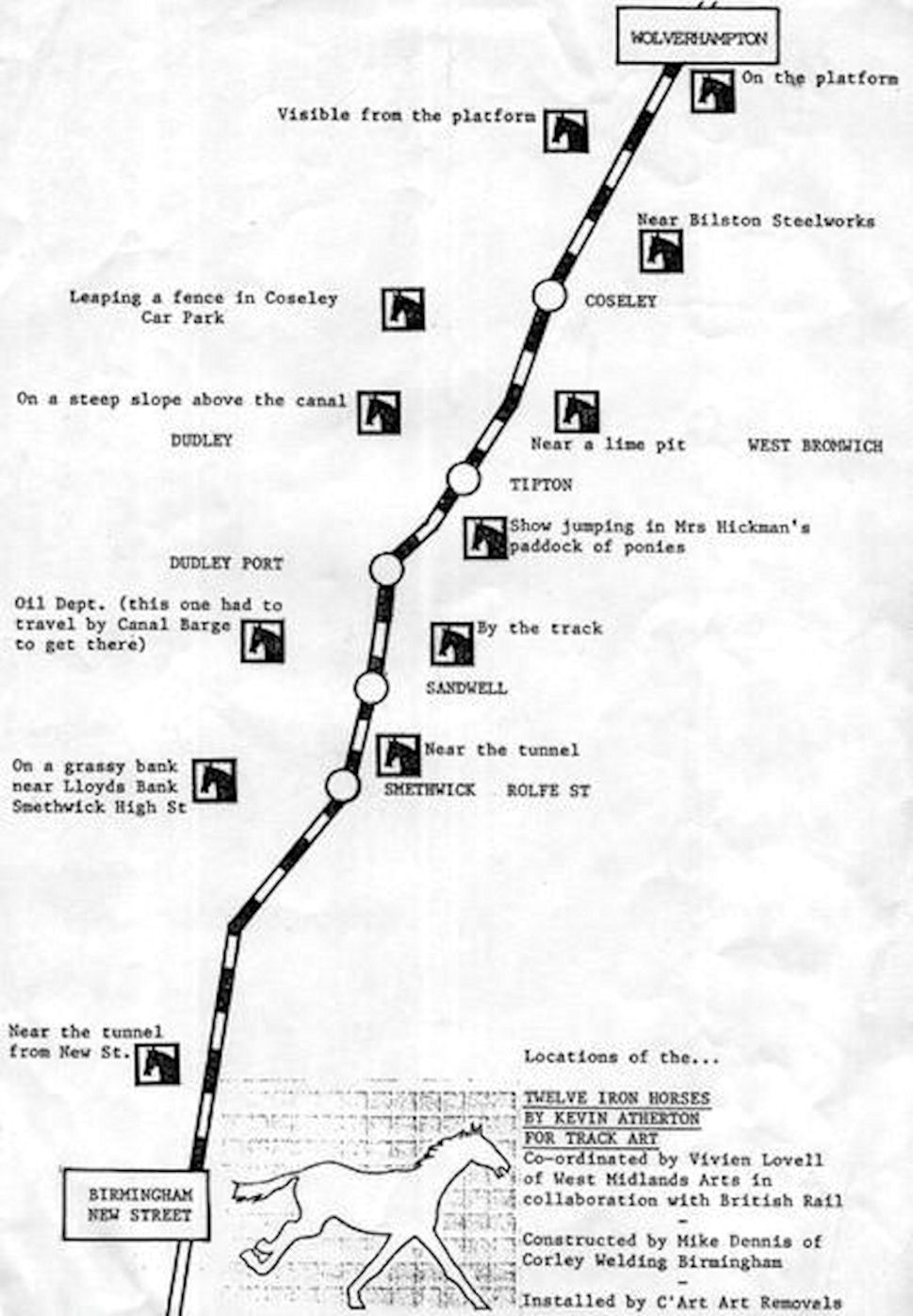
Very low resolution image of the original planned sites for the horses in 1987
[© Adam Turner 2026]