The Wittmer Excursion: - Author John Piesing with additional material by Paul Griffin.
Day 3 of our Braunschweig program started similarly to Day 2 but switching back to the loco from Day 1 (V45-211) with some of the same coaches.
The tour with nearly 40 participants left on time at 08.30 from Braunschweig Hbf (Hbf = main station); the platform passenger information screen seemed to have renamed it the 'Asse Explorer'! We came to a standstill north of Leifert due to a problem with the passenger train that left Braunschweig just in front of us. This was worrying, as the timekeeping for the tour was totally dependent on the hourly path for service trains. If we missed it, then the next path was in an hours' time and a hectic day was ahead!
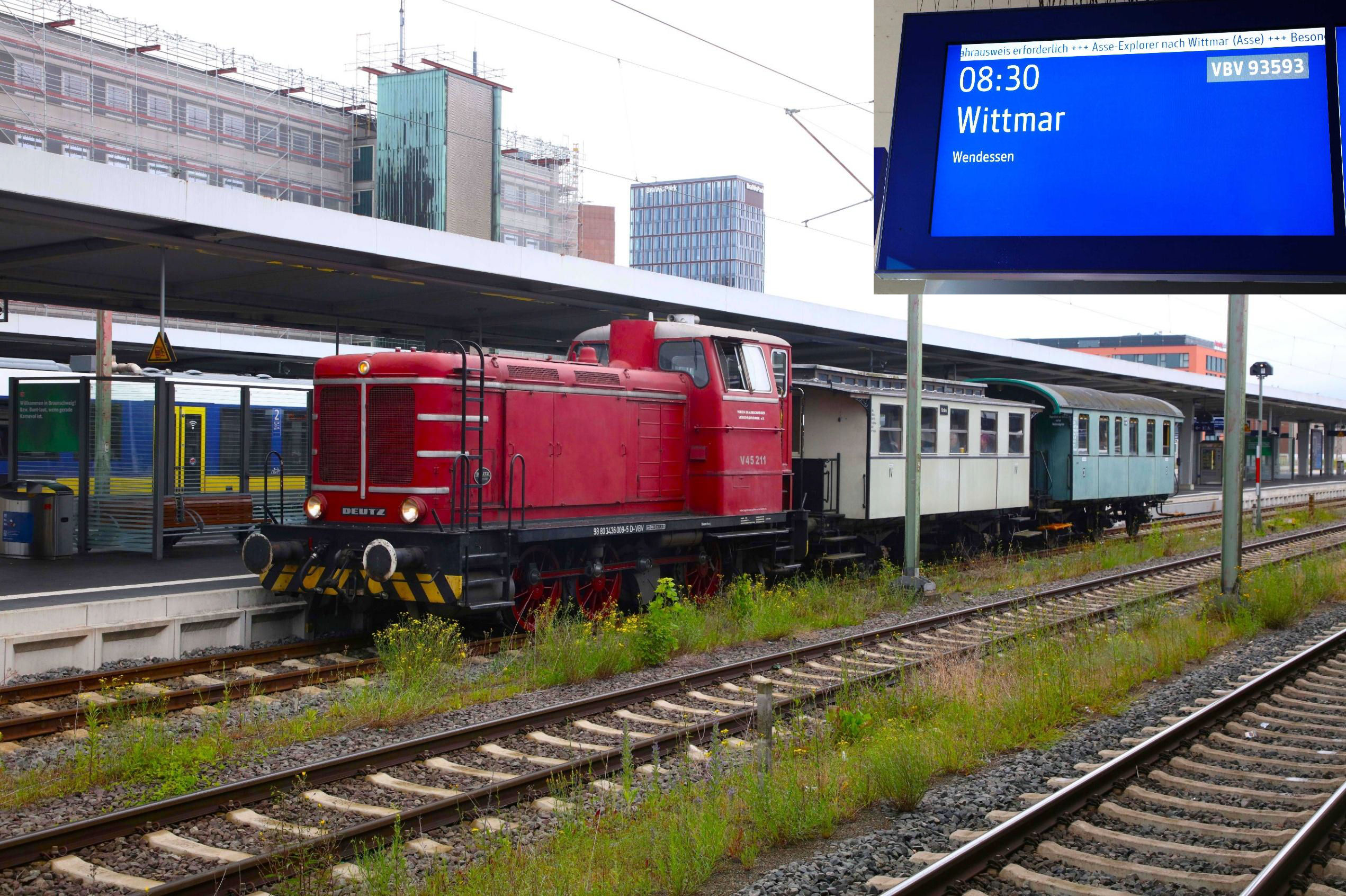
Braunschweig Hbf; our Wittmer Excursion AKA the Asse Explorer?
[© Iain Scotchman 2026]Fortunately, this was resolved quite quickly and we carried on to Wolfenbüttel, where our train stopped to complete the procedures for access to the branch towards Schoenstatt. Our guard, Daniel, was responsible for unlocking and changing points amongst other administrative duties and was kept very busy throughout the trip. The Schoenstatt line used to continue to Helmstedt past large opencast lignite mines. The expansion of these and the consequent need for relocation of an already lightly used railway led to the decision to close the line between Schoenstatt and Schöningen in Dec 2007.
At Wend Essen, Daniel changed the points, set the signal and operated the crossing. We turned off onto the tourist / freight line to Wittmar and Schachtanlage Asse (= Asse Mine, a former salt mine). We were now travelling on the sole remaining section of the Braunschweig to Schöninger Eisenbahn (Eisenbahn = railway) which ran from Braunschweig to Mattierzoll and Schöningen. Passenger rail service between Hötzum and Mattierzoll was discontinued from 1 Jul 1950 and on the Braunschweig to Schöningen line from 1 Oct 1954. The final blow came when the Schöningen saltworks ceased operations in 1970; salt mining in the Asse mine had already ended in 1964. The Wendessen - Groß Denkte - Wittmar section we were now travelling on was completely renovated in the late 1970s, equipped with new road bridges, and extended to the Asse II Mine shaft. Nuclear waste and rock salt are transported along this line from the Ronnenberg spoil heap to the Asse II experimental storage facility.
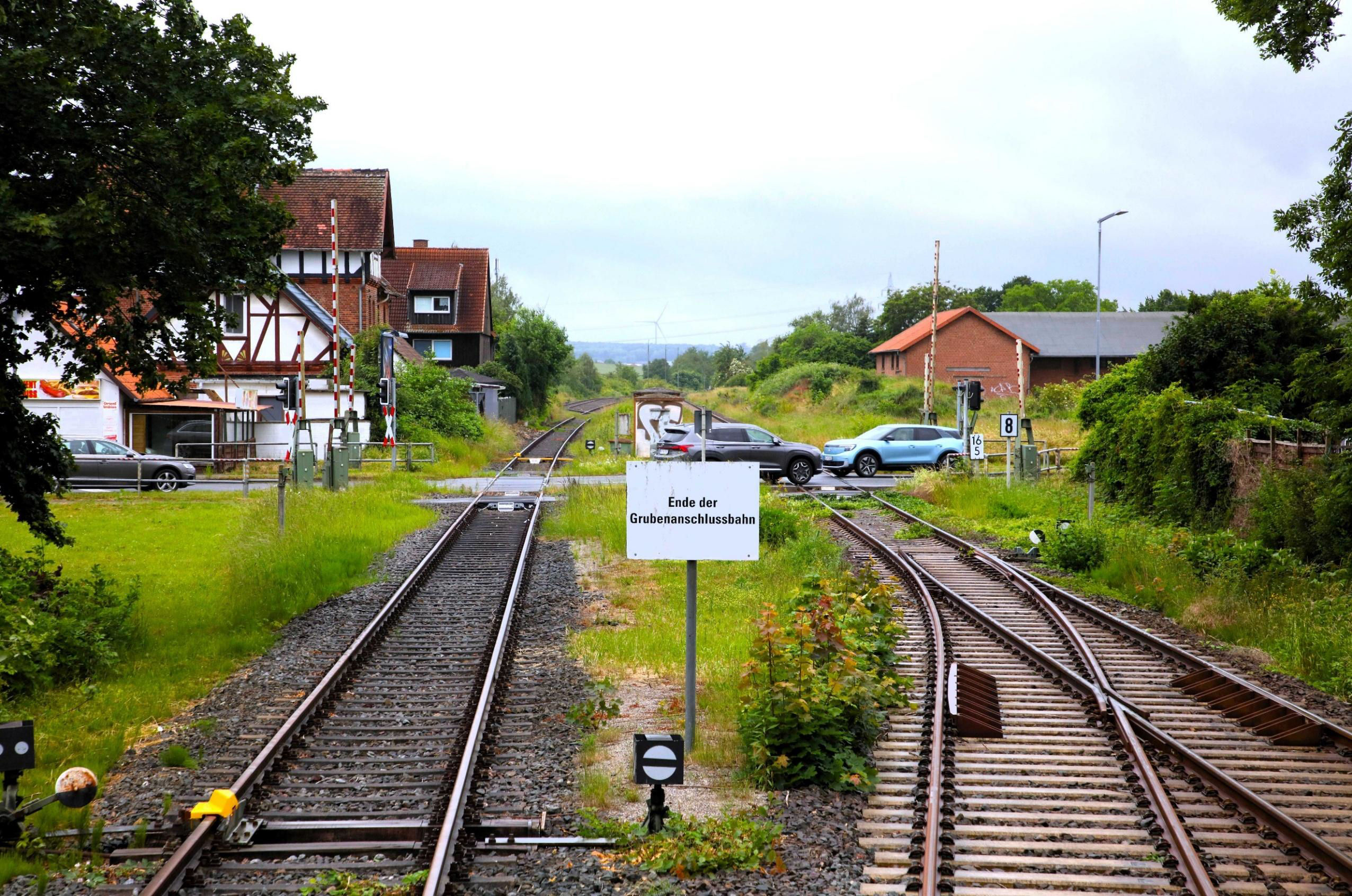
Wend Essen, junction for the Wittmar branch. Daniel (the guard) has changed the points, set the signal and operated the crossing ready to go.
[© Iain Scotchman 2026]There are sidings before the village of Wittmar and occasional steam excursions from Braunschweig operate to the old station. The loco ran round here in light rain and soon we were on our way again being propelled. Suggestions of another photo stop were dismissed - reaching the end of the line was more important and we started out on the climb of the 2km branch to Schachtanlage Asse. This is a steeply graded climb through a forest and we slipped to a stand a couple of times in the wet. The Esslingen railbus from the previous day slipped to a stand on the flat at Börßum, so switching back to the 0-6-0 loco and coaches was very sensible. [The decision to use loco and coaches rather than the railcar was made only a few weeks before. Loco and coaches are preferred for interest by our organiser; possible difficulties with the ascent to Schachtanlage Asse may have been the determining factor.]
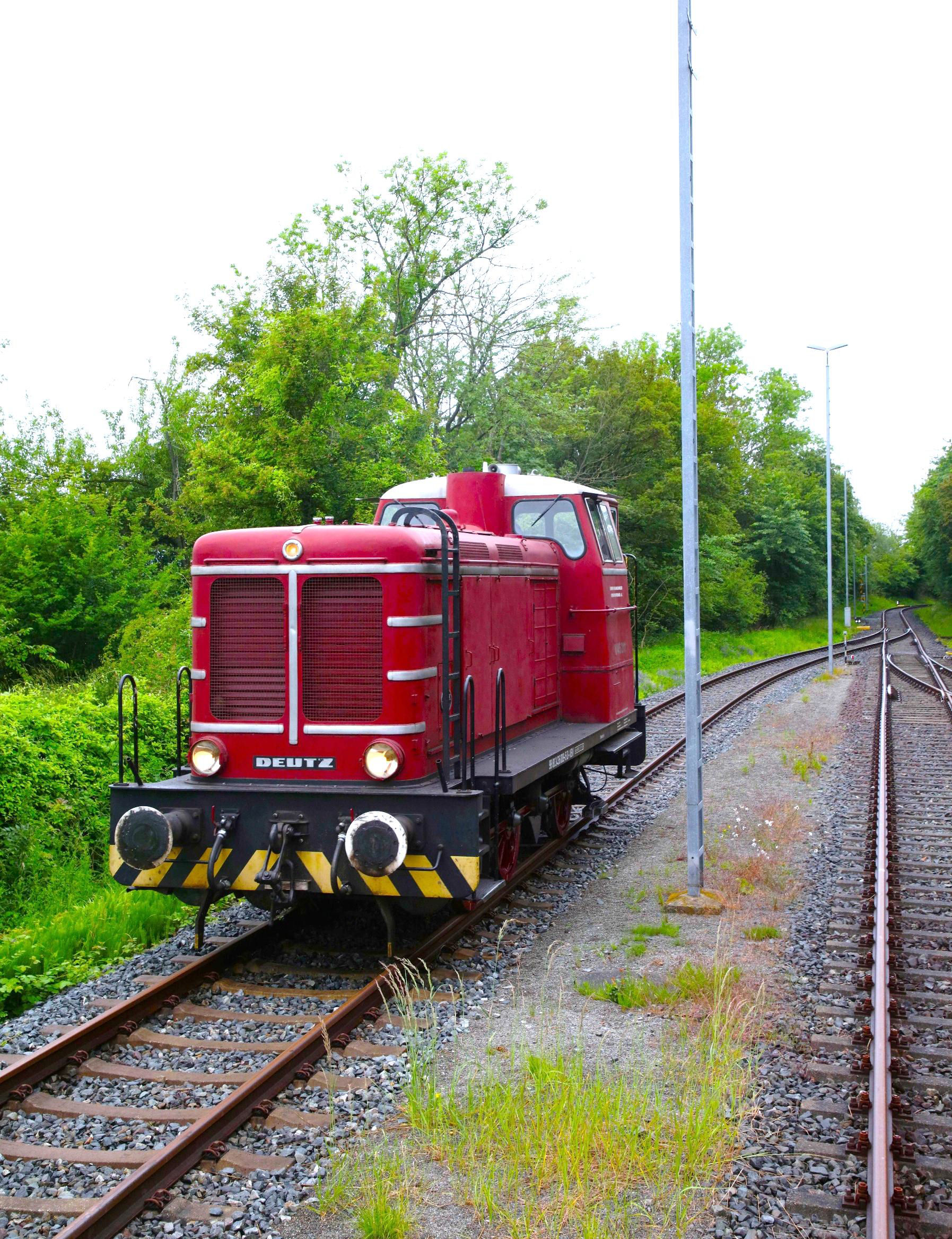
Our tour loco runs round in the sidings before the village of Wittmar.
[© Iain Scotchman 2026]Eventually, our tour passed the stop board (folded flat on the ground) and reached the road before the gates of Schachtanlage Asse, where a photo stop was made. The IBSE* railtour on this line had not gone past the stop board, so over a hundred metres of bragging rights for the BLS! On the return, we had time for a second photo stop at the platform in the forest where occasional tourist trains set down and pick up walkers. At Wittmar, we took the loop which the loco has used to run round on the outward trip. Braunschweig Hbf was reached with only a small delay for a defective level crossing on the main line.
(*Interessengemeinschaft zur Bereisung von Straßenbahn- und Eisenbahnstrecken e.V., or 'Interest Group for the Study of Tram and Railway Routes'. e.V. is eingetragener Verein, meaning a registered voluntary association in Germany.)
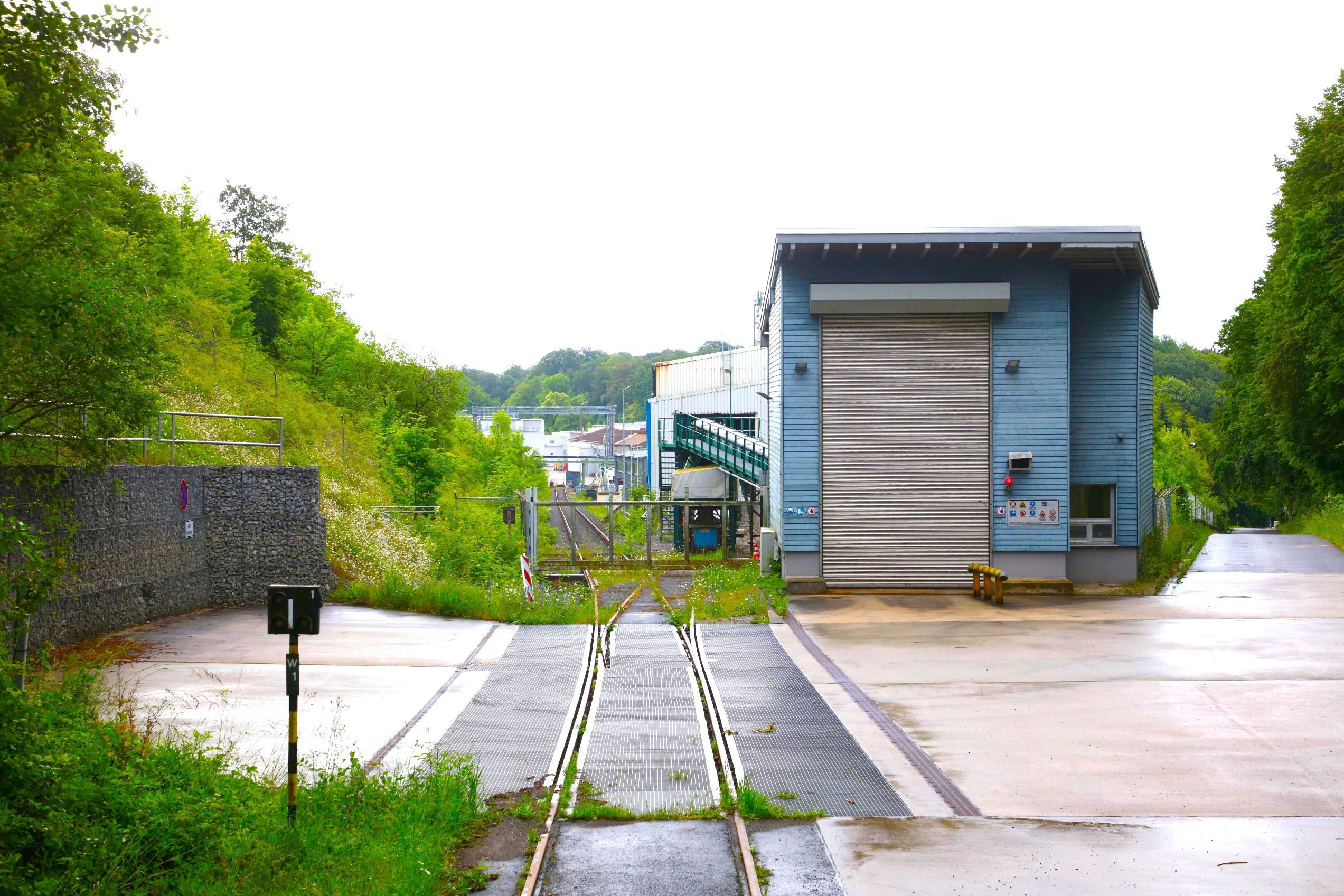
Our destination: Schachtanlage Asse nuclear waste repository; we reached the road before the gate (further than the IBSE tour went!).
[© Iain Scotchman 2026]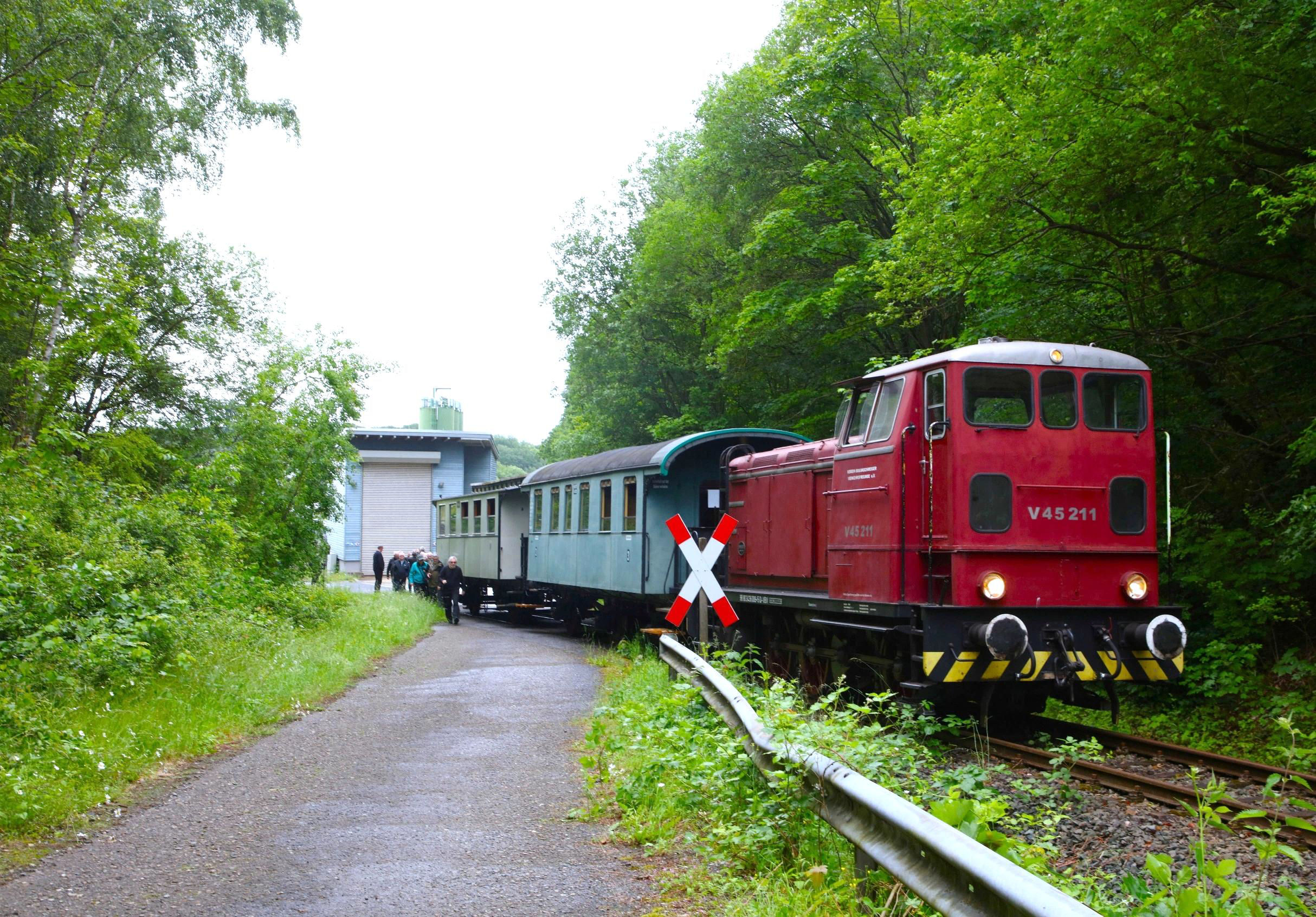
The view from the other direction of our train at the Schachtanlage Asse nuclear waste repository.
[© Iain Scotchman 2026]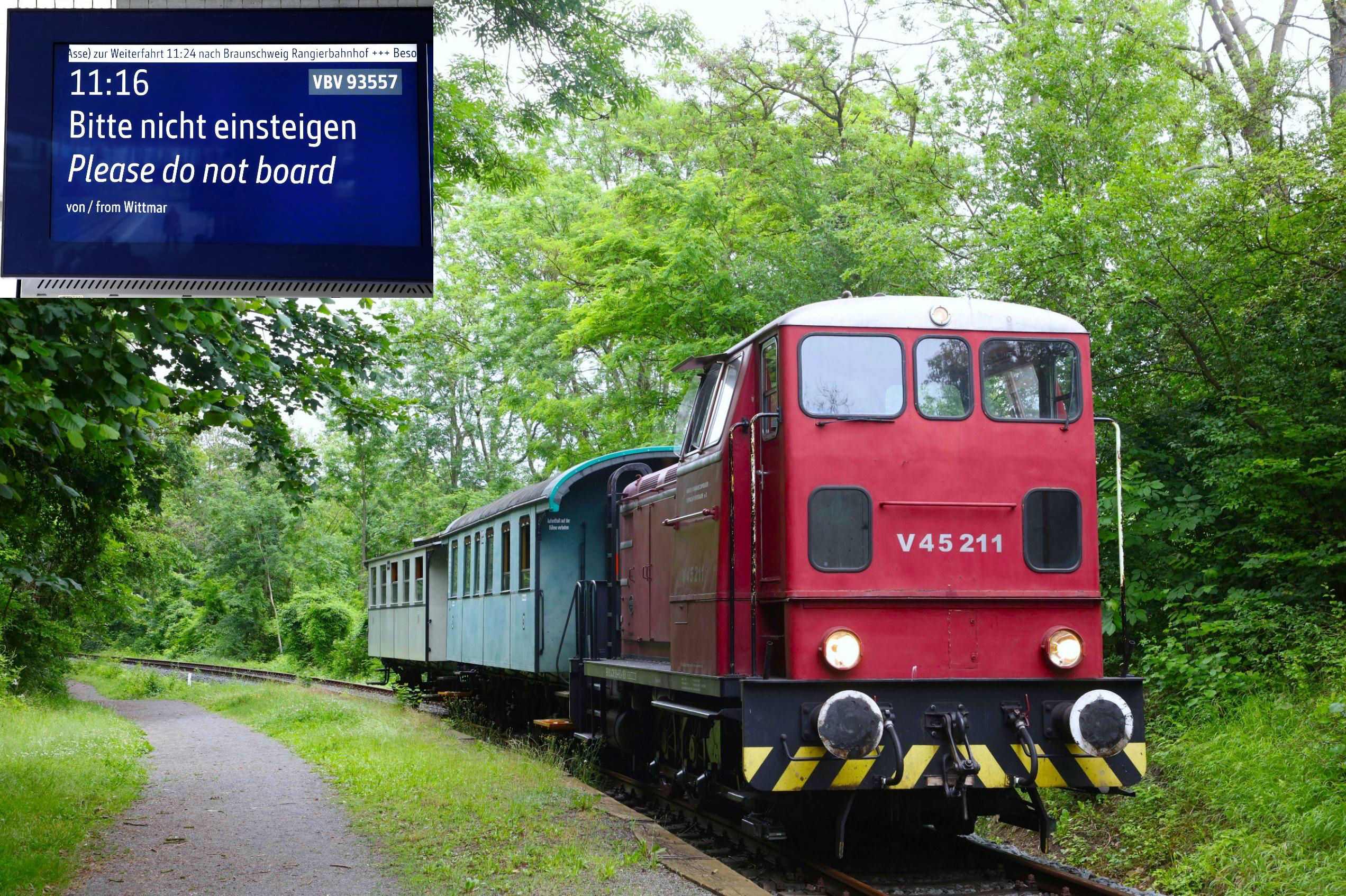
A photo stop at the platform in the forest, on the return. Inset - Arrival back at Braunschweig Hbf.
[© Iain Scotchman 2026]It is always a relief to see the coach you ordered over the internet actually present and waiting at the bus station, doors open, ready for passengers to board. I made sure that people at the station were aware of this and, with all 35 passengers seemingly boarded, the driver wanted to know if he could go. Not yet! We had one more person arriving by train, Professor Urs Kramer, who had been so invaluable in setting up the later tram tour, was hurrying towards the stand within a couple of minutes.
On this action packed day, I had allowed an hour for the journey to Westerbeck, about 35km north of Braunschweig in one of many areas of Germany known as the Großes Moor (Great Moor). A Moorbahn (= Moor Railway) sign directed us to the little station on the Peat Railway. Our train of four open sided carriages was waiting along with my contact Heinz Dettmer. Heinz is one of those wonderful people who reply almost immediately to emails, so organising this trip had been very easy. I introduced myself and he complimented me on my German! All our communications had been in German, with Google Translate doing the hard work! It turned out that he spoke excellent English!!
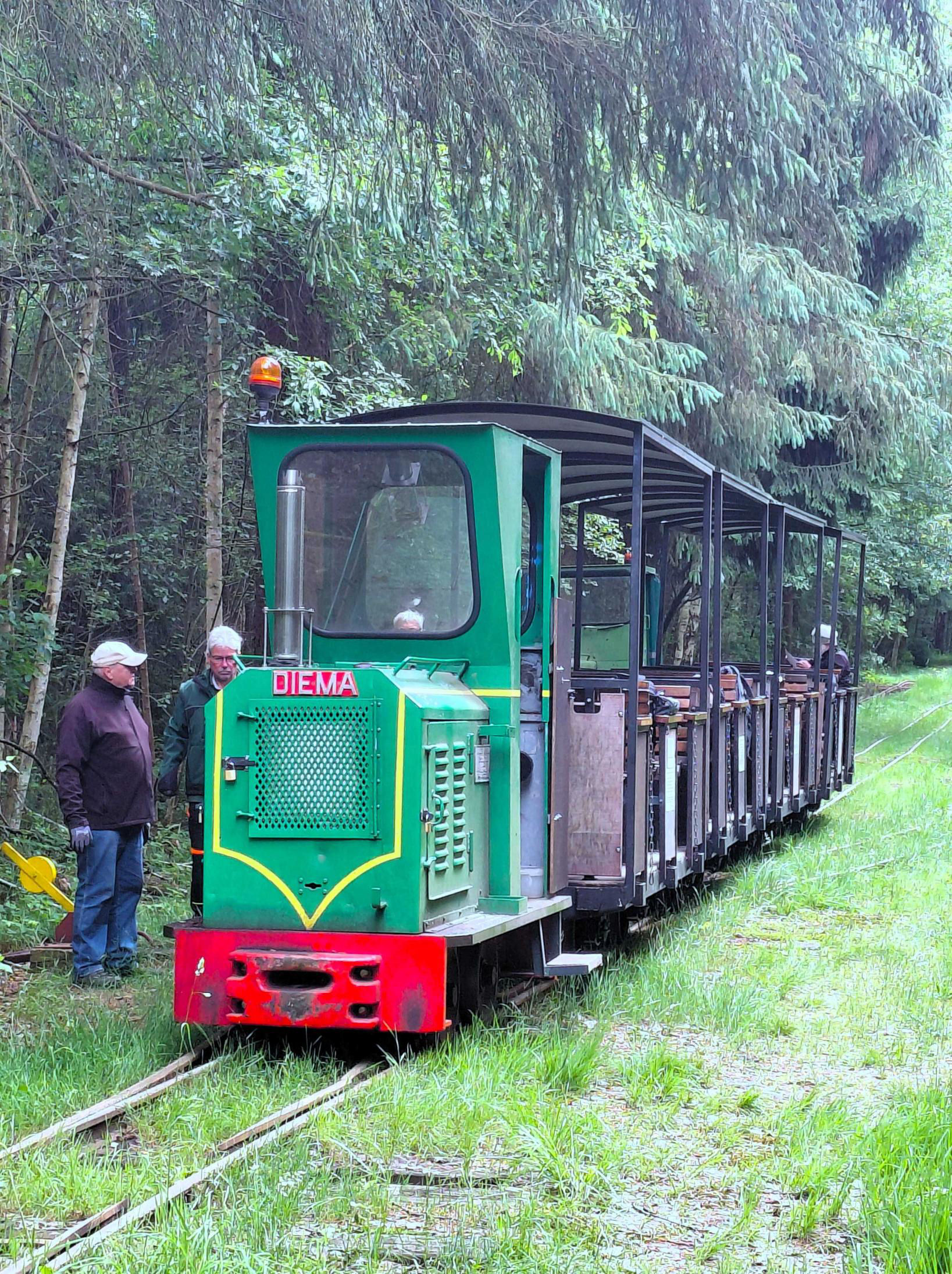
The Great Moor Excursion; Heinz with the empty stock (the loco is not No57).
[© Paul Griffin 2026]The peat works, now part of Euflor Humuswerk ('Humus Plant') GmbH, has been in operation since 1992 and originated from the previously independent Laffert peat works, the Mathildenhof peat works and part of Heinrich Wulfes' peat works. After the Euflor Group had taken over the peat works, they had the 600mm gauge peat railway network completely overhauled and partially rerouted. Standard gauge sleepers were used in this realignment and the 'main line' was extended north almost to Mathildenhof.
Alas, the great days have passed with closure of the remaining sections of the working railway coming in September this year. The southern area, where the station is, was worked out years ago and has been restored as a nature reserve. To promote it, an association of volunteers, Natur- und KulturErlebnispfad Großes Moor Gifhorn e.V. (= Großes Moor Gifhorn Nature and Cultural Heritage Trail, a voluntary group), with local and regional funding, turned a loop of the former railway into a tourist railway focusing on educating visitors about renaturing and wildlife. We set off to do this first, about 350m to the marshalling yard (= Rangierbahnhof); we took it VERY slowly. Worryingly slowly in fact - for Pete's sake. Little narrow-gauge wagons with freshly cut peat were present. We paused for a photo stop. Our little diesel was 'Diema (Diepholzer Maschinenfabrik* Fritz Schöttler GmbH) loco 1843, a type DS14, built in 1955 for the Herforder Dampfziegelei (= brickworks in Herford). [*Maschinenfabrik = machine factory.]
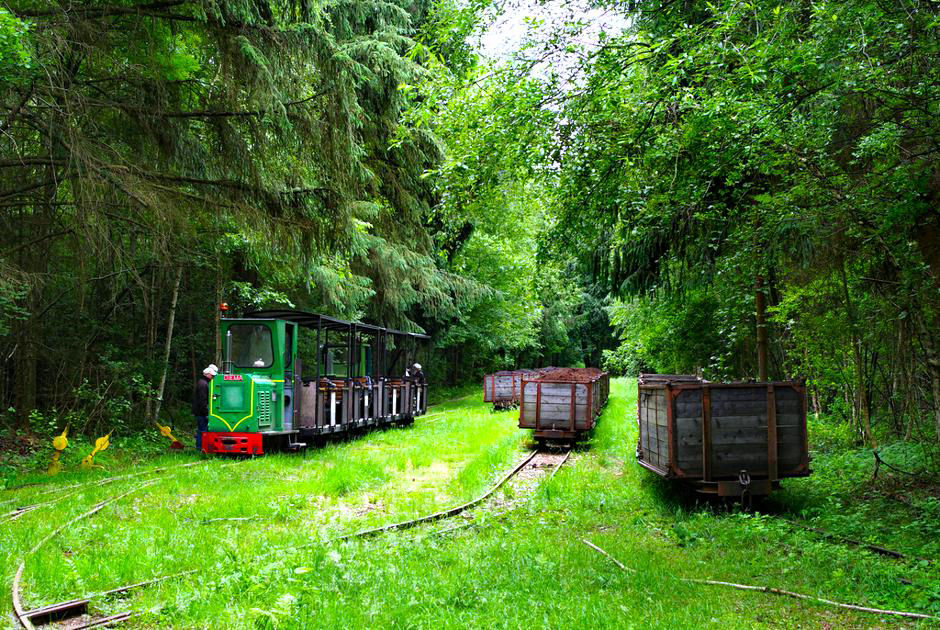
Loaded peat wagons at the Rangierbahnhof (= Marshalling Yard) where our special train paused for a photo stop.
[© Paul Griffin 2026]From here, the working railway diverges right on tracks not used by passenger trains, while the tourist railway goes left, somewhat faster now, through a very green and open landscape with no evidence of human habitation anywhere. Soon we stopped at a viewing platform for photos and to admire the areas of reed-fringed open water left from the old peat workings. When we set off again there were soon shouts from the front of the train to grab our attention. Two Common Cranes were walking ahead of the train, which obligingly slowed down until they made off into the undergrowth.
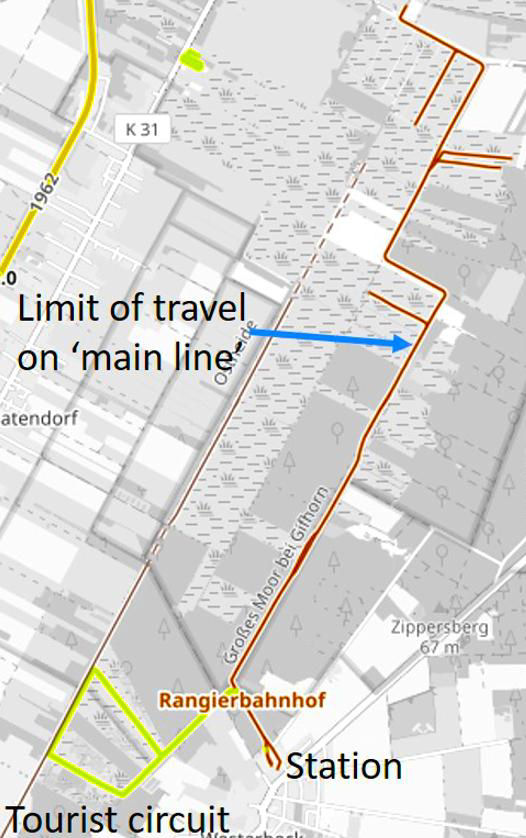
The track layout for the Großes Moor (Great Moor) Peat Railway.It was a rough ride with the poor track condition I associated with peat railways [but a soft landing if anything happens...], so it was a relief when we stopped again, this time at the platform serving a viewing tower, which most people ascended to gain fine views of the landscape and, more importantly, our train. I had to hurry things along here as we were on a schedule and too much delay was unwelcome. Interpretation boards, all in German, are provided here for educational purposes.
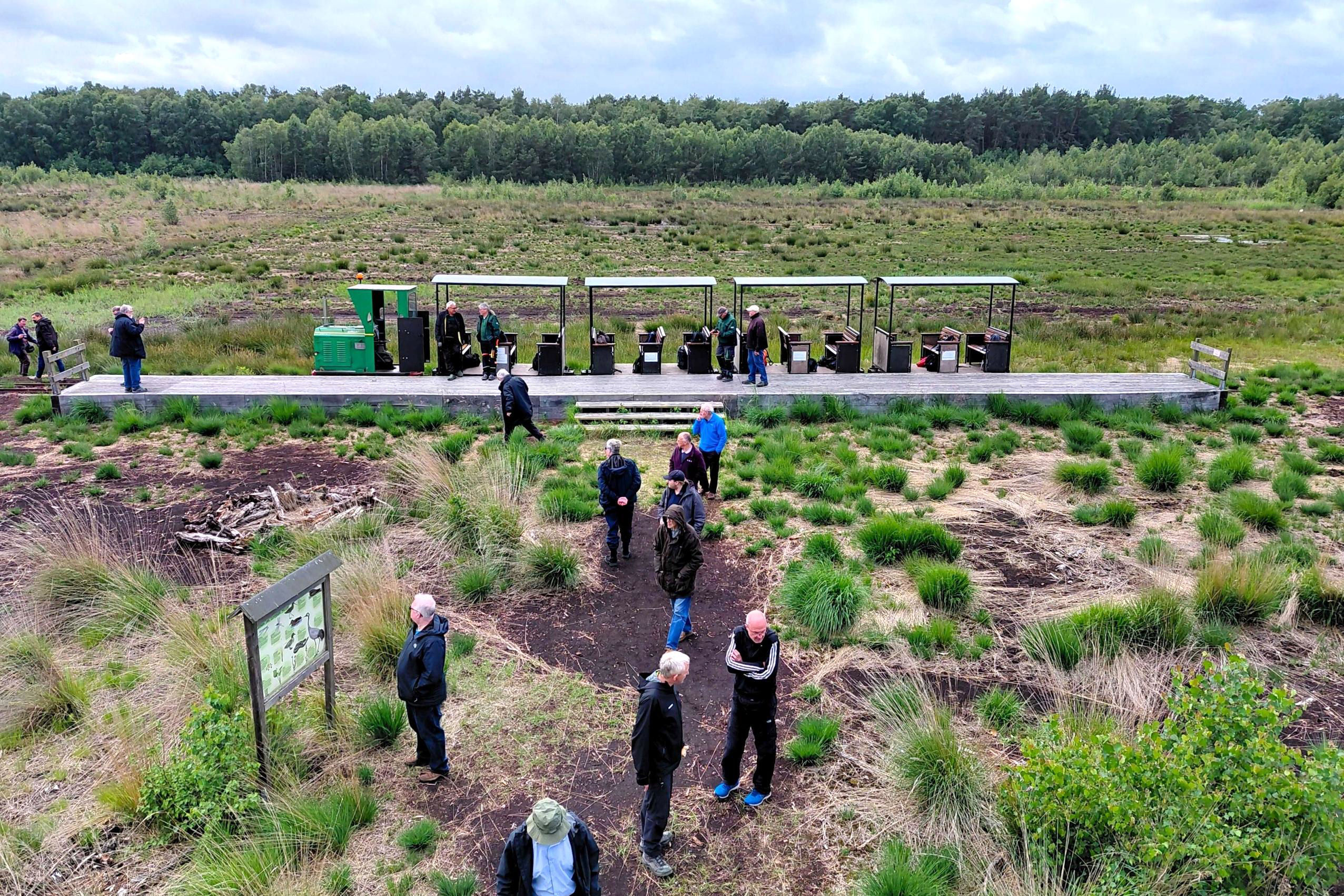
From the viewing tower over the former peat workings, at the station on the Tourist Circuit. The interpretation boards are in German.
[© Paul Griffin 2026]Before long, we rejoined our outward route (map bottom left) back again to the Rangierbahnhof where another little diesel was waiting and, after some messing around, 'top & tail' was set up. Before we could depart, a working peat train with several loaded wagons had to come off the single line. Another photo opportunity and we were informed that this was one of the last peat carrying trains that would run on the system.
Now for the main event! The 'main line' extends north for about 5km and I had been asking Heinz if this could be included. It took some time but finally he confirmed that we could travel on it for several kilometres. A little discreet promotion led to several German enthusiasts booking for the excursion at short notice. So, off we went. The track was lined by trees which had not been cut back, so branches encroached over the line, which was almost buried in grass in places. It was like going down a forested tunnel and many participants put their hoods up to avoid injury. Finally, we emerged into a more open area and stopped. We had travelled almost 2.6km but the land ahead was a nature reserve which Heinz was unwilling to enter as he risked a large fine if he took his train further and was caught.
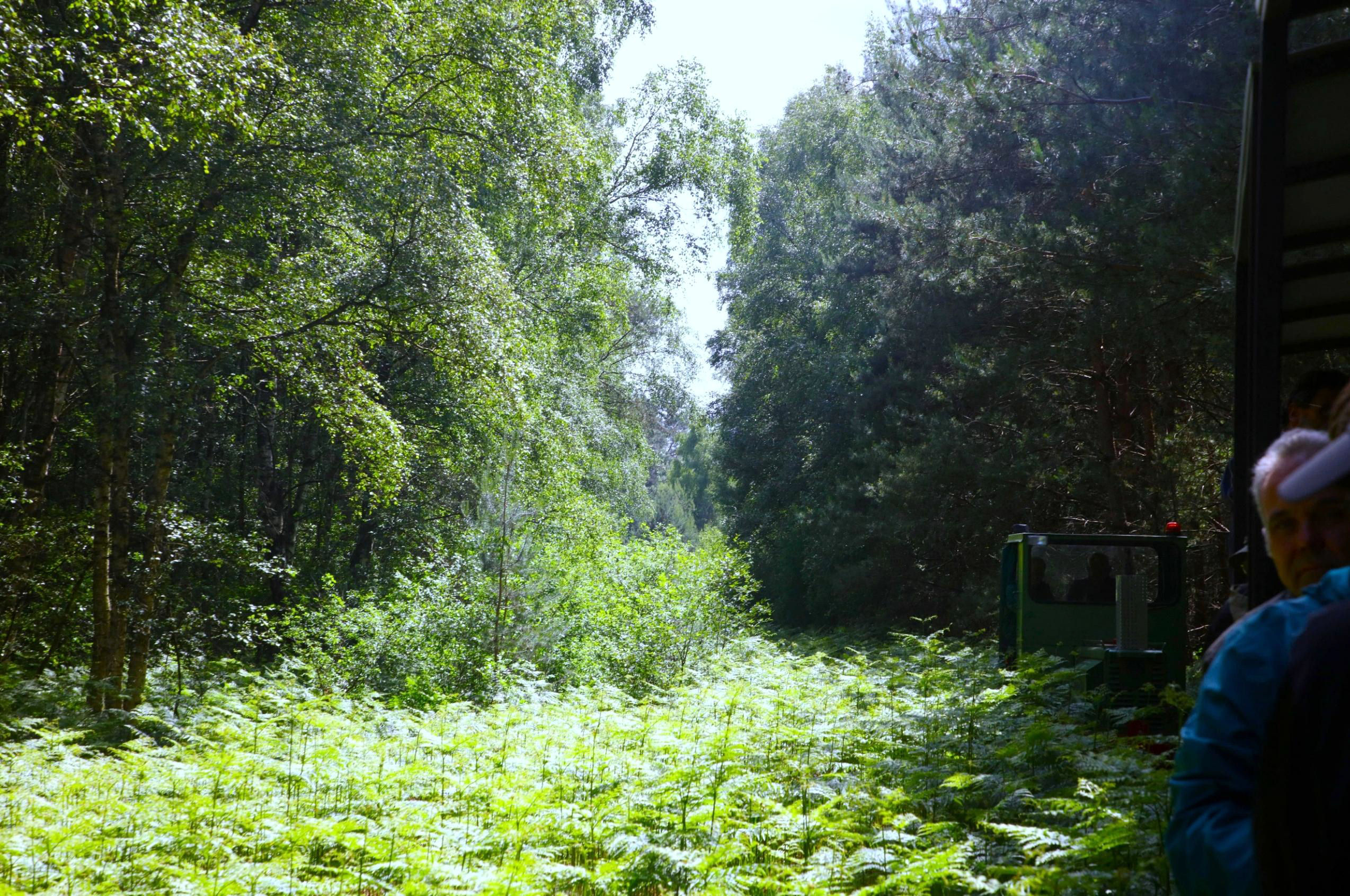
Taken from our train on the journey.
[© Iain Scotchman 2026]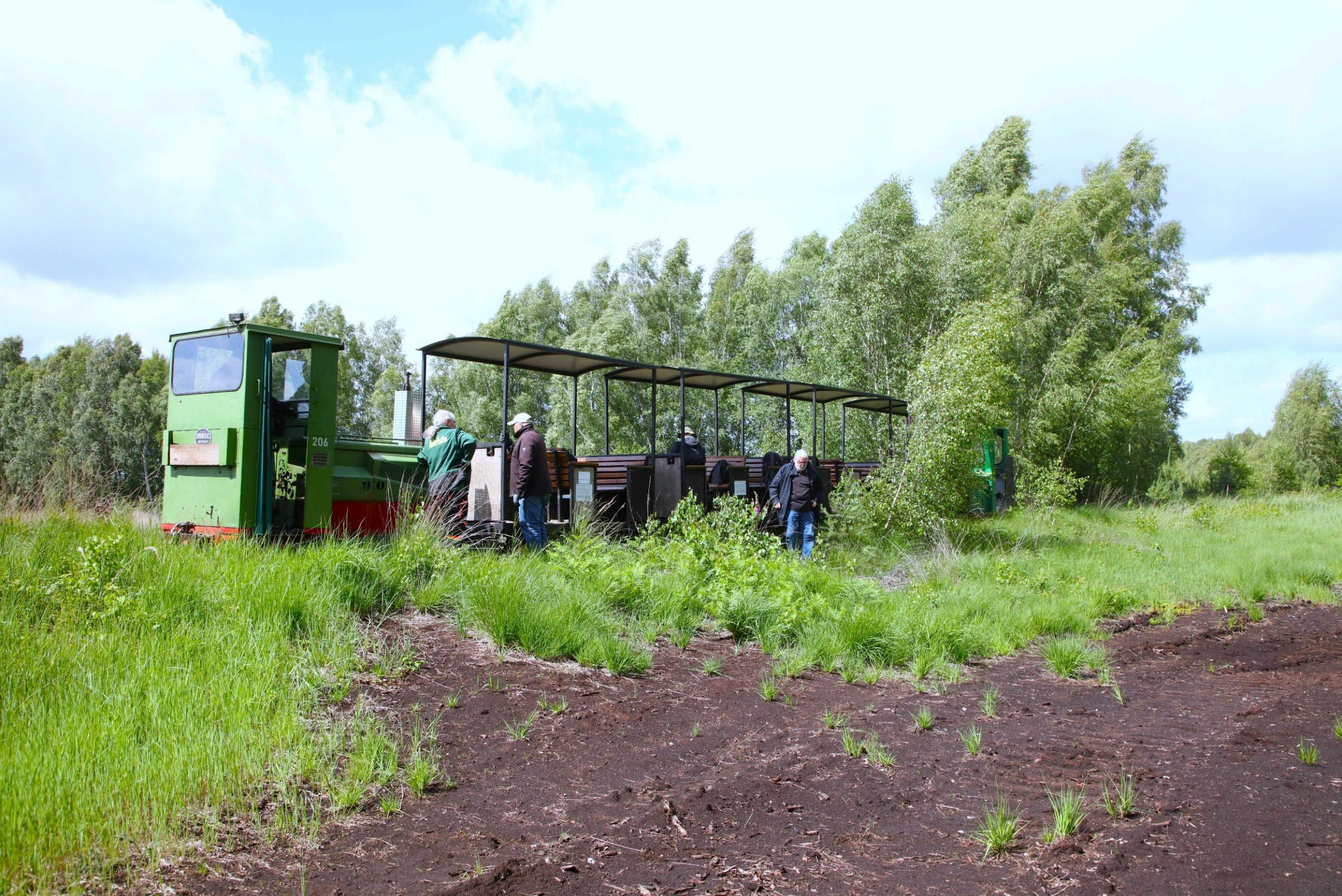
The tour at its limit on the rare non-passenger section which was soon to close, now in 'top & tail' mode.
[© Iain Scotchman 2026]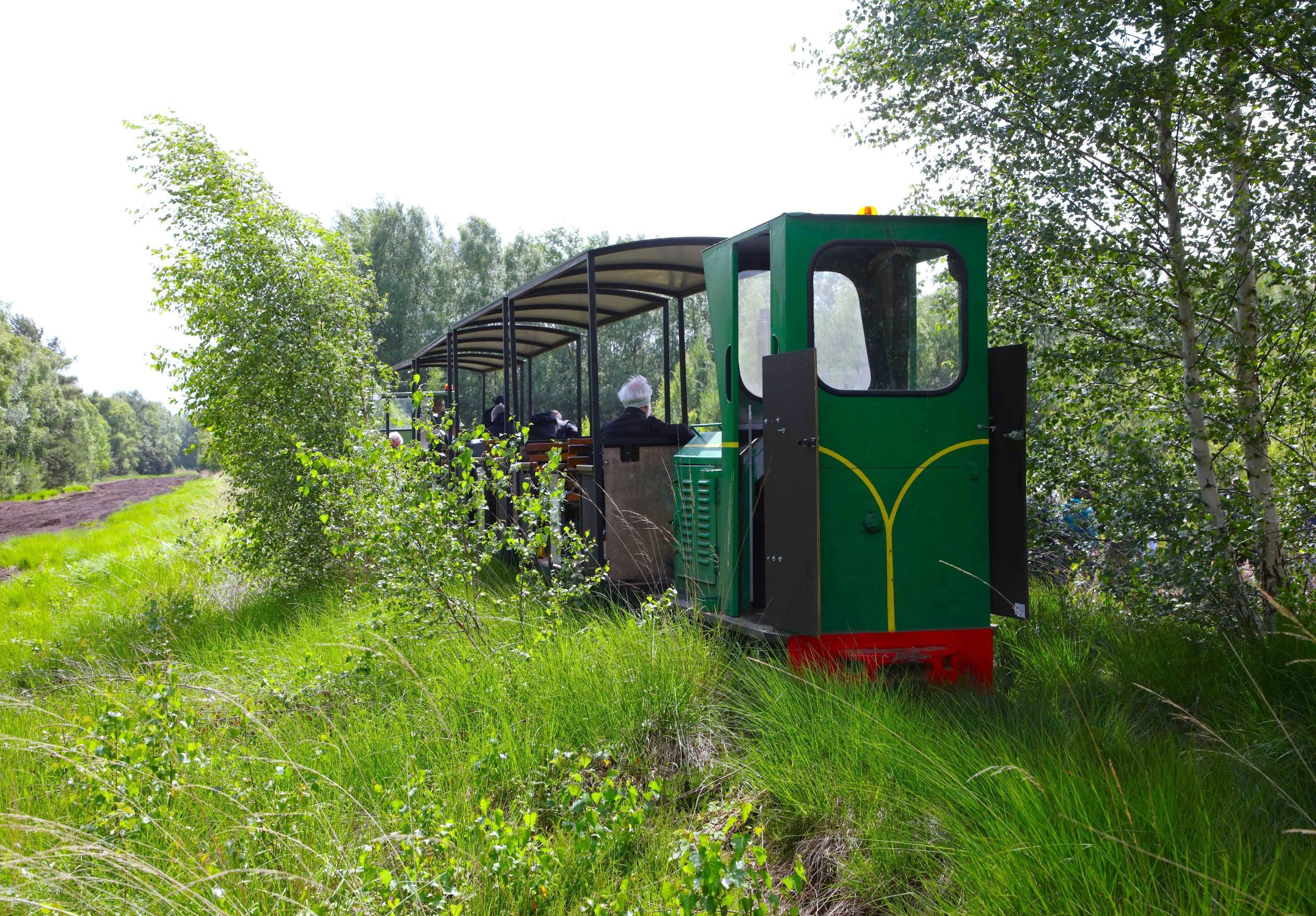
A view in the other direction of the tour at its limit on the rare non-passenger section.
[© Iain Scotchman 2026]This was a final photo opportunity, then we set off back to the station. I strongly suspect that we would be the final passenger train to travel the 'main line' before closure. A little bit of railway history. Back at the station, I had to pay the bill for the 35 passengers. Cash, with a receipt, which went straight into the hands of the Society Treasurer who was on the tour. Very efficient. I didn't manage to escape having my photo taken (with orange BLS stewards' hi-viz) for their magazine, so I'm now famous in Westerbeck. Toilet stop complete, it was on the coach back to Braunschweig Hbf for the next excursion of the day...