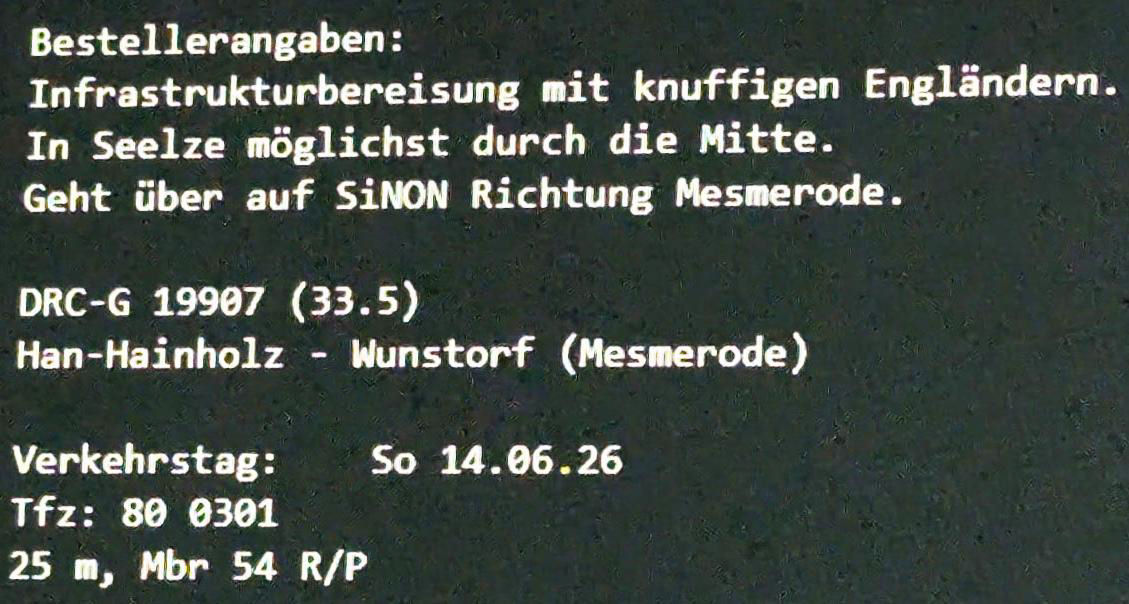
Infrastrukturbereisung mit knuffigen Engländern translates as 'Infrastructure tour with adorable English people!' In the days before the tour, a German BLS member who is a signaller for DB, found our train on DB's internal system and was delighted by the description. 'Knuffig' also translates as cute or cuddly, neither term ever having been applied to the organiser.To an outsider, this full day tour seemed to have presented the most problems in the run up with both the Hannover Nordhafen (Nordhafen = north harbour) and Linden Harbour lines ending up as unavailable due to engineering works and authorisation issues, respectively. Nevertheless, some very attractive tour content remained with the Mesmerode branch added.
40 participants gathered on a cool morning at Braunschweig Hbf (Hbf = main station) on the now familiar P4a, where 12oC felt more like 6oC awaiting the arrival of the Esslingen railcar from the Lokpark (= Locomotive Park). The increased comfort of the railcar's seats over the wooden ones in the coaches used on the previous day was immediately apparent. However, the toilet had not been tanked and jerry cans were provided! Of note, our conductor Daniel was dressed in historic railway uniform. The driver's enthusiasm for giving us many ad hoc opportunities for new track by contacting control / signallers during the day was quickly evident. Paul and Peter floated some possibilities to him as we set off for the Hannover area at 08.28; it was agreed that requests would be made with no promises as to the results.
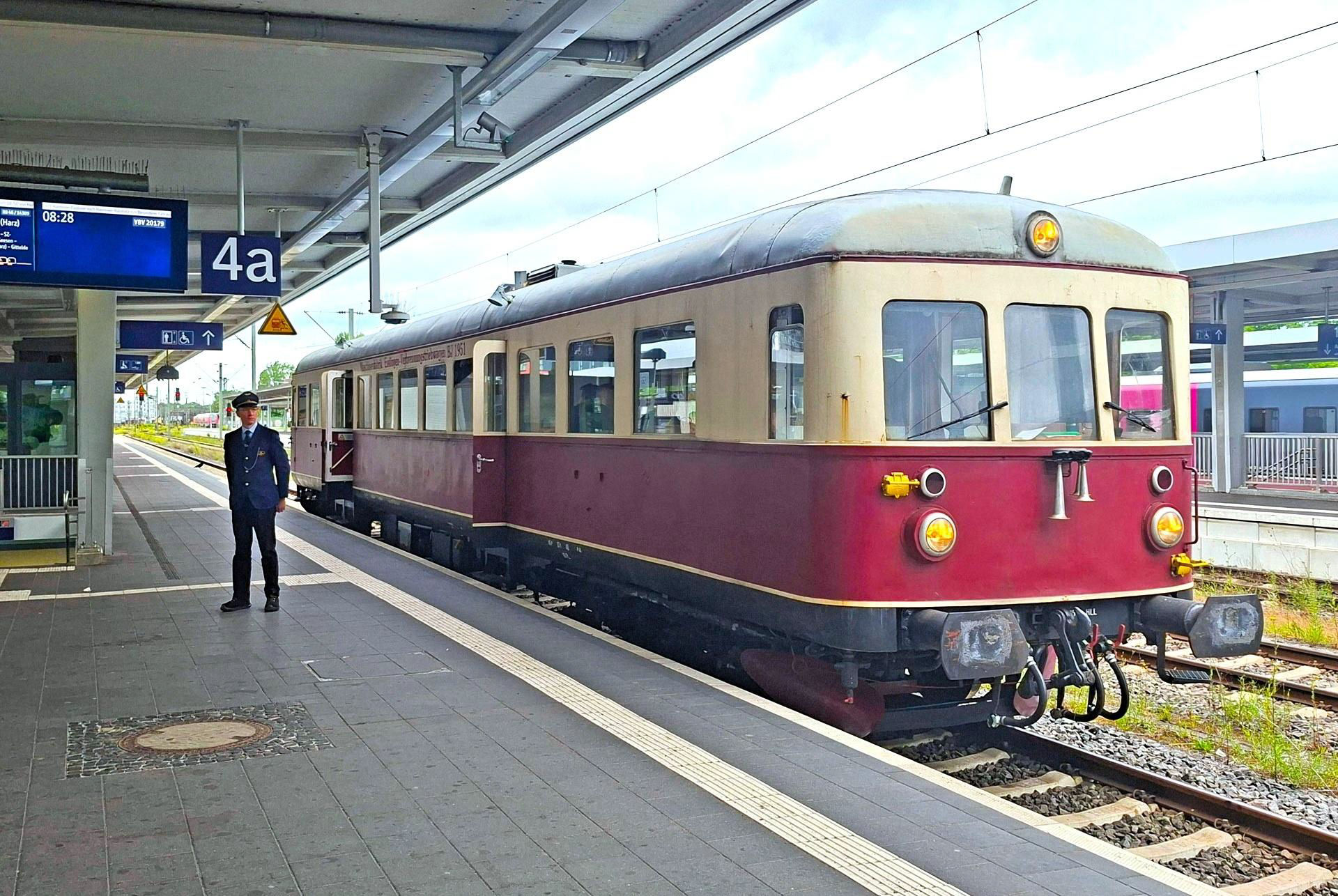
At Braunschweig Hbf our conductor, Daniel, in historic railway uniform, awaits the signal for departure of the railtour.
[© Hans-Peter Gladtfeld 2026]Diverging right from the main line at Ramhorst against the backdrop of a lovely poppy field, we passed through Lehrte station, joining the Güterumgehungsbahn Hannover (Hannover freight bypass railway) past the MegaHub* and on through Misburg before crossing over the Hannover line to join the southern ring line. Soon after, we passed over the Hannover to Göttingen mainline, past Waldheim, then through Hannover Linden / Fischerhof station, which your writer first remembers from staying at a nearby Youth Hostel during a 1987 Interrail. [*Lehrte MegaHub is a €171M advanced, fast automated transhipment facility for combined road rail freight transport. Opened fully in 2021, it uses an innovative sorting system and high performance gantry cranes to efficiently transfer containers between trains and trucks.]
Having left the ring line at its southwest point, we reversed in the centre road at Ronnenberg before returning to the 'much sought after' [©Kev Adlam] Empelde Curve (Line 1752) to rejoin the ring heading north. Cheers turned to muted boos as we passed the junction for the denied Hannover Linden Harbour branch. The volume of freight trains operating was striking as we took the south to east Hannover Curve from Abzweigstelle (= a junction on an open line outside station limits) Ahlem to access Hannover Hainholz Line 803, eventually reversing at Signal Z803.
Heading towards Seelze Marshalling Yard, the Christmas Lights adorning part of the larger passenger accommodation area of the railcar started to cycle in flashes and did so for the rest of the day reflecting the Hannover Christmas weather being experienced in June! We initially took Line 816 in the Yard before pausing to let a freight train be shunted ahead by DB loco 296-023. It included liquid chalk (china clay?) wagons. Once underway again, we passed a selection of locomotives old and new before taking Line 390 in the west end, noting a variety of bicycles used to travel round the yard. No e-bikes here yet.
Parallelling the Mittellandkanal (Midland Canal) to the south, we reached Wunstorf P2 via the Minden Goods Line early at 10.29. Our tour paused for a short leg stretch [those with long legs need not apply], while a succession of passenger and freight trains passed on the Bremen and Minden routes. Two of each former DB Class 120 and 181 locos were stabled east of the station awaiting their next private hire.
The SinON (Schieneninfrastruktur Ost-Niedersachsen GmbH = Rail Infrastructure in Eastern Lower Saxony Ltd!) operated is quite attractive, with some housing on the south side and open countryside to the north. Roadside fruit selling from large strawberry shaped red kiosks seemed to be popular! In true BLS fashion, our driver took the railcar right to the end of line buffer stop for a photo stop and another by the junction for the Sigmundshall former potash mine.
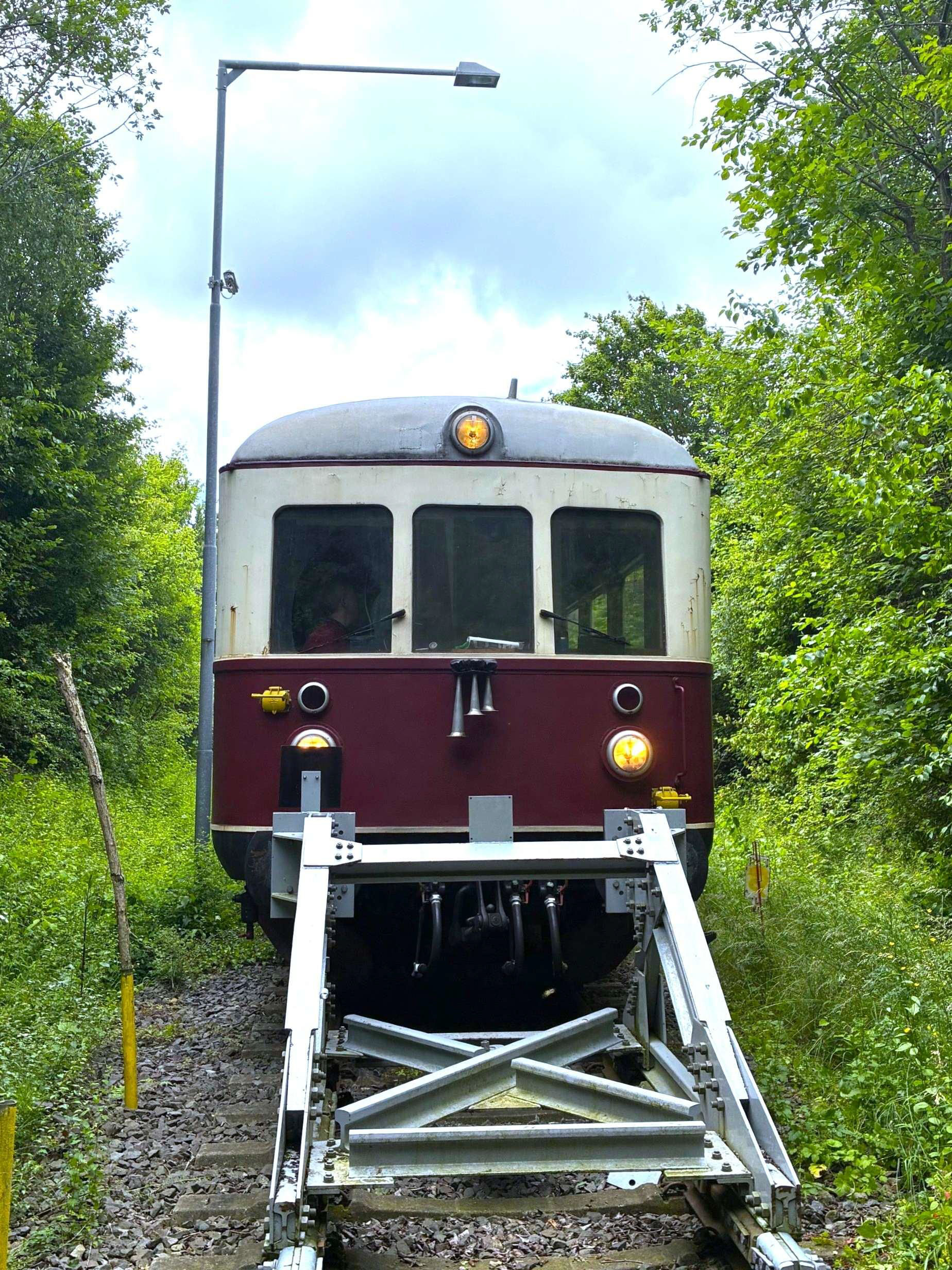
At the very end of the 6.6km long Mesmerode branch (Line 9178), reached in true BLS fashion.
[© Hans-Peter Gladtfeld 2026]By now, it was apparent that we couldn't go down that short branch as an on the day extra, the gates remaining firmly locked. The potash mining that has been carried out here since the turn of the century is reflected in the town's coat of arms symbols 'mallet and iron'. Activity ended in 2018; the underground cavities are filled with brine and the largest, most modern indoor shrimp farm in Europe is planned.
Pausing briefly at Bokeloh (beech forest) village station for more photos, at 11.51 we returned to DB infrastructure 44 mins early, with the train bar doing a good trade. Our driver confidently predicted 'everything works at Seelze Yard'. After pausing before it for a ballast and METRANS container train, we unfortunately took a very similar route (Line 176, the 151-152 crossover, back left onto 244/245 to 247 then Line 816 used earlier), through the Yard instead of the hoped for more southerly trundle there.
Heading back round the southern ring, our railcar joined the Göttingen main line using the Waldhausen to Wülfel west to south curve and made good progress before diverging left at Barnten towards Hildesheim, taking the non-electrified line towards Salzgitter. We were held at Groß (= Gross / large) Düngen for 20 mins as regional trains passed in both directions. We crossed over to the Braunschweig (also known as Brunswick) route at Salzgitter-Ringelheim, before taking the next track highlight at Salzgitter-Bad by joining the 16km Börßum (or Boerssum) branch (Line 1940). It was reassuring to see a member of the preservation group, Tourismus & Warnetalbahn GmbH, (Warne Valley Railway Tourism Ltd) that now operates the line at the first level crossing, so they knew that we were coming!
Our tour arrived at Klein Mahner station and preservation base for a 45-minute break, sampling drinks and very tasty freshly grilled bratwurst from the beer hut as well as touring the shed where 2-8-2 steam locomotive 41096 is on long term overhaul. Bratwurst is a traditional German fresh link sausage made from pork, veal or beef, seasoned with spices like marjoram, nutmeg and caraway; it is meant for panfrying or grilling. Most importantly the railcar toilet was finally tanked!
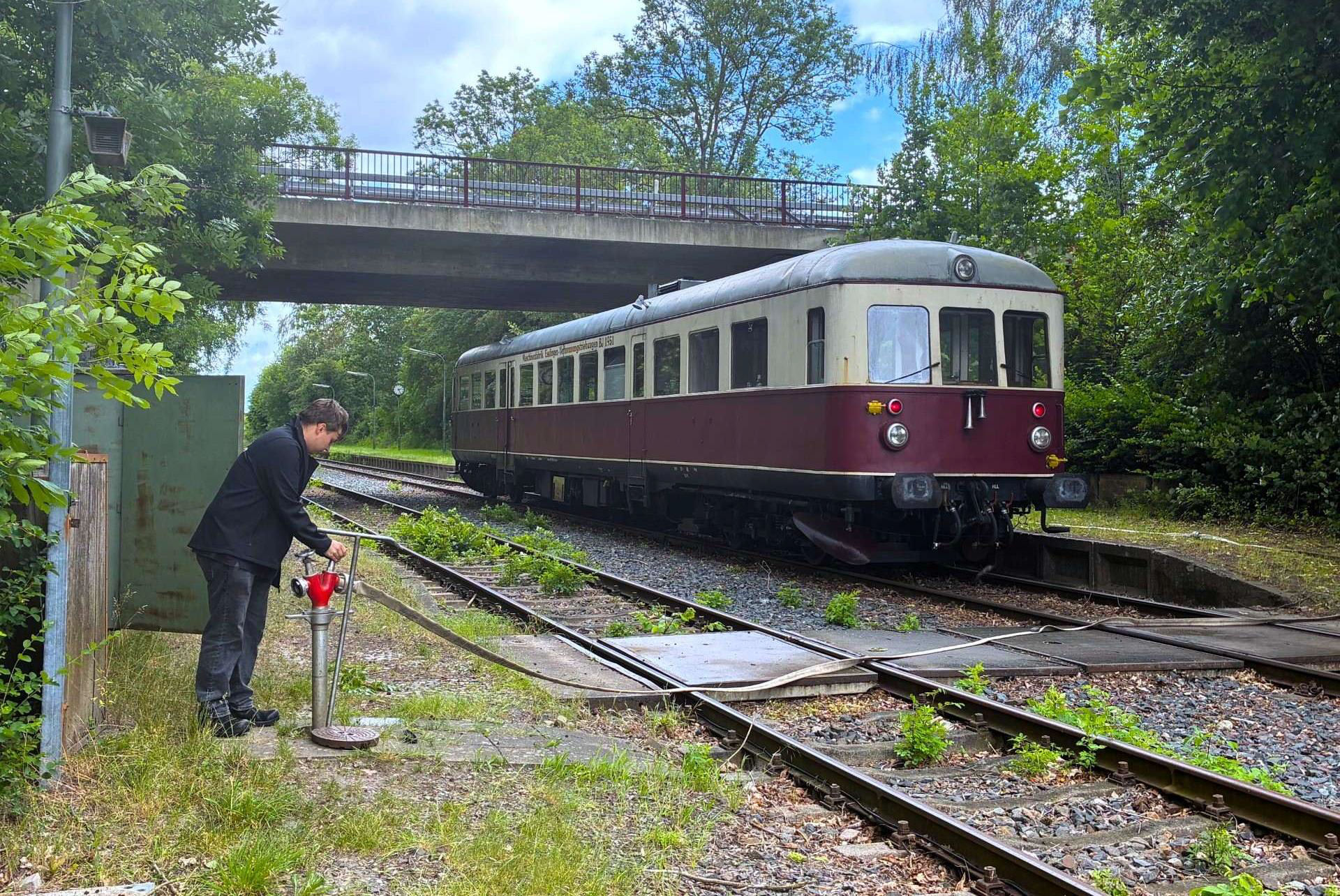
Klein Mahner station and preservation base with water for the train toilets at last!
[© Hans-Peter Gladtfeld 2026]In contrast to the west end of the line, beyond Klein Mahner was remarkably overgrown in places, tree lined in the most part with a real long grass meadow on the track at Gielde! The line had apparently been cleared in February but there had been plenty of growth since. The driver was happy to continue through the lush vegetation and even offered some photo stops but these were mostly declined as you couldn't see beneath the wet grass on the track and embankments. The rails however seemed in good condition without many joints which gave some confidence. The many crossings on the line reminded everyone that the horn at one end of the railcar sounded like a strangled bird. We paused at the bridge over the River Oker for a photo stop at 15.21, then continued (or was it ploughed on?) much to the relief of those who had on previous tours turned back there. Rounding the corner into Börßum station, we edged forward into the jungle of tall brambles beyond the platform end, the driver finally giving up at 15.38 after an air leak developed as vegetation brushed against the underside of the railcar.
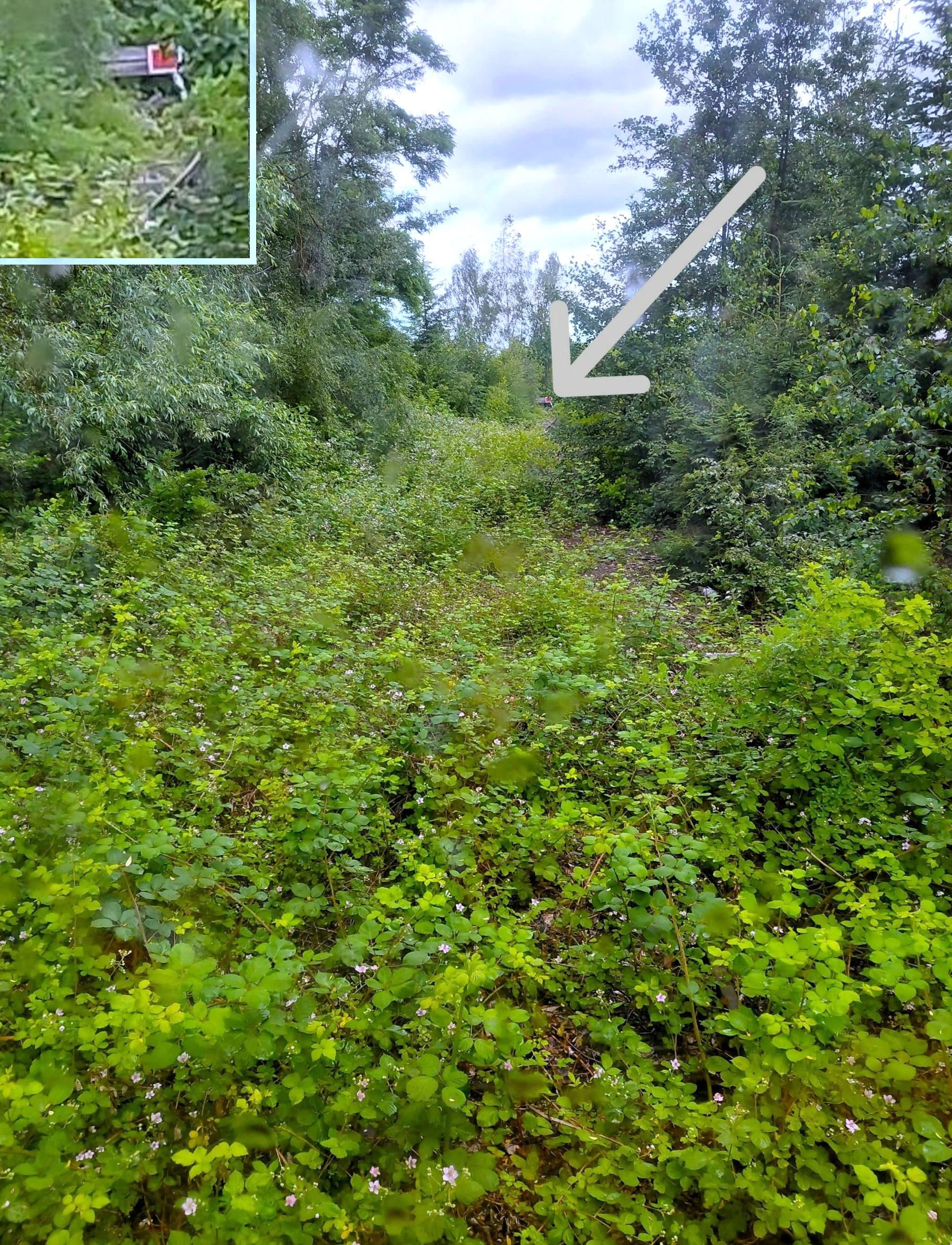
The stop board beyond Börßum; behind it was the connection (removed) to DB. The arrow and inset are for those who should have gone to Specsavers. Taken through wet glass.
[© Paul Griffin 2026]Cue spontaneous applause from the tour participants for going well beyond what was expected! The next challenge was getting back out of the undergrowth with wet grass compacted on the rails causing slippery conditions. We gingerly set back into the platform (no connection to DB) at Börßum; the strikingly large former station building reflecting its history as the centre piece of a five line junction.
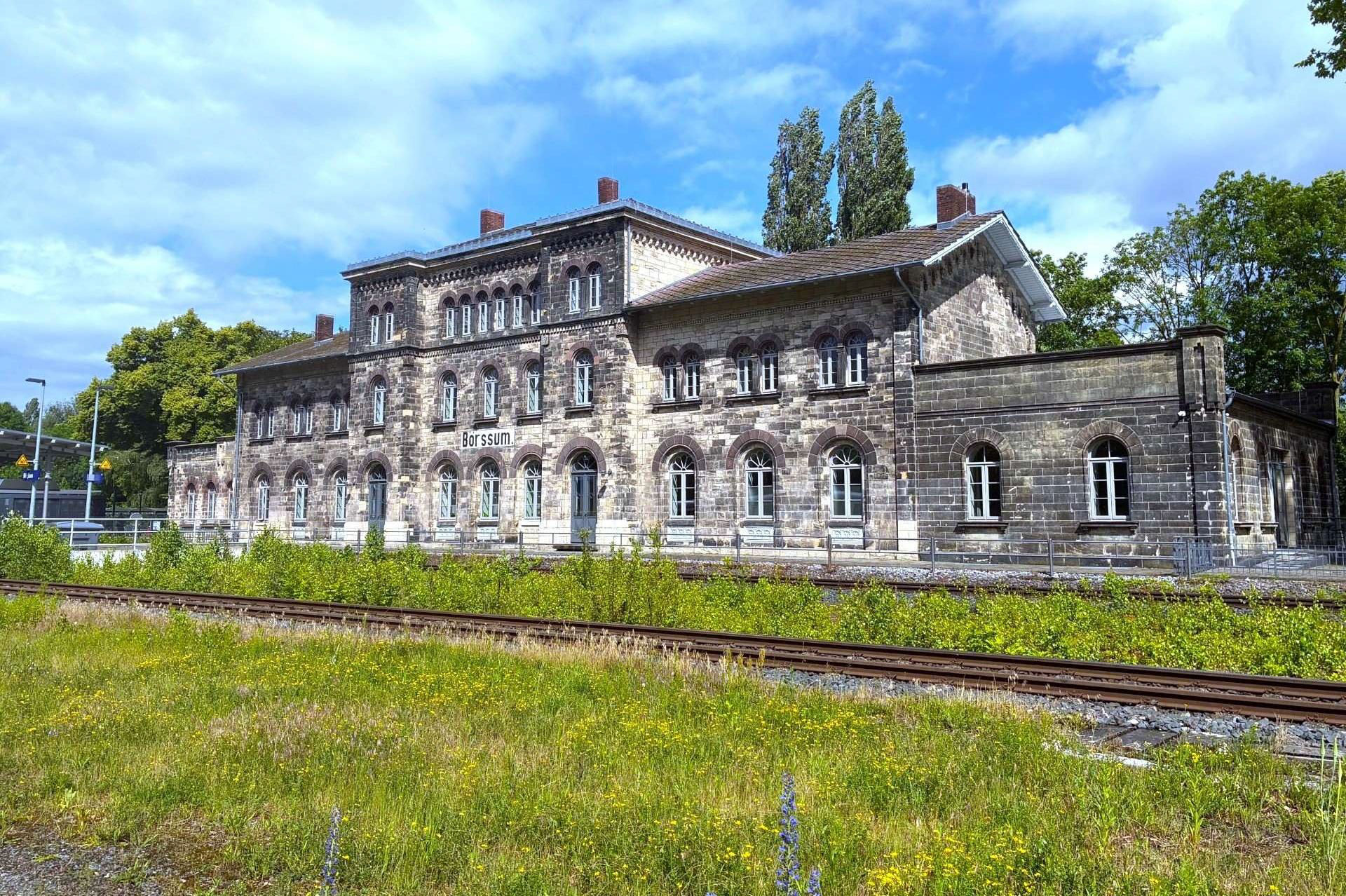
The magnificent Börßum station building.
[© Hans-Peter Gladtfeld 2026]There was time to photo this and the tour train before departing back towards Salzgitter-Bad at 15.57 as another rain squall set in. The once important line was singled in 1968 but still had eight train pairs when closed to DB passenger at the end of 1975. Our outstanding driver was relieved by Markus Steinbach, who had been a key contact in running the tour; he drove the train back to Braunschweig Lokpark. After reversing at Salzgitter-Bad, we entered what Markus described as the 'high speed' section of the Verkehrsbetreibe Peine-Salzgitter GmbH (VPS) = Peine-Salzgitter Public Transport Co Ltd system. This was 50km per hour instead of the usual 40 on a couple of lengthy straight sections. Two of several N06 Coradia Nordic EMUs (newly constructed by Alstom at Salzgitter for Norway) were in Calbecht Sidings. These would be supplied once 'validated for use'.
Our railcar passed the closed branch to Haverlahwiese (a former massive open pit iron ore mine, now a nature reserve). There, we had to wait at Signal 8007B at Hütte Süd (= South Steelworks) for a long VPS train of internal user wagons 'top & tailed' by locos 608 & 631 to arrive and pass sufficiently through to clear the points at the north end. Hütte Süd signal box controls this end of the VPS system and Peine box the rest. We left 10 minutes late, glimpsing a Blue Tiger loco in sidings to the left before reaching where our Saturday tour reversed (BLN 1498.1672). We forked left onto the VPS line to Peine alongside the DB Salzgitter-Lebenstedt branch with overgrown connection before turning north to Broistedt. After paralleling the Braunschweig to Salzgitter-Lebenstedt line for a short distance from Broistedt, we headed north through wooded areas then farmland, before arriving 20 mins late at Klein Ilsede (18.25).
Continuing north, our railcar passed Peine Hafen (harbour) branch, one for another day, before crossing the Mittellandkanal again to rejoin DB tracks and reach Peine Yard on Track 282 to the DB / VPS boundary but not down to the canal side. Reversing back to under the Stahlwerkbrücke (= Steelworks Bridge), we waited until 19.04 as three trains passed on the adjacent main line, then ran back to Braunschweig Hbf. Most alighted there, pleased with their day and mindful that Germany was playing their first World Cup game, so bars and restaurants could be lively! A handful continued to the Lokpark.
Thanks to our very own Paul Griffin for arranging an interesting and very enjoyable day with some good track highlights and also dealing with the loss of two headline items before the confirmed tour routing and making efforts to add content where possible.