Our walk, on the remains of the Fighting Cocks Line, an original 1825 section of the S&DR, was led by two guides from the Friends of the Stockton & Darlington Railway and began at North Road station, where most arrived on a well-timed Saltburn to Bishop Auckland train.
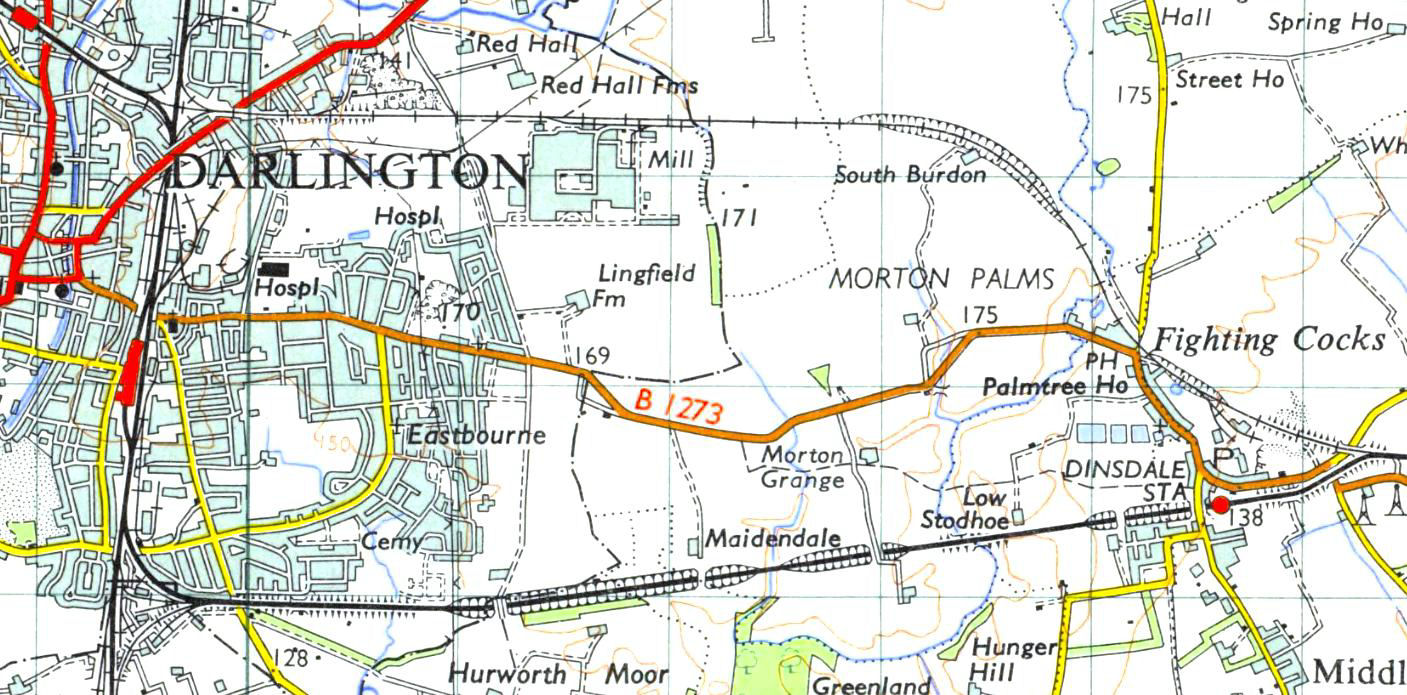
1961 map, North Road station is top left; Fighting Cocks is centre, far right, north of Dinsdale.
[© 1961]After a short 'comfort break' in the splendid Grade II listed Goods Shed at Hopetown Darlington, our 16 members and guides headed off down the steps across High Northgate and into Skerne Bridge Nature Reserve, to view the iconic stone-built Skerne Bridge. The Grade I listed structure is the oldest railway bridge in the world still in continuous operation. After a break for photographs, we continued through the pedestrian tunnel, noting the later abutments which carried a second pair of tracks across the River Skerne, although the metal bridge deck had been removed. Joining Cleveland Street, we headed east through what was an industrial area, with Albert Hill Foundry to the south and Darlington Forge to the north, then past the former terraced streets, now long gone. After passing under the East Coast Main Line (ECML), we turned right into Allan Street, following the ECML south to reach and view the site of the famous location where the S&DR crossed the ECML on the level, now marked by a large metal sign.
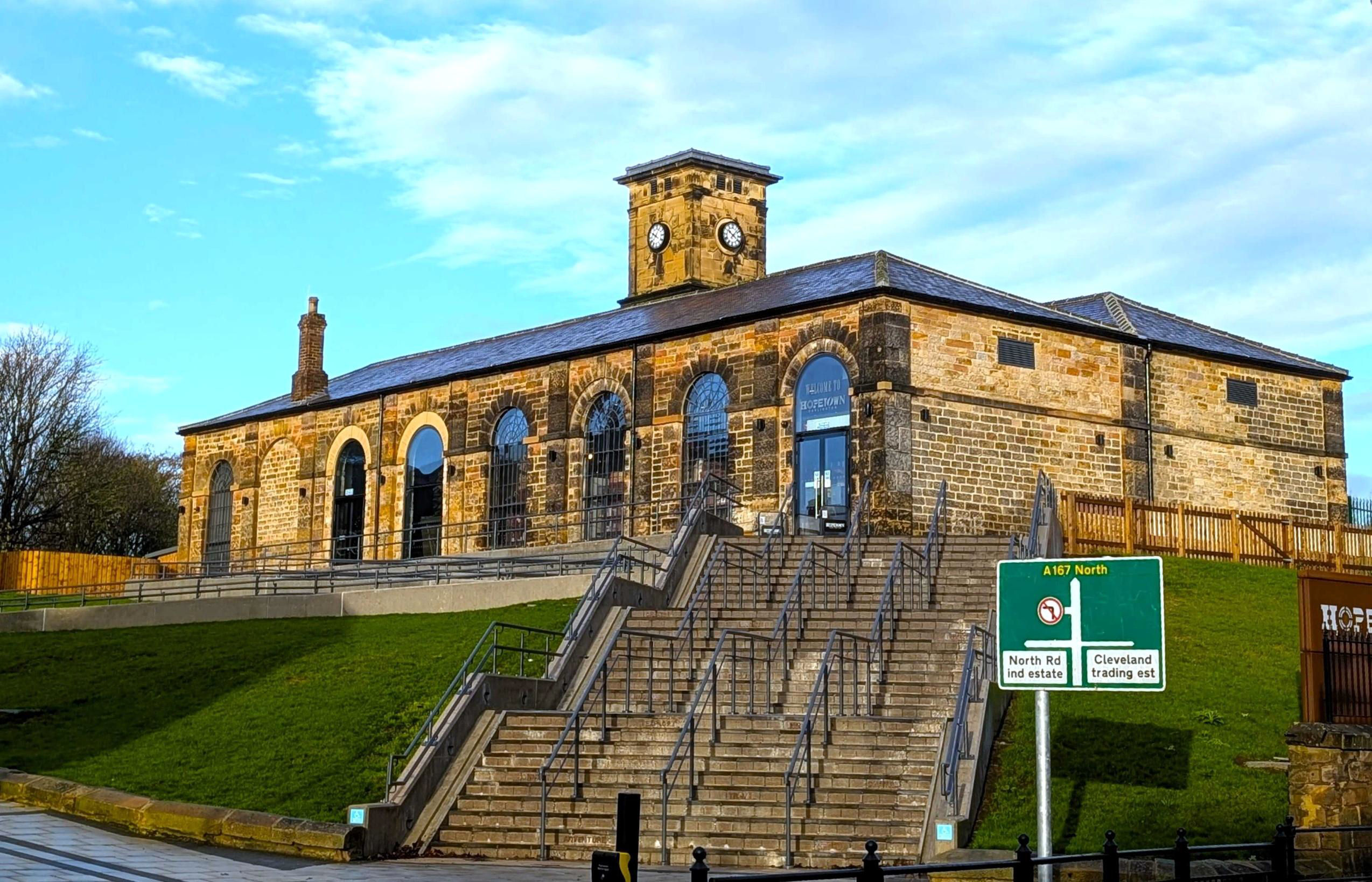
Darlington, the former North Road goods station building which is now part of Hopetown Museum.
[© Catherine Yates 2025]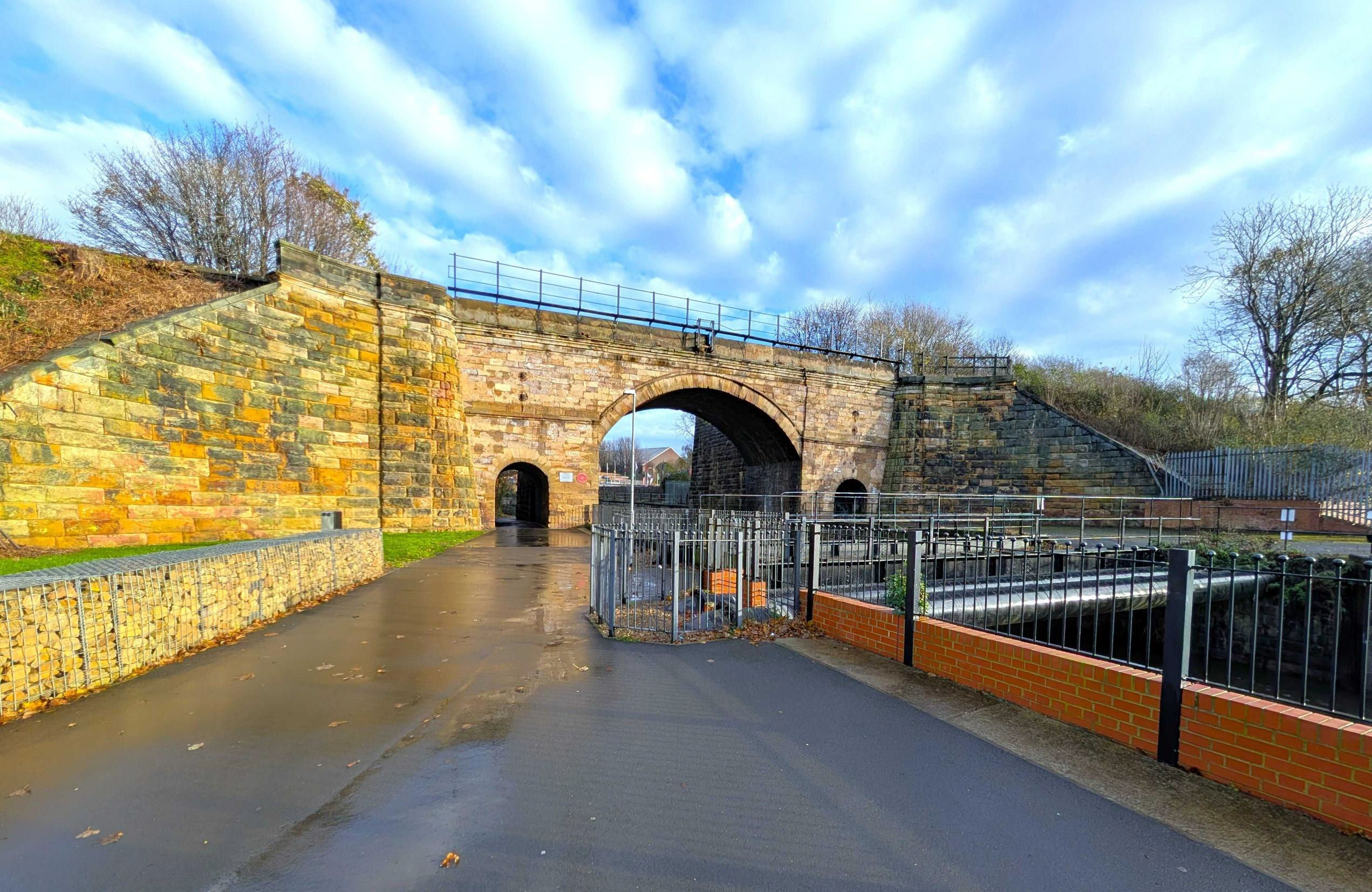
The remaining stone section of Skerne Bridge from the southwest side which still carries the Bishop Auckland branch, the River Skerne is right. Part of the original 1825 S&DR, it is the oldest railway bridge in the world in continuous use, through the arch was the later metal widening (since removed).
[© John Hampson 2025]Just south of the flat crossing, a former goods shed has been tastefully converted into multiple dwellings.
We continued along Engine House Lane, broadly on the formation of the S&DR, to the Haughton Road roundabout, which has four impressions of locomotive nameplates around the central reservation: Locomotion No1 (1825), Derwent (1845), Tornado No60163 (2008) and Prince of Wales No2007 (2023).
After eventually crossing the busy road, we rejoined the S&DR trackbed, now a metalled path, alongside the B6279 Tornado Way. Heading almost due east, both the trackbed and road cross a very wide bridge just beyond the roundabout, where the original S&DR structure had been extended over time to provide space for six tracks. As we continued along the trackbed, with the road parallel and right, a number of railway-related artefacts, installed by the Friends of the S&DR, were noted. Thankfully, at the A66 roundabout, Tornado Way ends. So, after crossing the A66 on a footbridge, the trackbed was rejoined without the constant roar of traffic, as we headed into a shallow wooded cutting on a broad right-hand curve, under the A67 and into the outskirts of Middleton St George. As we approached the former S&DR station at Fighting Cocks, a small section of stone sleepers was seen laid out towards the end of an old siding, indicative of the early permanent way, with evidence of the onetime coal drops opposite.
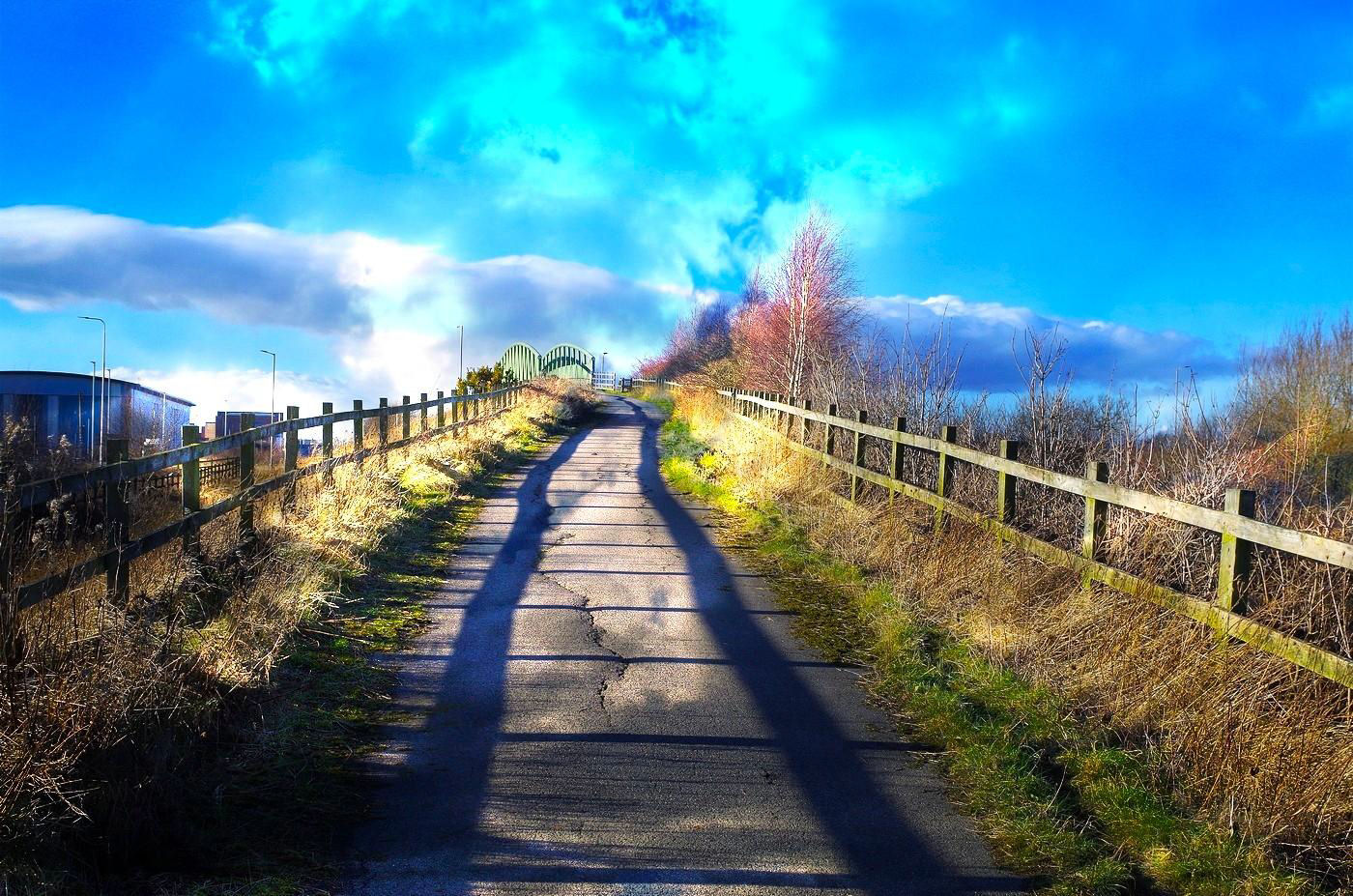
'Visions of the track' by Catherine Yates, where the S&DR Fighting Cocks Loop crosses over the A66 (not shown on the 1961 Map) east of Darlington.
[© John Hampson 2025]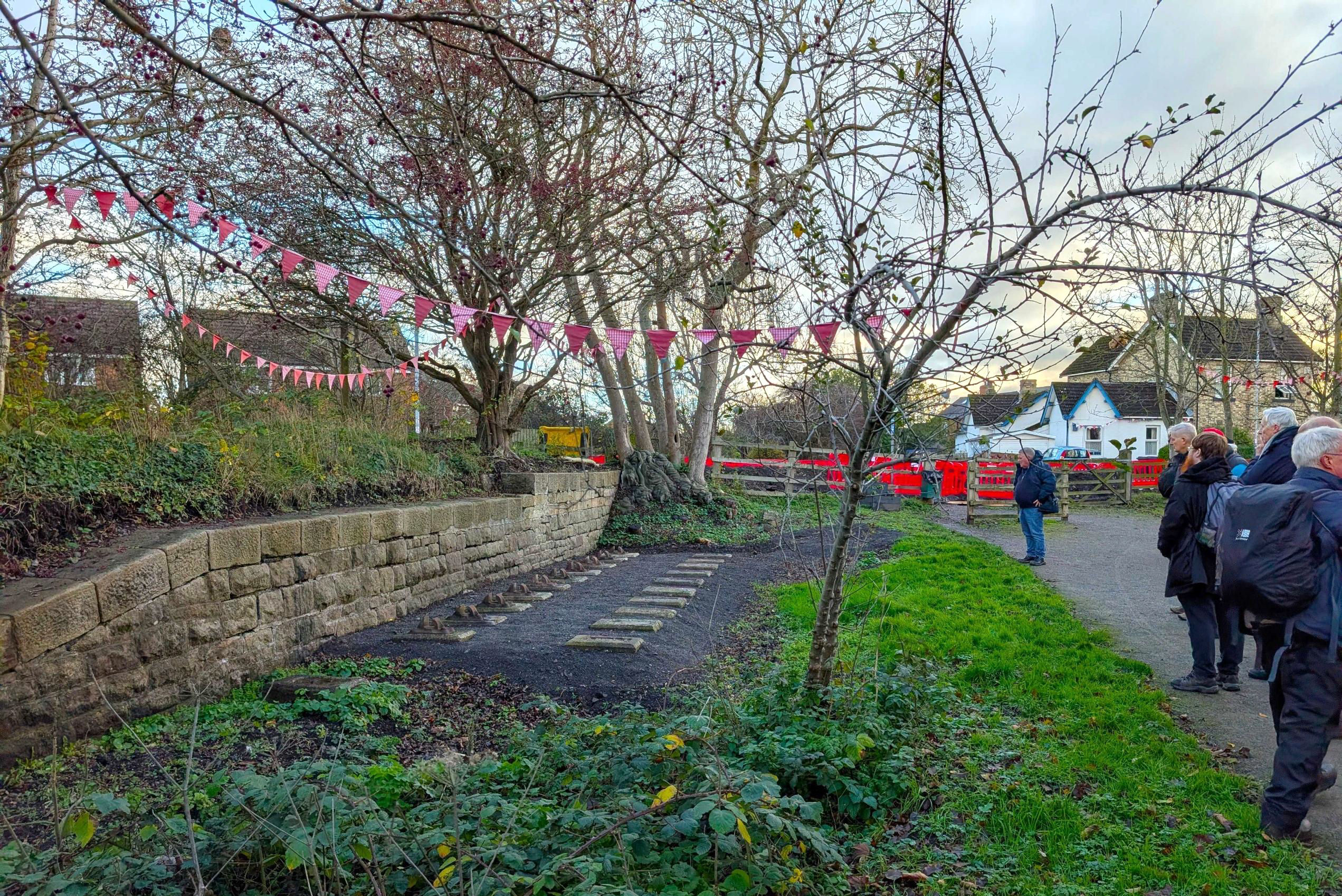
Members on the walk just before the site of Fighting Cocks Level Crossing with the station building beyond right. (Display by the Friends of the S&DR).
[© John Hampson 2025]There was a level crossing of Sadberge Road before the station site, where excavations were taking place at the time of our visit. These exposed old rail ends, at a significantly lower level than the current road surface. Across the road, was the former Fighting Cocks station, its building still extant as a dwelling.
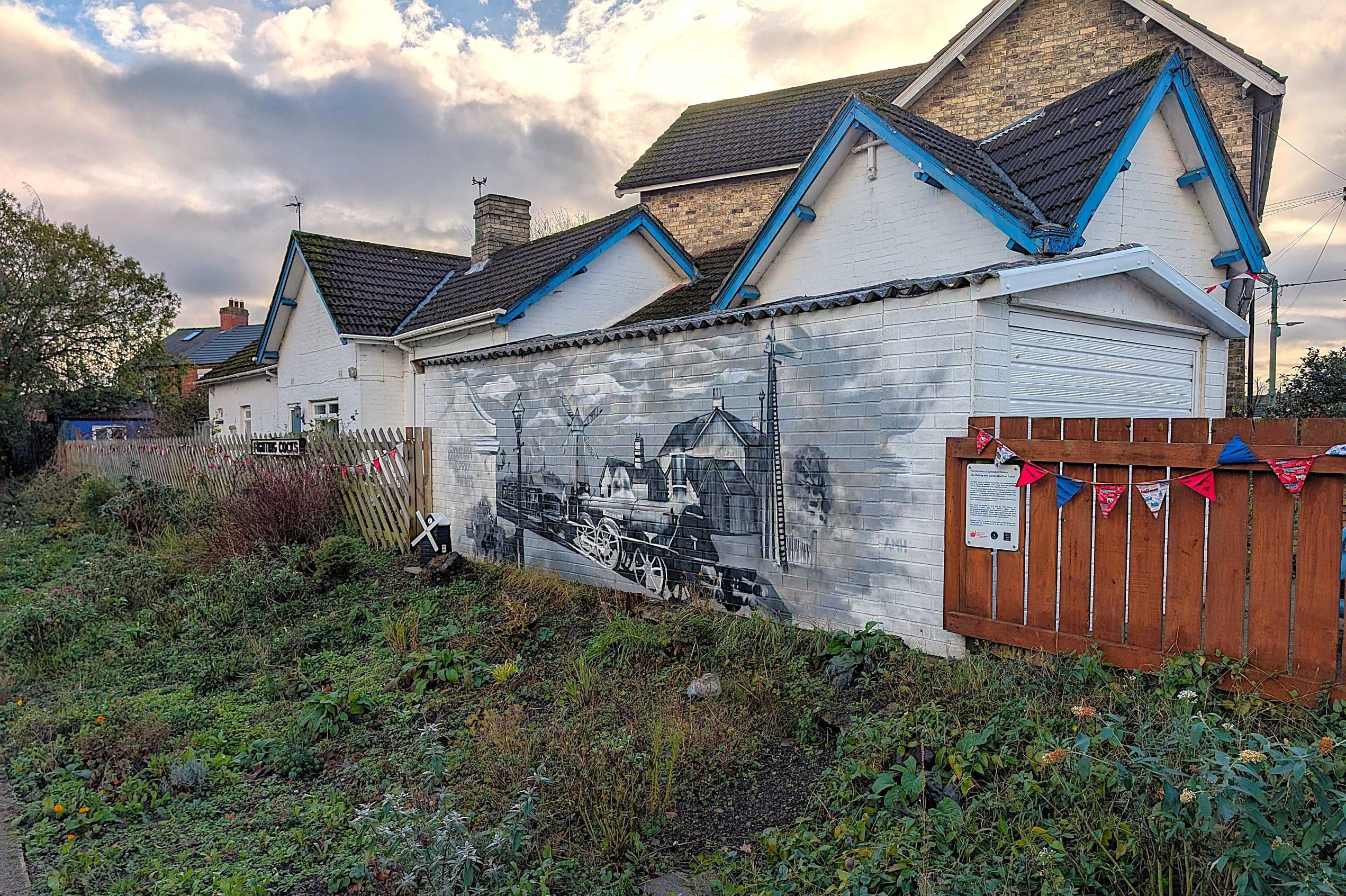
Beyond the level crossing, the original Fighting Cocks station building is now a dwelling.
[© John Hampson 2025]Some of us took a short walk down Sadberge Road to view the former 19th Century Fighting Cocks public house, after which the station was named. The name comes from Henry Cocks, a local landowner whose family crest featured three fighting cockerels. The Inn became a key landmark and booking office on the S&DR. It is now a Sainsbury's Local convenience store. We then continued along the trackbed towards the former Oaktree Jn, just east of Dinsdale station on the current Darlington to Stockton (etc) line.
At Woolsington Drive, a few participants headed through the adjacent housing estate (built on the site of Middleton Iron Works) to catch a train to Eaglescliffe, for the short walk to our afternoon Teesside Small Gauge Railway visit (report BLN 1488.453), while the rest walked down to the former junction location. After crossing Yarm Road, the footpath leaves the S&DR formation and continues at a lower level, with the former line on a low embankment right, as it converged with the Saltburn / Stockton line.
The double track line through Fighting Cocks opened on 27 Sep 1825 with the rest of the original S&DR and avoided the centre of Darlington. However, regular passenger services (horse drawn) didn't start until 10 Oct 1825. It avoided Darlington due to fierce opposition from the Earl of Darlington, a powerful landowner and ultra-NIMBY, who deemed the railway a nuisance to his fox hunting. Fighting Cocks station was first in Bradshaw in 1846 as Middleton & Dinsdale but was renamed to the former from 1 Sep 1866 and closed 1 July 1887, when it was replaced by Dinsdale, half a mile to the south, on the deviation via Darlington. Reportedly, 30,000 tickets were sold from Fighting Cocks station during its lifetime. What became known as the Fighting Cocks Loop Line closed as a through route on 21 May 1967, when Darlington Albert Hill Jn to Patons & Baldwins Ltd Siding at Lingfield Lane via the flat crossing of the ECML, closed. The line on to Oak Tree Jn (3 miles) was singled from that date and the flat crossing removed on 2 Jul 1967. This branch was traversed by our 24 Mar 1973 South Durham Railtour No2. In Jun 1976, BLN reported that the section past Fighting Cocks (Dinsdale Long Welded Rail Depot) was overgrown and out of use. Dinsdale Rail Welding Depot itself closed in the late 1980s.
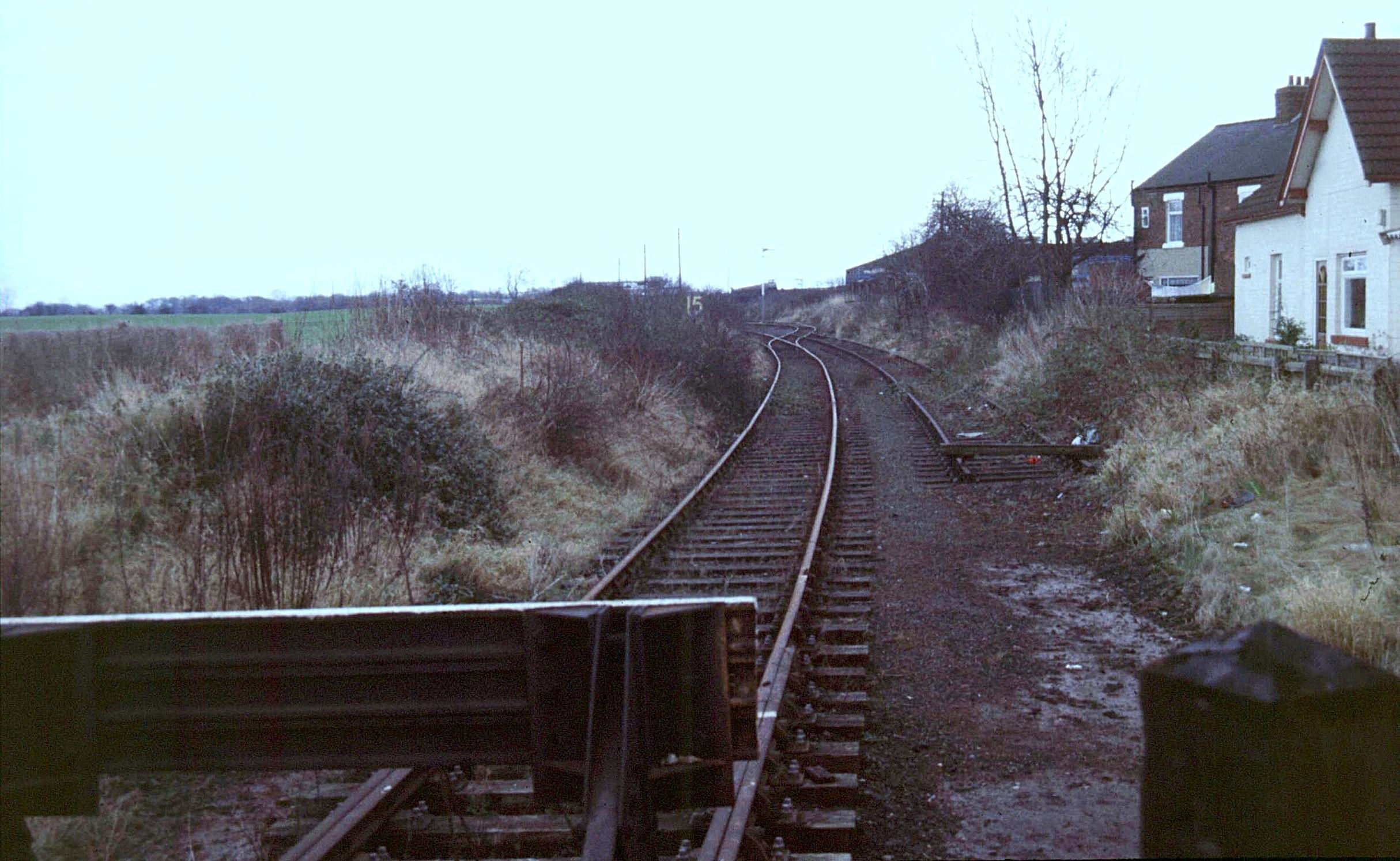
End of line at Fighting Cocks (white station building right) when it was the headshunt for Dinsdale Rail Welding Depot, 9 Jan 1988.
[© Angus McDougall 1988]The rest of us then returned along the Yarm Road past Killinghall Row and New Row, two groups of terraced houses presumably built for Iron Works employees. At Dinsdale station the group dispersed, while your correspondent retired to the Havelock Arms for a pint, ready for his long train journey home. The clever ones had parked their cars at this station first thing and travelled to North Road by train for the start of the walk, so could go directly to our Teesside Small Gauge Railway escapade in the afternoon. Many thanks to our excellent and informative Friends of the S&DR guides, John Raw and Catherine Yates.
As a result of all our 2025 AGM weekend fixtures, £5,500 was donated to Friends of the S&DR.