When this fixture was announced, I booked the instant I saw the words 'Wapping Tunnel' in the heading. I was gratified to learn, a few days later, that I had been the first to sign up, although slightly less gratified to find that this had put me top of the list of candidates for writing the fixture report. It was a small price to pay, however, for what was to come. [The 12 available places were booked up within 72 minutes of release - Editor.]
Just west of the present Edge Hill station is the historic but normally inaccessible Wapping Cutting. It was part of the Liverpool & Manchester Railway's original route into Liverpool opened on 15 Sep 1830. Here, spanning the tracks and the cutting, was the famed Moorish Arch depicted in many contemporary prints but long since demolished. After the arch, the railway divided into two; passenger trains took a short uphill tunnel to the original Crown Street passenger terminus OP 17 Sep 1830. It CP 15 Aug 1836, replaced by Lime Street which opened that day. Goods trains took the long, downhill Wapping Tunnel under the streets of Liverpool to Wapping Dock. Both tunnels were rope-worked in the uphill direction and gravity worked in the downhill direction. Thus, the cutting was the scene of intense activity, with locos attached and detached, horses shunting, rolling stock and men operating the boilers and stationary engines that hauled the trains up the gradients. The site was known as Edge Hill Engine Station.
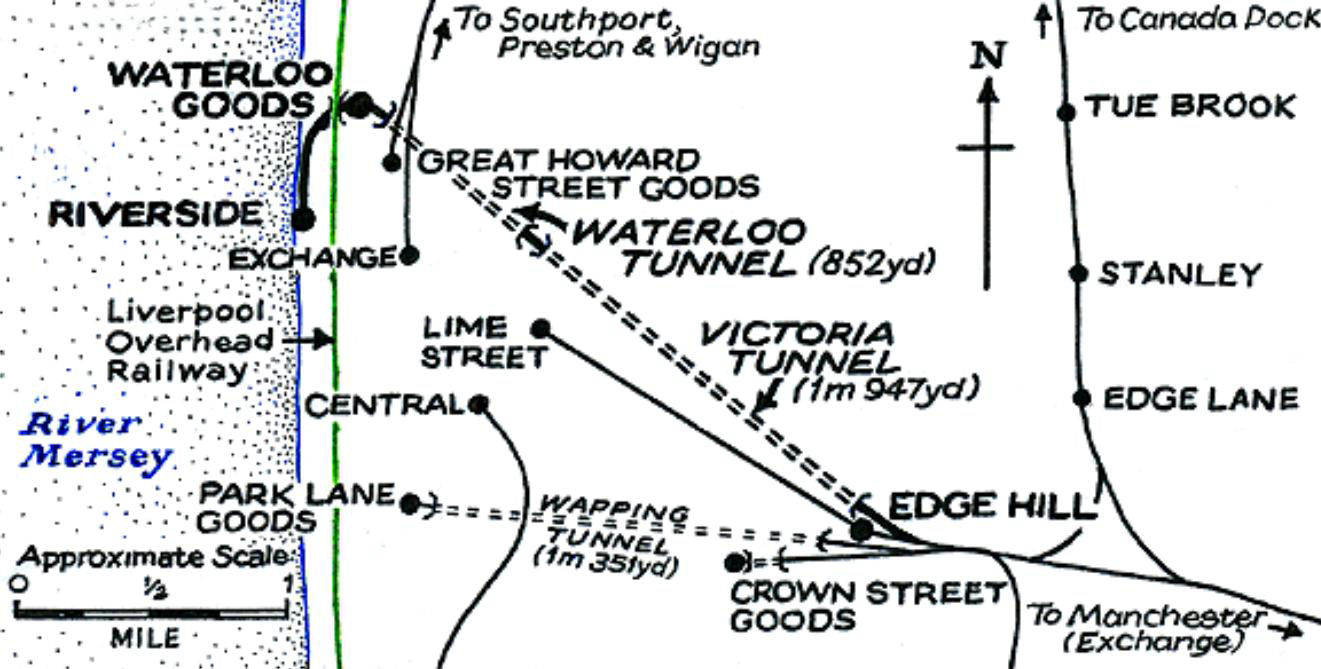
Edge Hill from 'Disused Stations', showing Wapping Tunnel to Park Lane Goods (Wapping Dock) and the line to Crown Street Goods (the former passenger station before Lime Street opened). This still has useable track at its junction end. On the other (Up) side of Edge Hill, there is a short headshunt into the start of Victoria Tunnel (see TRACKmaps4 p38A 2022, a continuation of Tuebrook Road 4); also railtoured in recent years. The line off the bottom at Edge Hill is to Runcorn and Crewe.
[© AEY 2015]The large, double track portal of Wapping Tunnel occupied pride of place in the centre of the cutting's end wall, while the smaller single track portal of Crown Street Tunnel was on the right. For symmetry, a dummy tunnel entrance matching Crown Street portal was built on the left. In 1846, after passenger operations had moved to Lime Street station and Crown Street had become a goods depot, the dummy portal was replaced by a real, double track tunnel with a gentle gradient. Thus, it was loco-worked from the outset - leading into the expanding Crown Street Goods Yard. This newer tunnel (Crown Street No5 Tunnel), just 130yd long, is still notionally in use, being occupied by a pair of sidings which join at a head shunt just beyond the tunnel exit. It is shown on TRACKmaps 4 p38A 2022 on the Down side of the line.
The 9 Feb 2002 Pathfinder 'Mersey Yardmaster'
https://tinyurl.com/yd6xv946 went to the end of line and
https://tinyurl.com/yck7xudu the 14 Jan 2017 Pathfinder 'Mersey Weaver II' tour also visited.
https://tinyurl.com/3ems6dkx is a nice photo of our 1991 tour although Maxwelltown is in Scotland!
Edge Hill Engine Station and the Crown Street Tunnel were explored by the Society on 14 Jul 2025, a fascinating walking tour which I was lucky enough to take part in (
view report). Then, Wapping Tunnel (1m 351yds), a wonder of the pre-Victorian age, remained tantalisingly off limits. I had hardly dared hope that one day it might be possible to enter that tunnel too, However, thanks to Adam Turner's uncanny ability to gain access to the inaccessible, here we were at Edge Hill about to enter its hallowed portal.
The 11 of us (one didn't make it) assembled at Edge Hill station, where we met our host, Chris, NR Senior Tunnel Engineer for the North West and Rob, the Controller of Site Safety, making a party of 13. Having donned hard hats and clad ourselves in orange polyester, we exited the station onto the aptly named Tunnel Road. Our group walked the short distance to the secure NR gate accessing Wapping Cutting. We then descended the steep zig-zag path leading to the bottom of the cutting to begin our tour.
As we walked westward along the right hand side of the cutting, the two live siding lines were on the opposite side, to our left. The centre of the cutting was heavily overgrown restricting visibility of the far wall. As Adam explained, the cutting was widened on the far side in or around 1865 to fit in additional tracks, so our side of the cutting retained more of the history. (Adam certainly researches his tours well.)
On our way to the tunnel mouth, we passed and peeped into numerous chambers hewn into the vertical sandstone wall of the cutting. (There was an opportunity for a longer look on the way back.) Some of these chambers were boiler houses; others were coke stores, stables or staff rooms and one higher up held a water tank for the locos. The stationary engines were originally in the base of the Moorish Arch. The winding engines at Chatsworth Street were later replaced by new engines installed near the present Edge Hill station. It is easy enough to see where the arch stood but there are few visible remains.
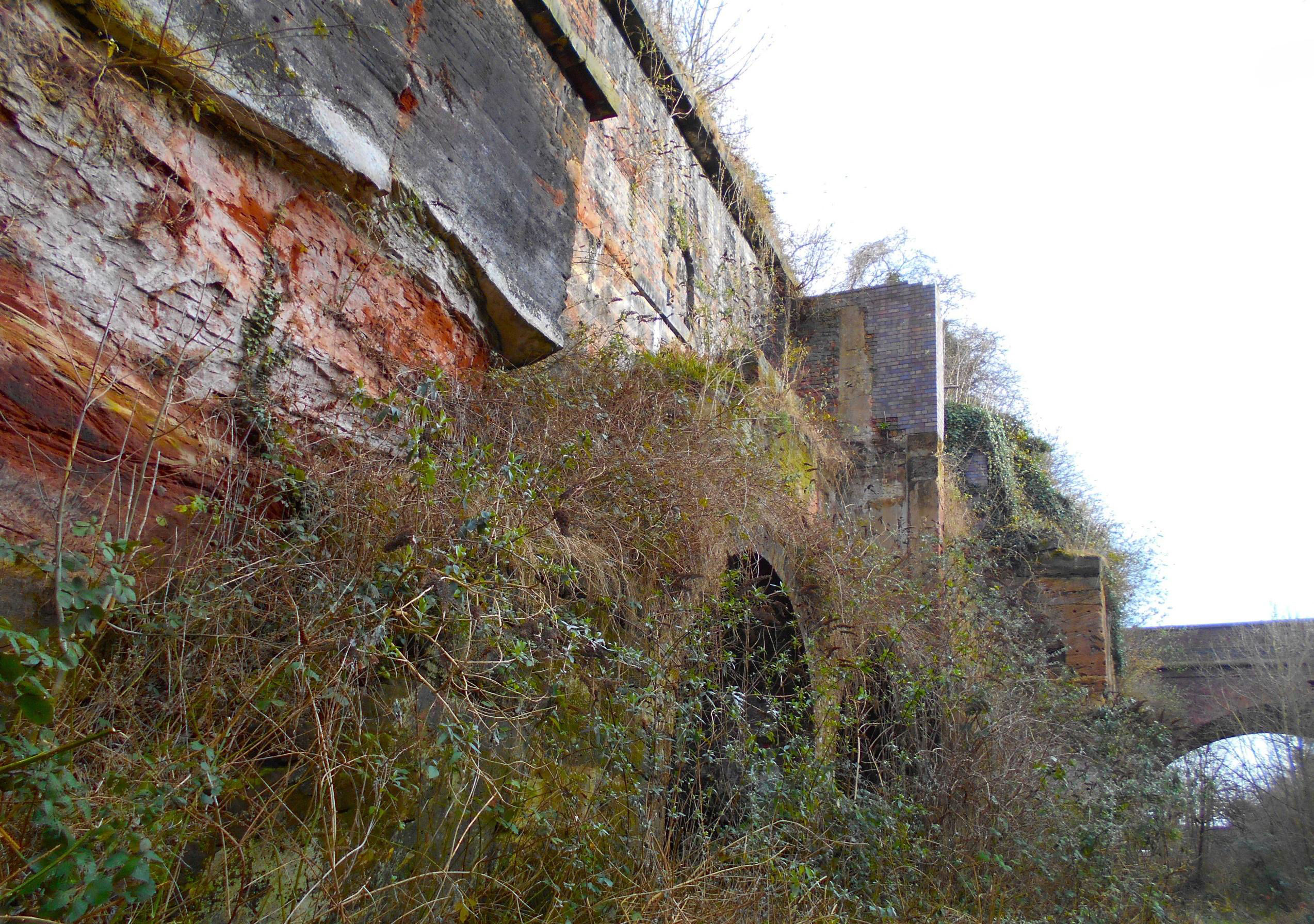
The remains of the Moorish Arch jut out (closer to the camera) above the boiler house and the remains of the staircase which went up over the top of the arch of the tunnel mouth. Looking towards Chatsworth Drive.
[© Liz Moralee 2026]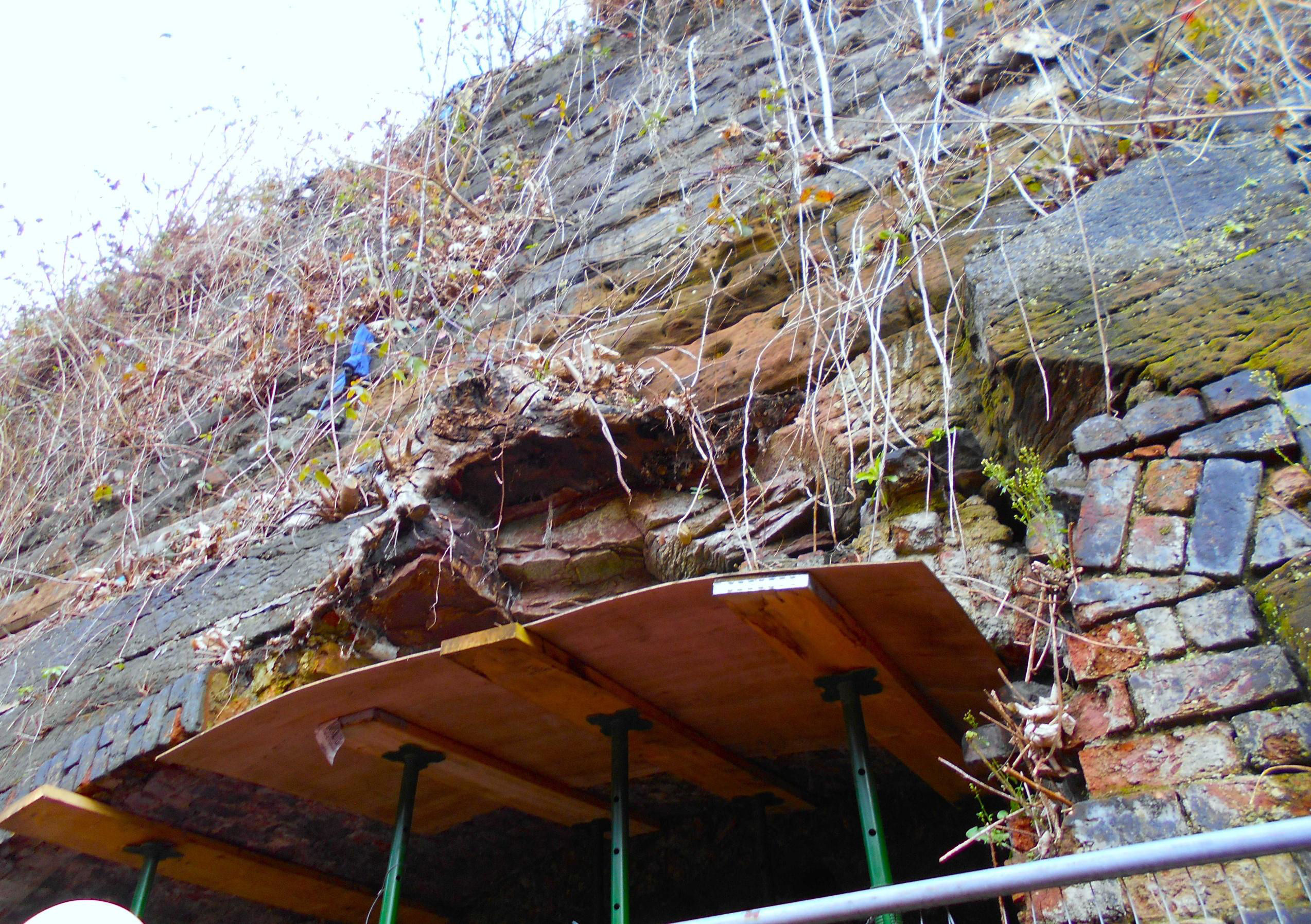
Repair work to an arch since our 14 Jul 2025 Society visit to the area.
[© Liz Moralee 2026]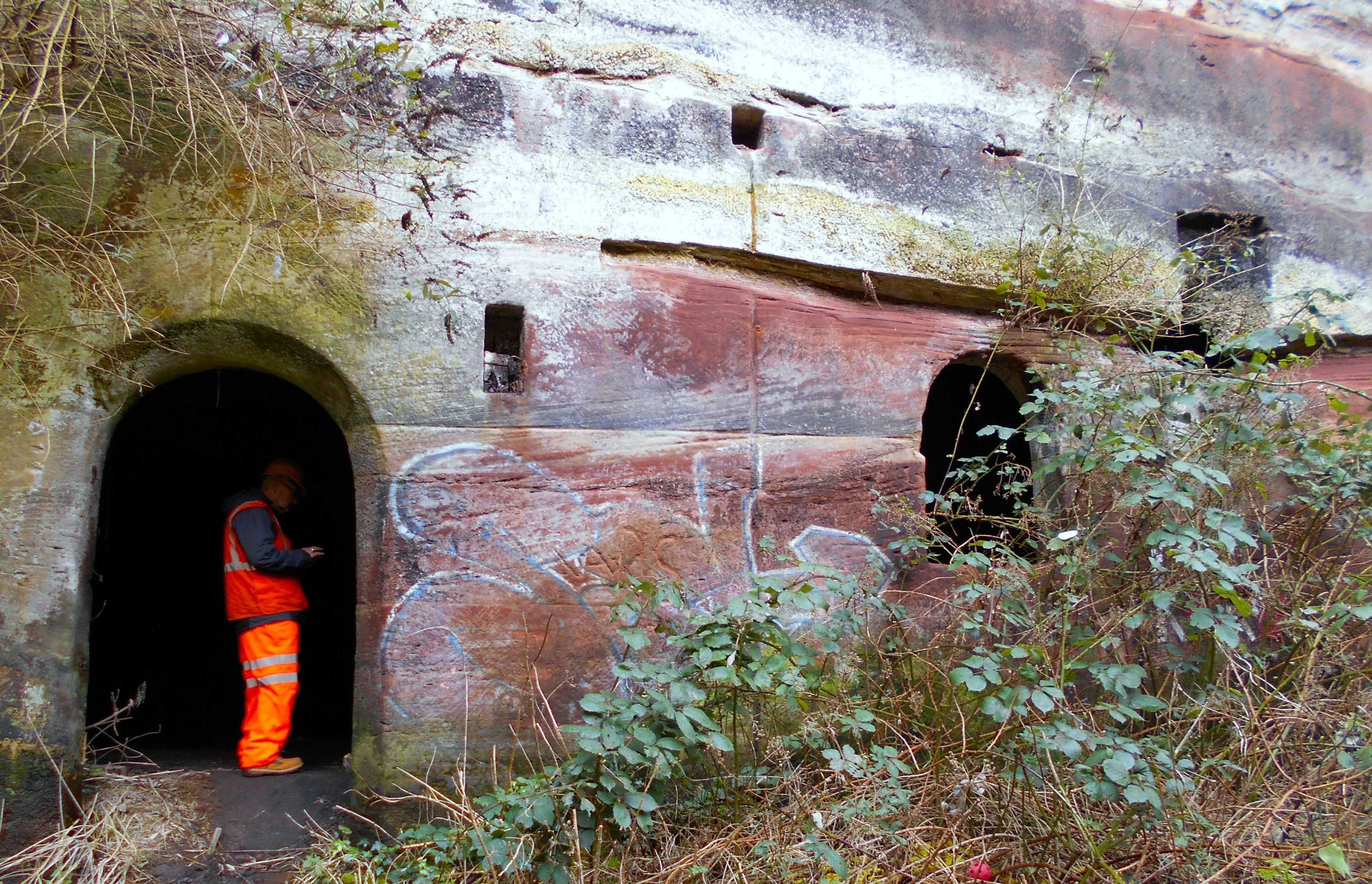
Outside Wapping Tunnel at Edge Hill, some of the various cave 'rooms' that were used as stables and offices.
[© Liz Moralee 2026]Soon enough, we came to the array of three tunnel mouths, the two originals behind palisade fencing and the still operational, later 1846 Crown Street No5 Tunnel.
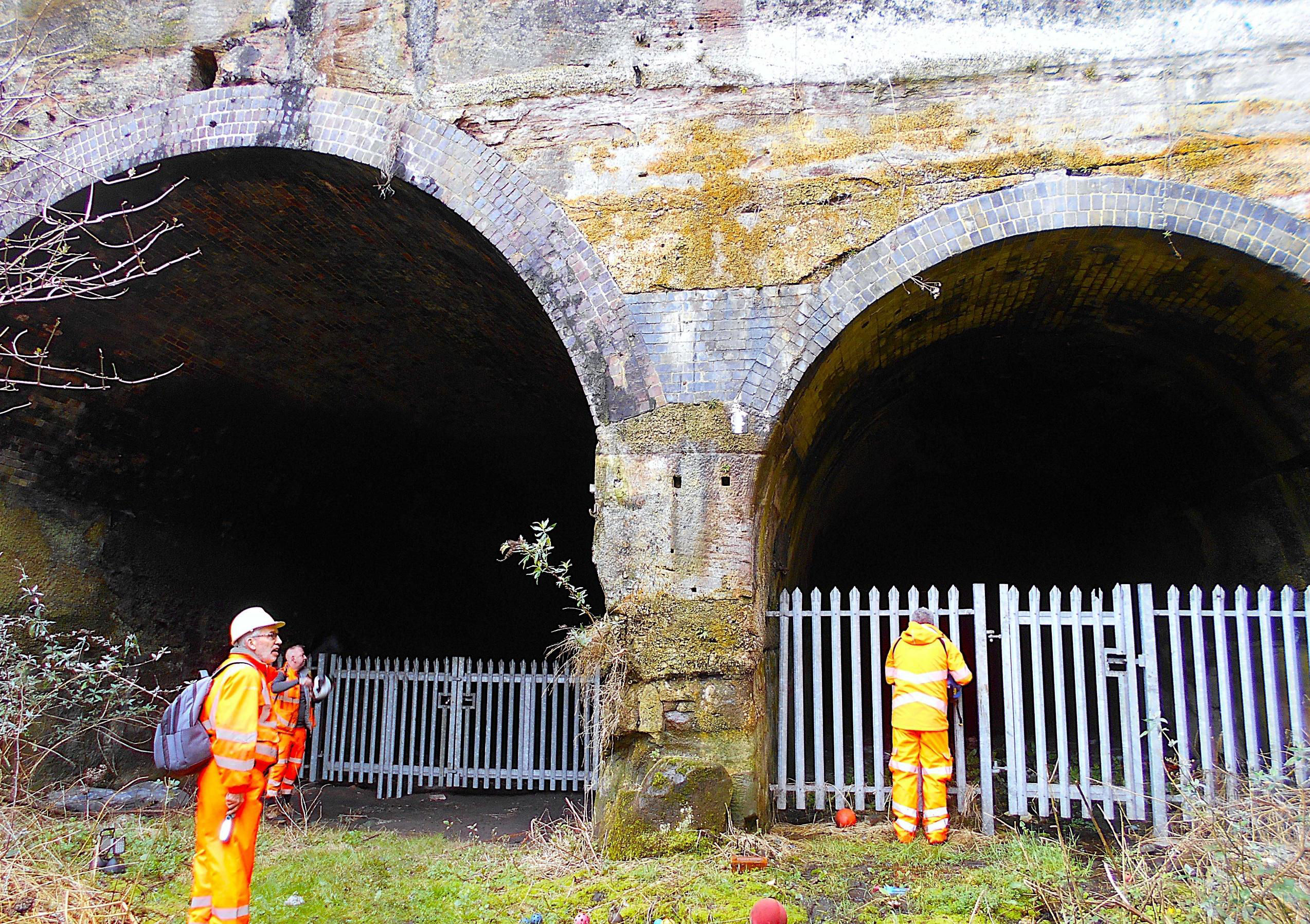
Wapping Tunnel is right with Crown Street Tunnel (beyond the current limit of track) left.
[© Liz Moralee 2026]After Chris had unlocked the gate, we filed into the cavernous interior of Wapping Tunnel, switched on our torches and started our long walk beneath the Liverpool streets towards the far end. If only we had arrived 197 years earlier, we could have done without the torches since the tunnel was apparently whitewashed, gas lit and open to walkers when it was completed in 1829 ahead of the railway itself.
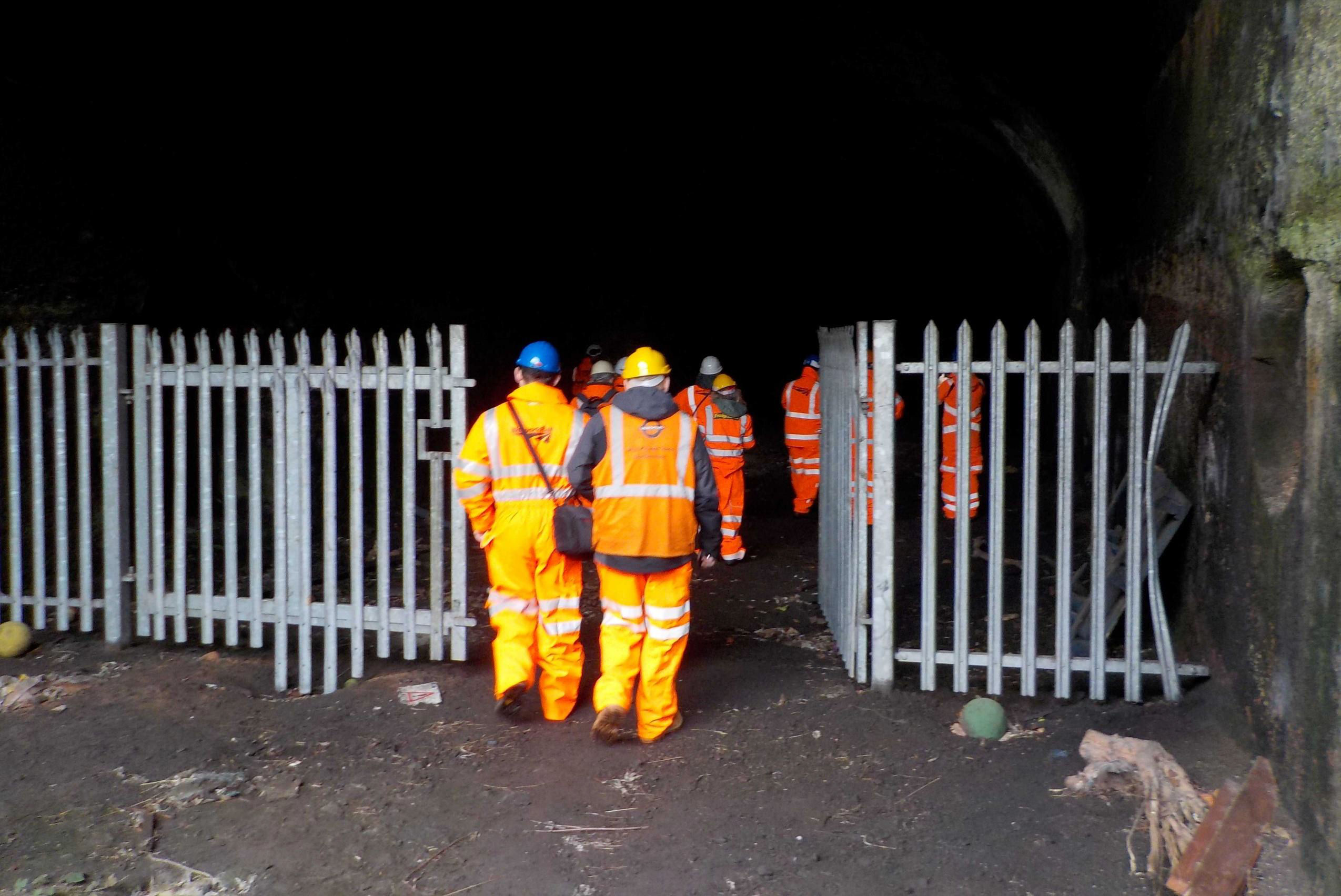
Entering the Edge Hill portal of the dark, cavernous 1m 351yd Wapping Tunnel.
[© Tim Hall-Smith 2026]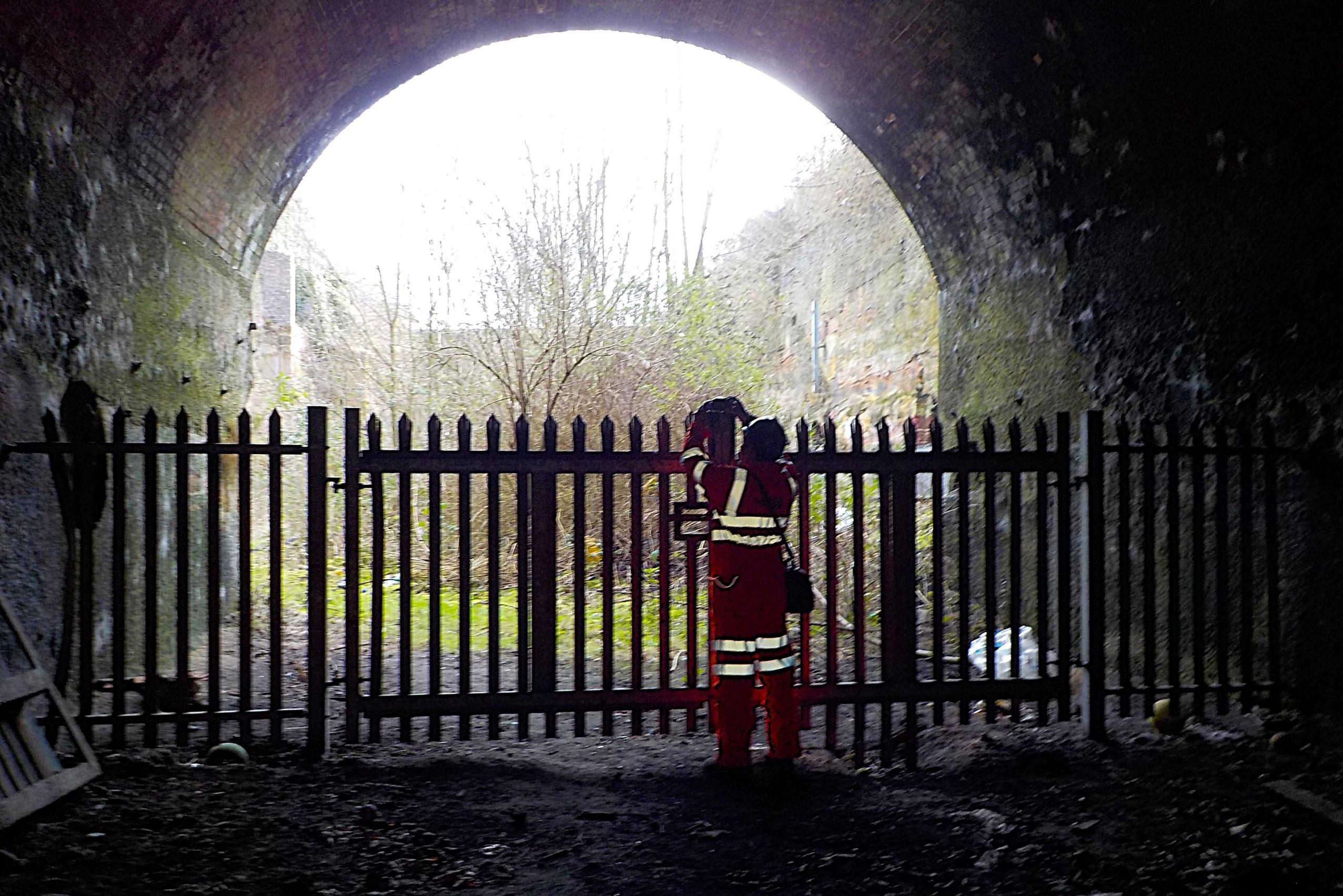
The man from QTS closes the gate after our group has entered (QTS was founded in 1992, the letters stand for Quality Tree Specialists!)
[© Tim Hall-Smith 2026]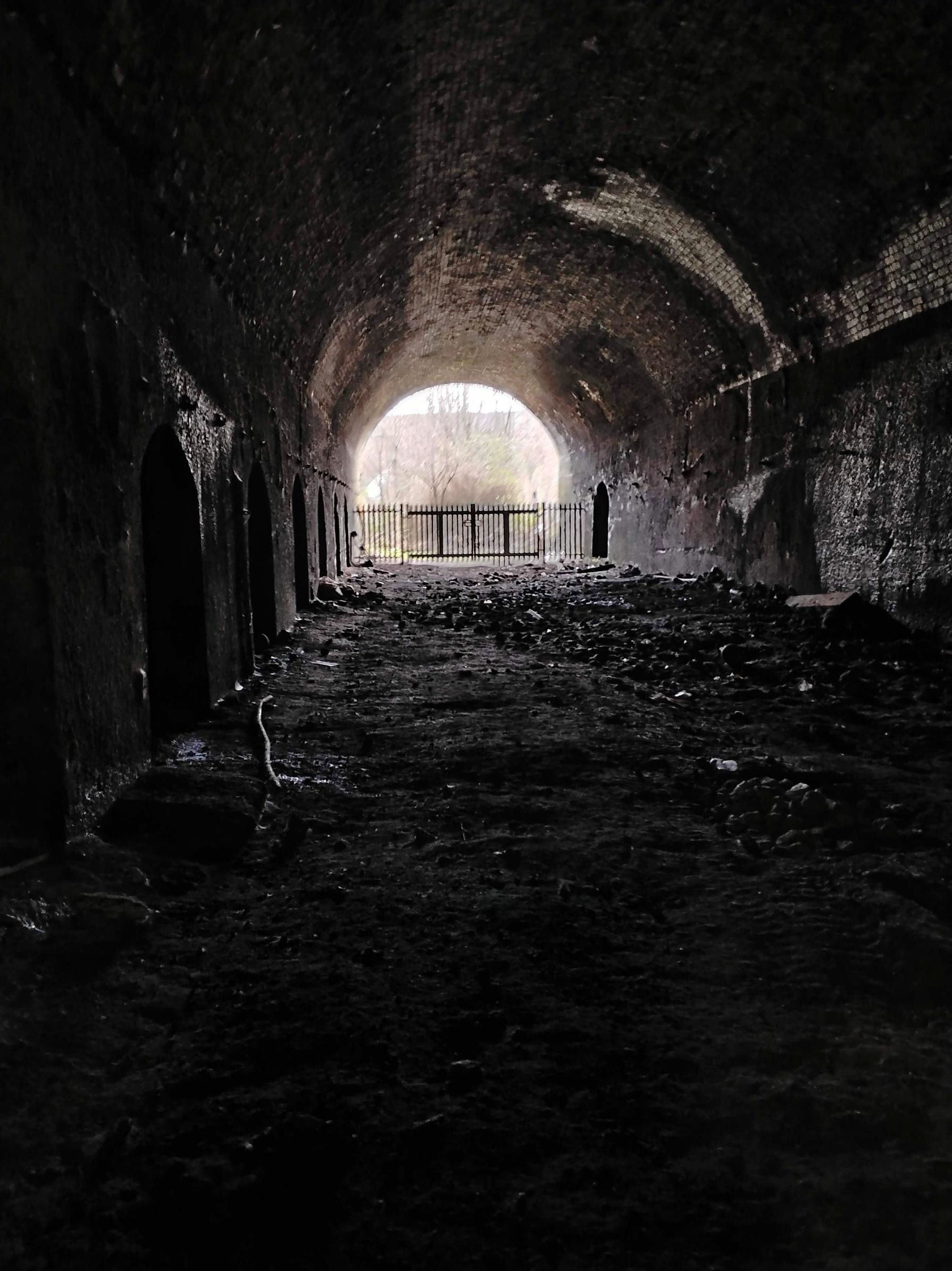
Looking back at Wapping Tunnel entrance.
[© Tim Hall-Smith 2026]As we started our walk along the Tunnel, the 1:48 downhill gradient was immediately apparent. For the most part, the Tunnel was brick arched with walls carved out of solid sandstone but, at frequent intervals, the walls were reinforced or repaired with patches or entire sections of brickwork. In some places the walls were covered in bright white calcite. Other areas provided a geology lesson by revealing multiple layers of different coloured sandstone, resulting from the accumulation of successive layers of sediment over millions of years. Refuges were carved out of the walls at frequent intervals, one near the entrance revealing a break-through into the neighbouring Crown Street Tunnel. Occasional holes in the tunnel floor revealed running water flowing through the so called 'six-foot drain', which is a channel running the length of the tunnel beneath the nominal six-foot gap between the Up and Down lines.
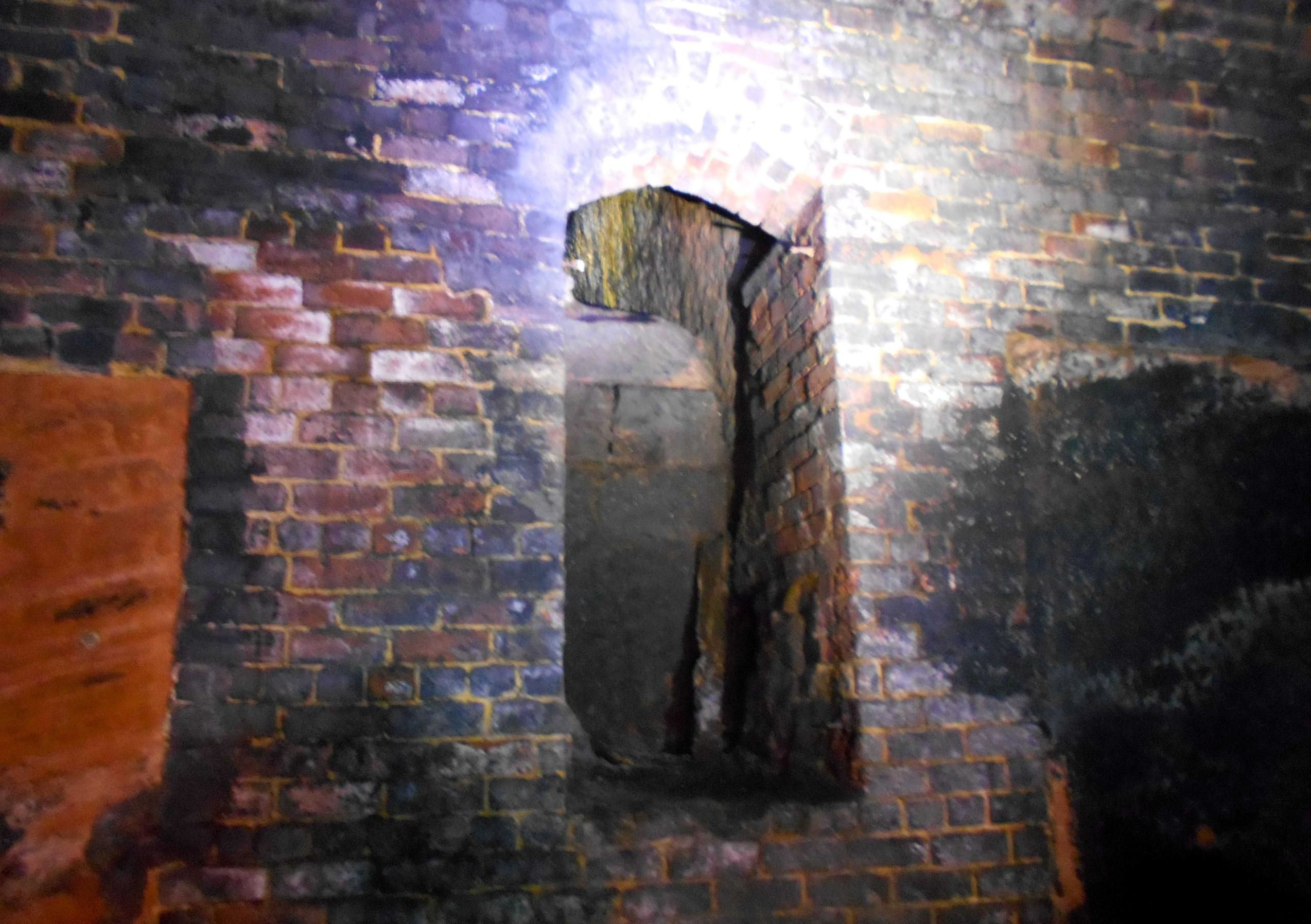
A mystery hole in the Tunnel that seemed to lead to another chamber above.
[© Liz Moralee 2026]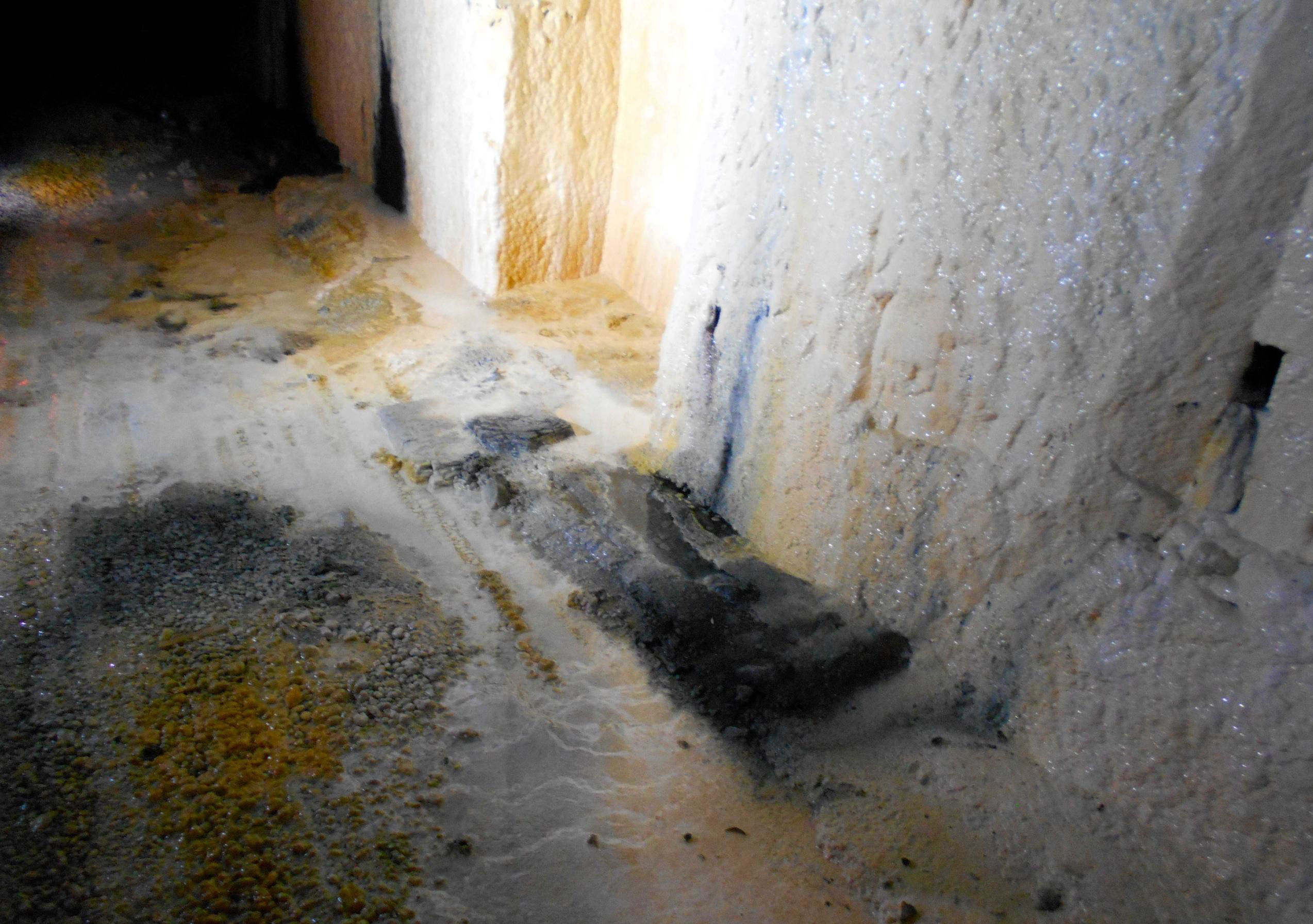
Eerie calcite deposits on the walls and floor. Who needs Blue John Caverns?
[© Liz Moralee 2026]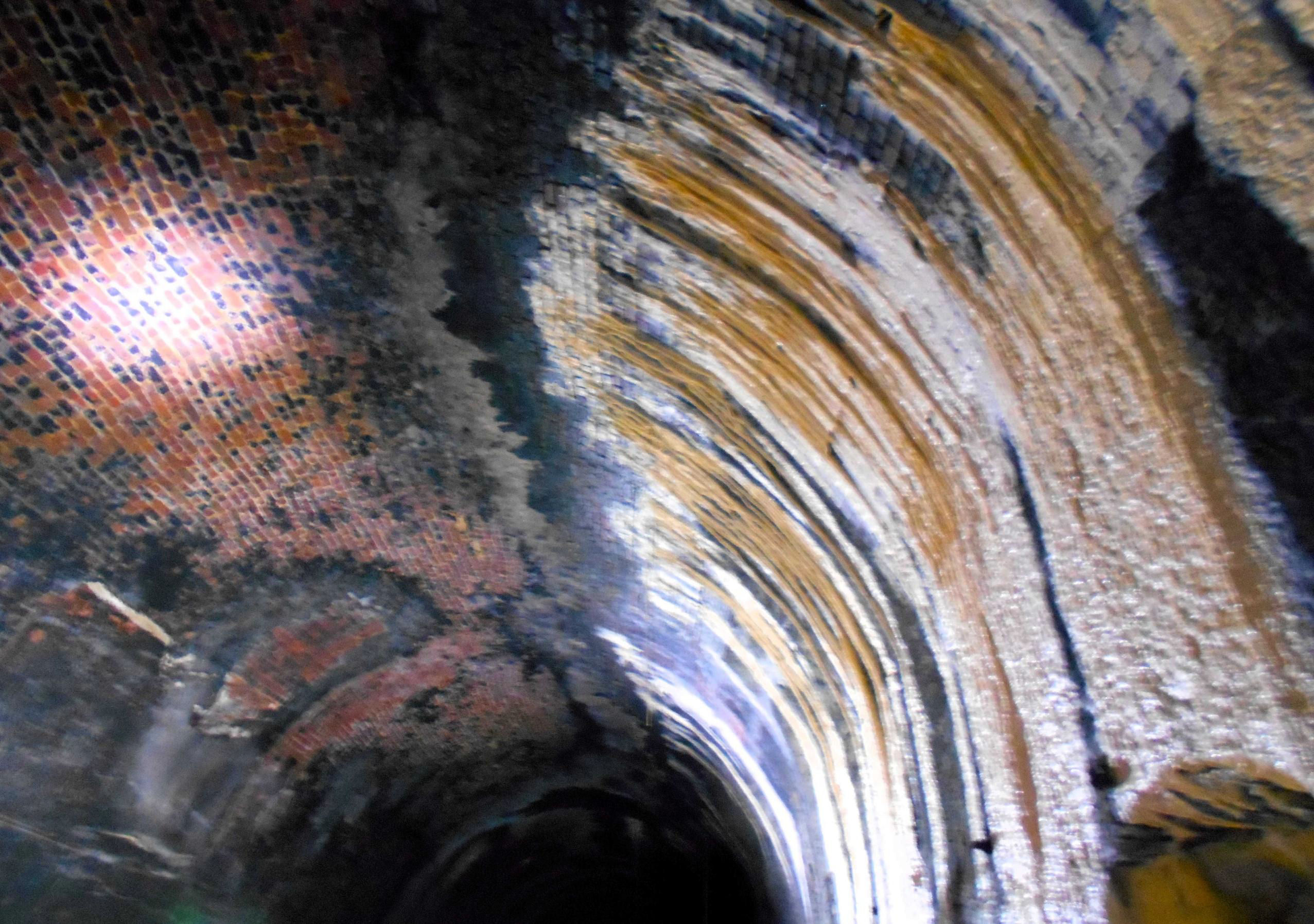
Eerie calcite deposits down the walls.
[© Liz Moralee 2026]About 100 yards into the tunnel, on the right, I was amazed to see a treadle-operated gong at the side of the track with its mechanism still largely intact. We soon found two more of these. One was further along on the right, followed by the first of what might have been a corresponding pair on the left. These were possibly installed by the London & North Western Railway after locos replaced rope working from 11 May 1896 to help drivers and brakesmen orientate themselves in the smoke-filled tunnel.
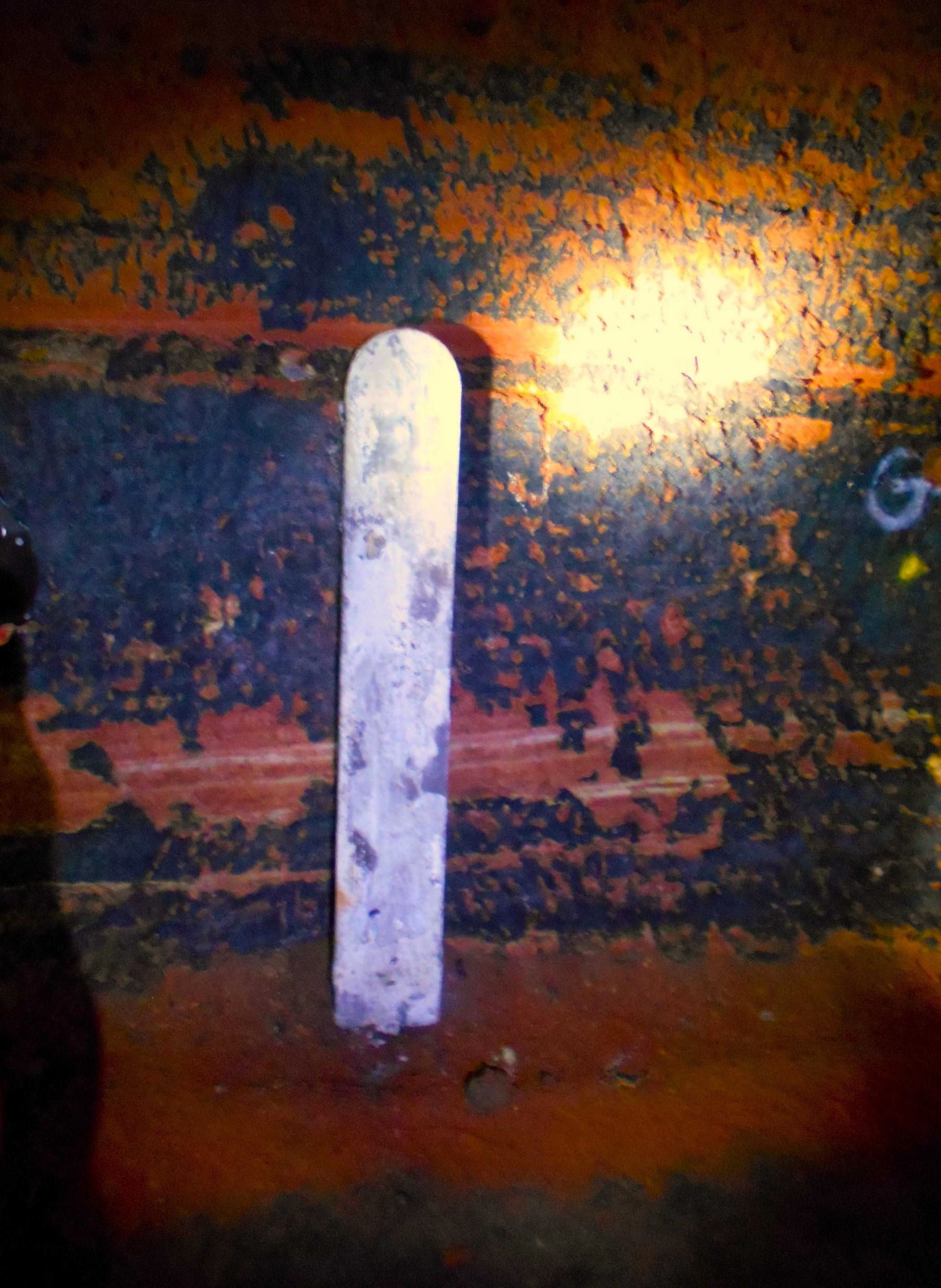
A possible milepost with feint numbers on it.
[© Liz Moralee 2026]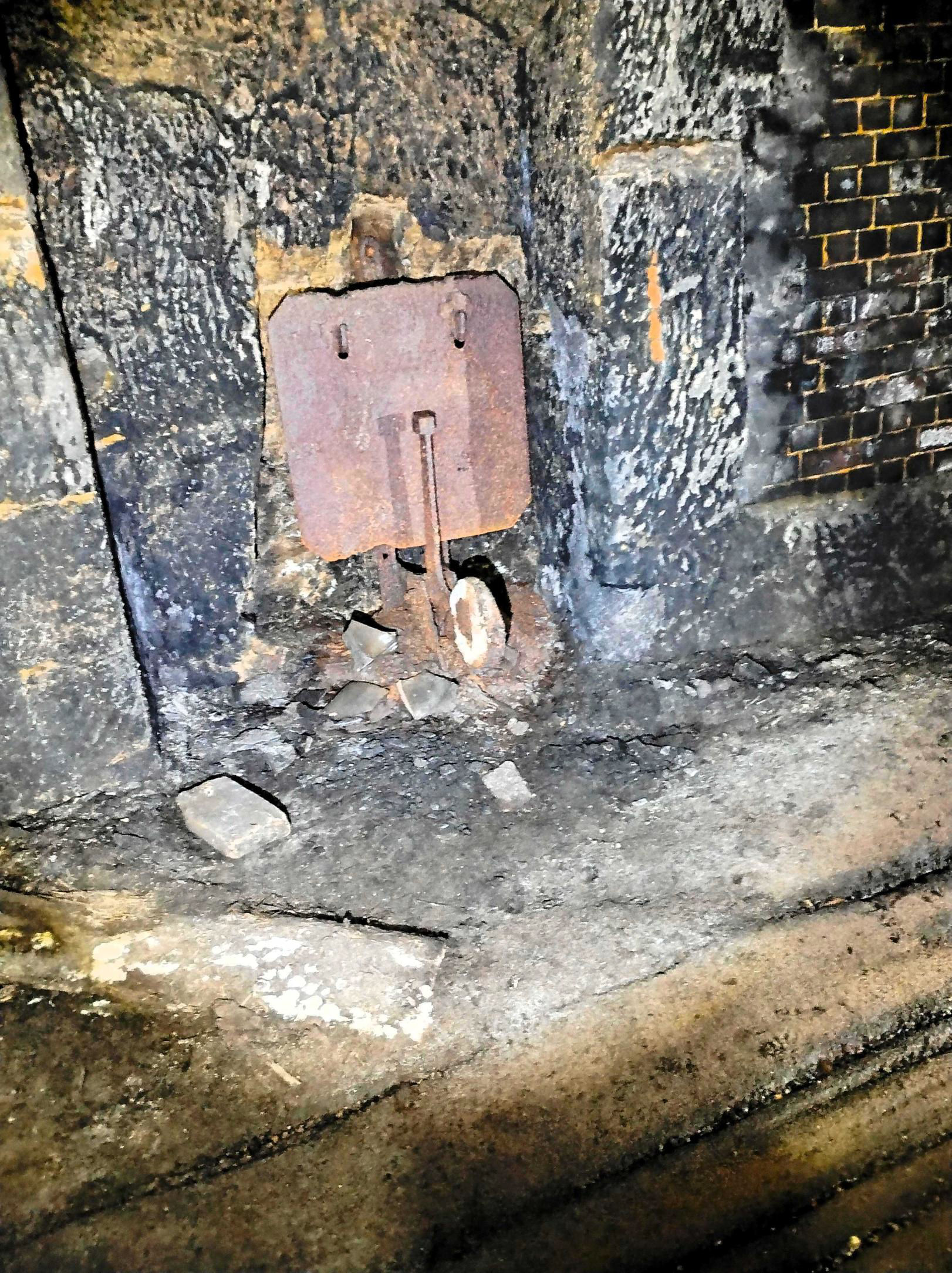
One of the gongs on the Tunnel wall.
[© Tim Hall-Smith 2026]The word 'brakesmen' applies as gravity working continued even after loco working began. The Down line (towards Wapping) was only gravity worked, with brakesmen riding in specially adapted brakevans at the front and rear of each train. Conversely the Up line (towards Edge Hill) was exclusively loco-worked and was therefore bidirectional in the sense that locos used it to travel down to Wapping light engine, sometimes coupled in twos or threes, before hauling their loaded trains back up the same line.
Having left the gongs, we soon came across another curiosity. On our left, the Tunnel widened to accommodate what looked for all the world like a siding ending in a set of wooden buffers. A siding in a tunnel? Surely not. A run-out for runaways? Too near the top of the incline. An accidental misalignment of the tunnel bore? Conceivably but doesn't explain the buffer stops. An unsolved mystery? Definitely.
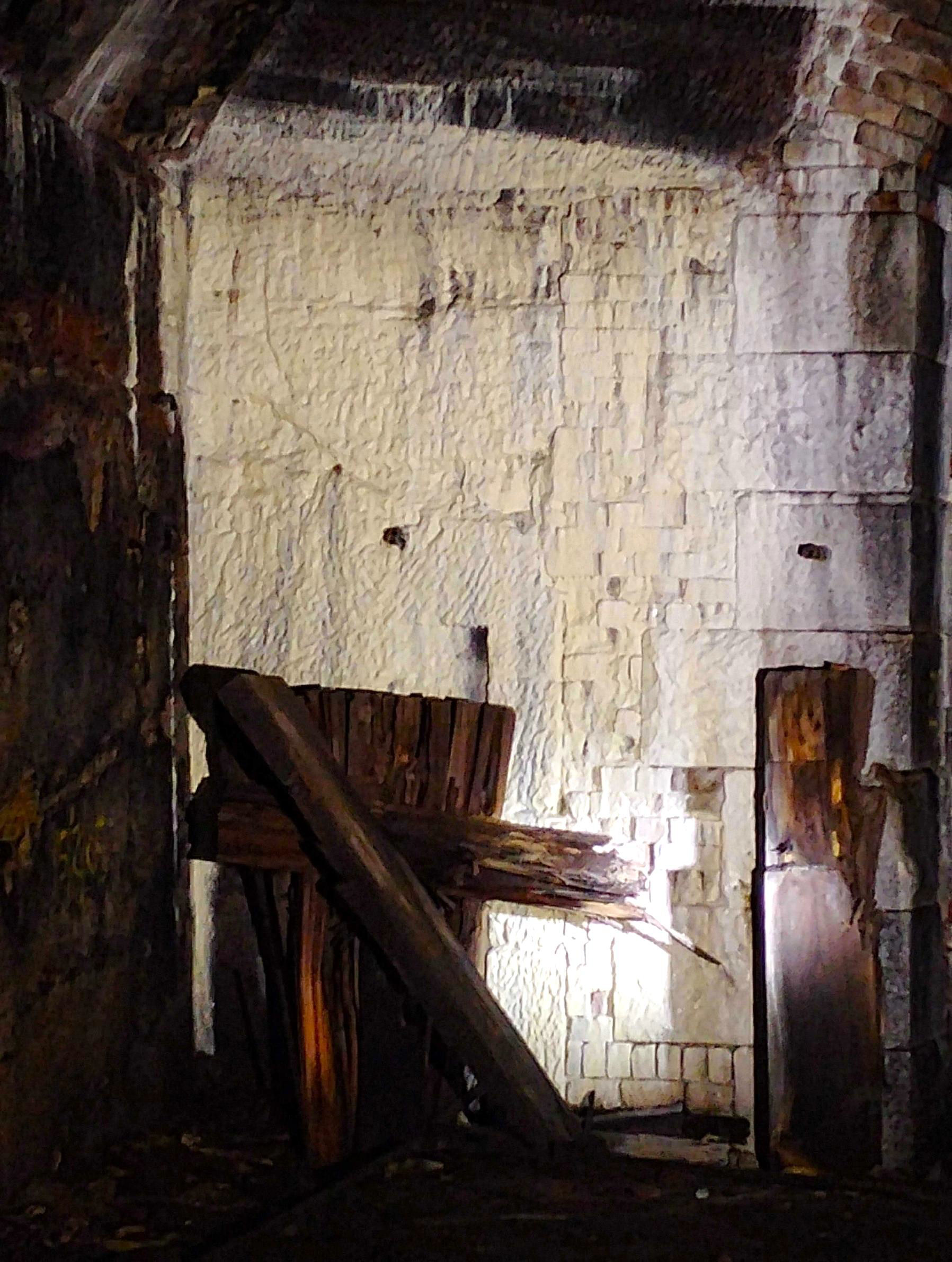
Wapping Tunnel was very wide here, possibly for a siding at one time; that wood could have been a buffer stop but wouldn't stop much.
[© Tim Hall-Smith 2026]Next came our first ventilation shaft of originally five, casting a pool of unaccustomed light onto the tunnel floor. These shafts were built when locos replaced rope working in a largely unsuccessful attempt to dispel the choking smoke. Looking up from beneath, we could clearly see the inside of the tall octagonal tower still standing in Crown Street Park, near the site of the original Crown Street station. Other towers still stand at Blackburne Place and Grenville Street South, while two more, at Great George Street and Myrtle Street, were demolished with their shafts capped at ground level. It is possible that these towers occupy the sites of the original construction shafts but this is by no means certain.
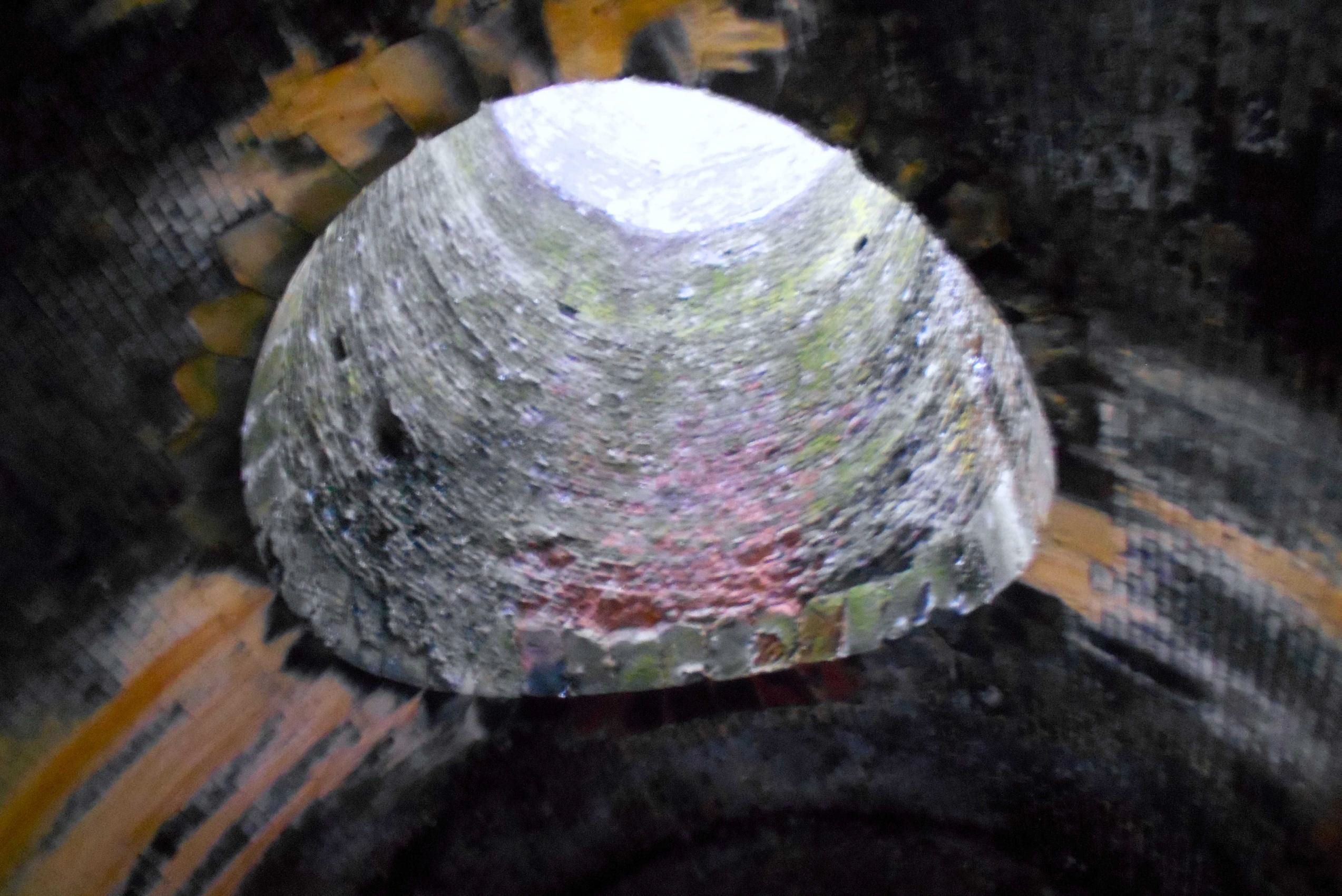
Crown Street ventilation shaft, note the layered brickwork.
[© Liz Moralee 2026]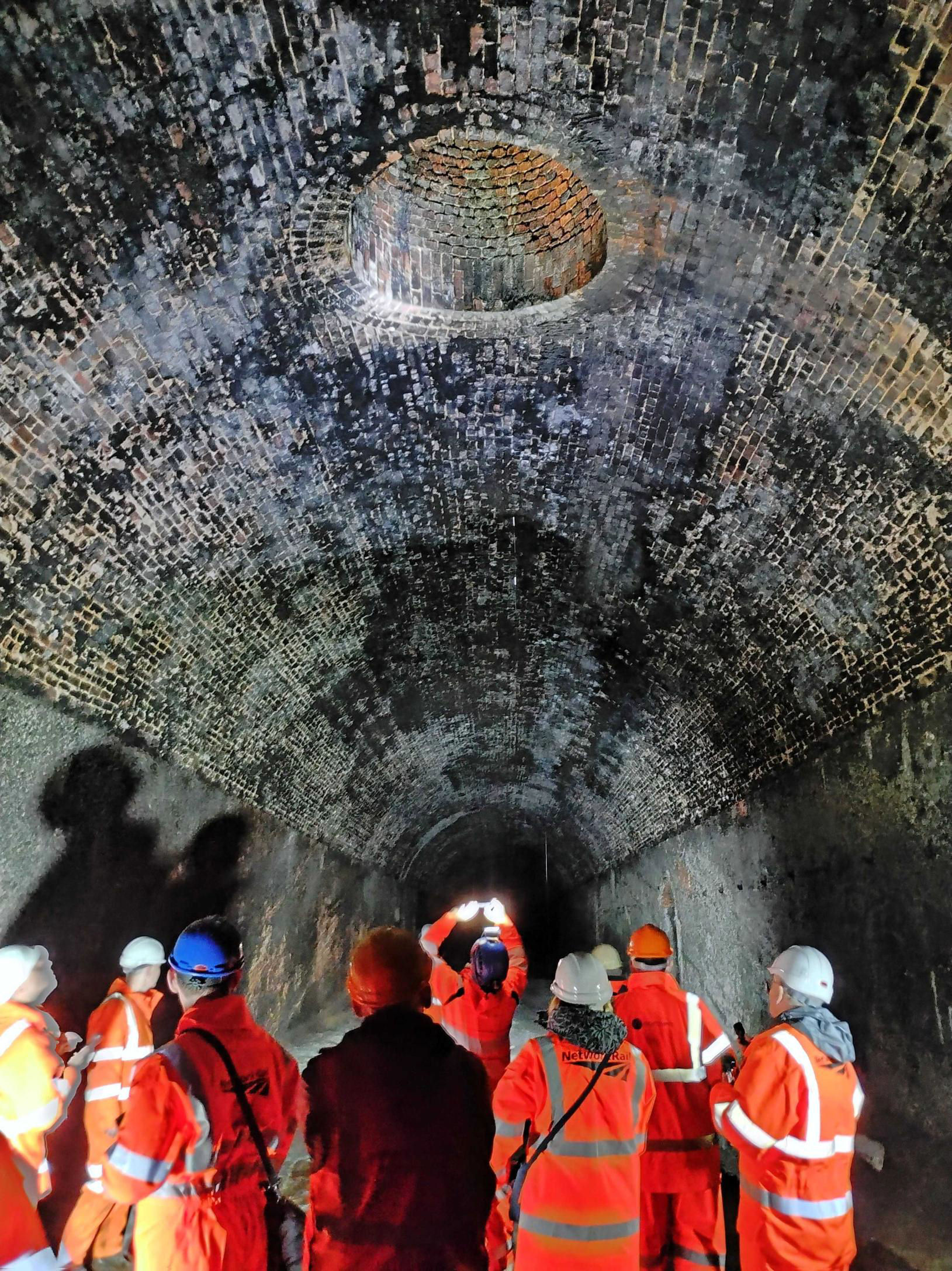
Some of the party admire a very small shaft that could have been for works access.
[© Tim Hall-Smith 2026]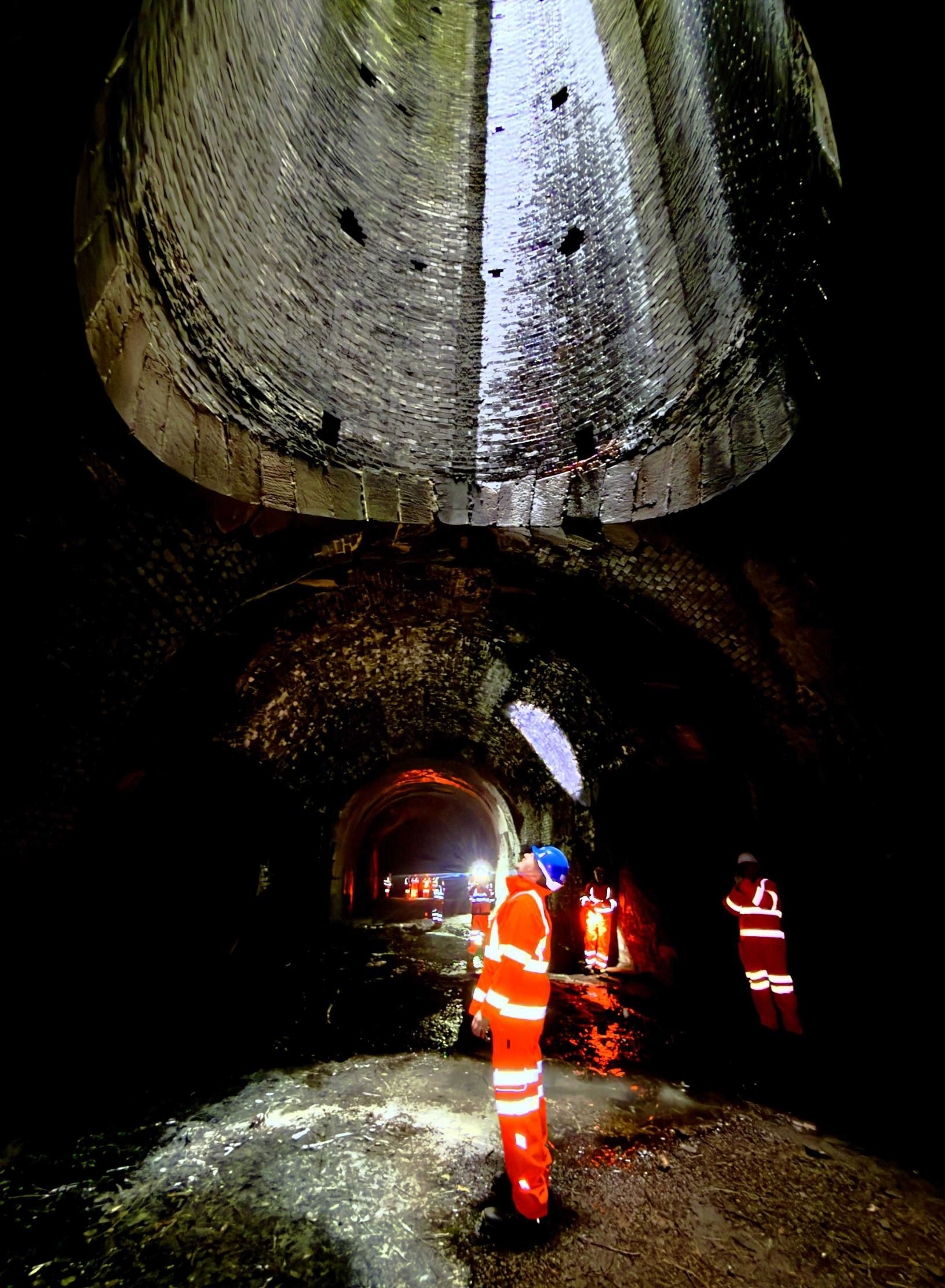
Another a ventilation shaft.
[© Adam Turner 2026]One of the many curiosities of this Tunnel is that NR owns part and Liverpool City Council part. The NR boundary is at Crown Street ventilation shaft, onwards west we were proceeding with the permission of the Council. Chris said that NR maintains its section of the tunnel; the Council is responsible for the rest.
Progressing further along the Tunnel, we passed numerous wooden boards on the walls, some with metal numbers attached, presumably former distance markers (in chains?) for maintenance purposes. We saw the bricked up portal of what looked like a cross tunnel, its purpose unknown. Then, out of the darkness came the distant rumble of an approaching train, a surprise since the tunnel closed with Park Lane Goods (formerly Wapping Goods) from 1 Nov 1965 and the track was lifted soon after.
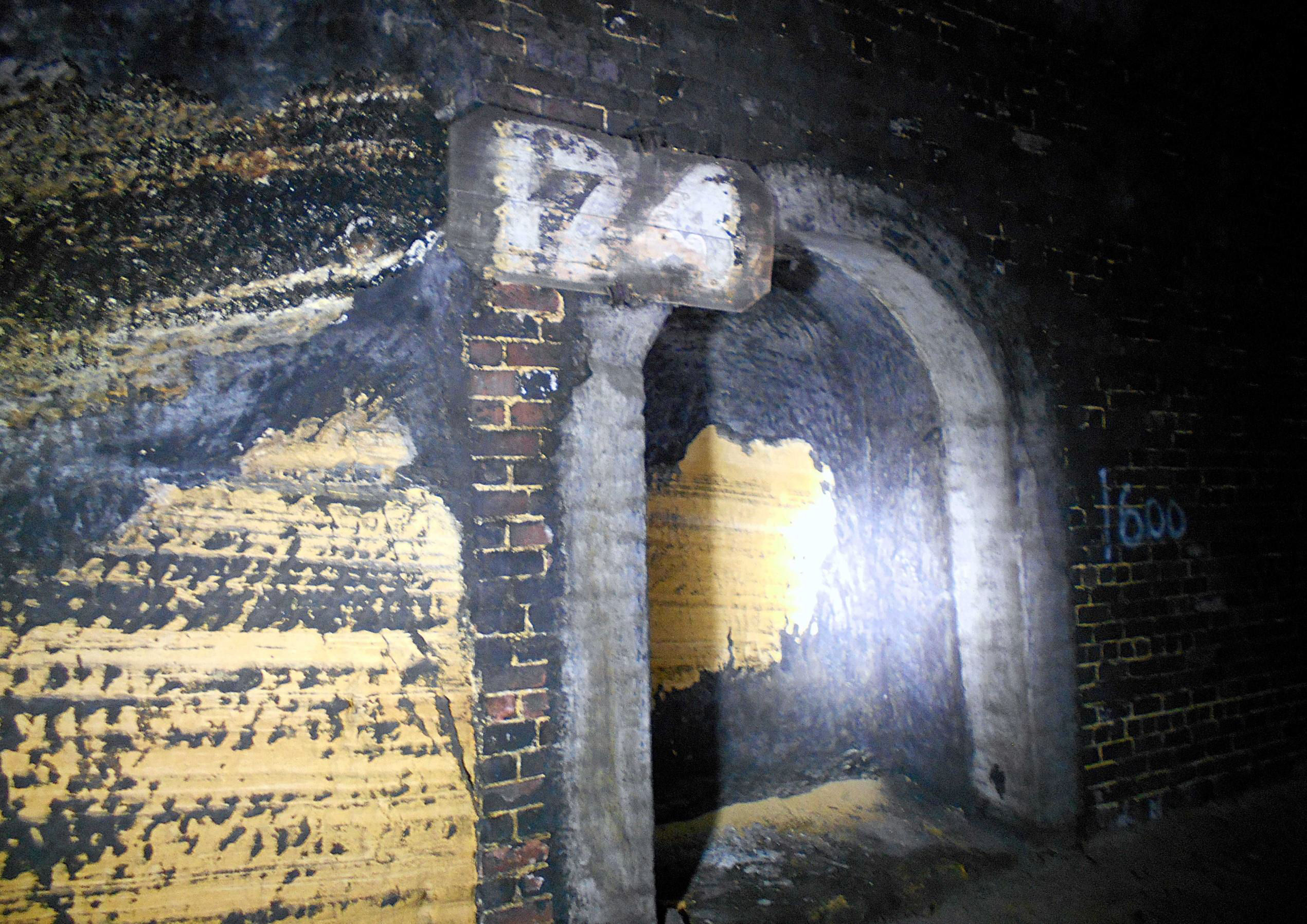
A refuge with a number board.
[© Liz Moralee 2026]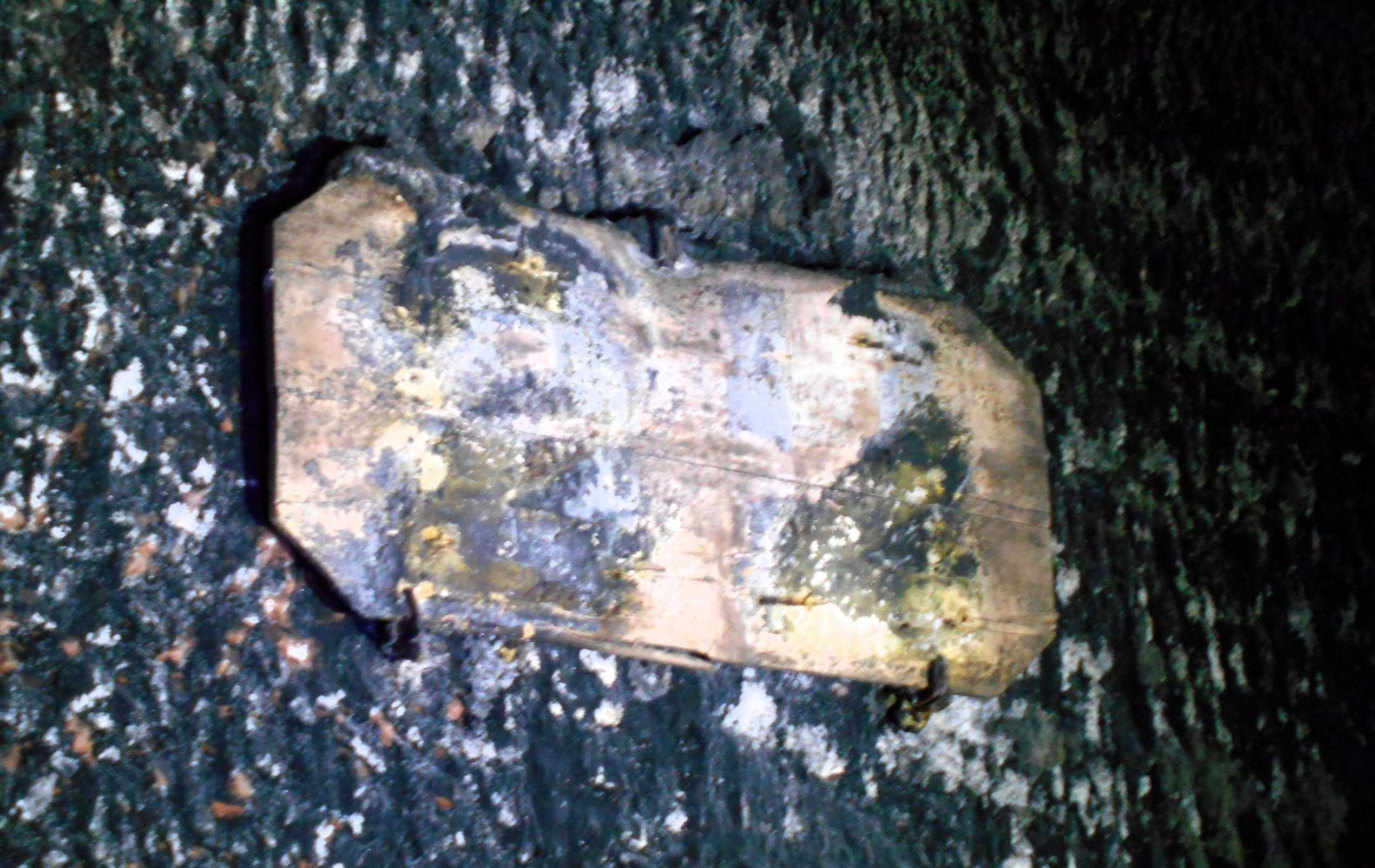
Another possible distance marker board on the Tunnel wall.
[© Liz Moralee 2026]Our torches revealed that the noise was not a ghost train but more prosaically a Merseyrail train passing over an enclosed concrete bridge which, since the 1970s, has cut through Wapping Tunnel at right angles just above head height. This bridge carries the Merseyrail Northern Line built to redirect Garston (superseded by Liverpool South Parkway) trains from their previous terminus at Liverpool Central High Level (CP 17 Apr 1972 along with its final service to Gateacre via Garston and Hunts Cross) to an end on connection with the platforms at Liverpool Central Low Level, thereby forming part of the Northern Line. It opened / reopened to Garston on 3 Jan 1978 and was extended to Hunts Cross on 16 May 1983.
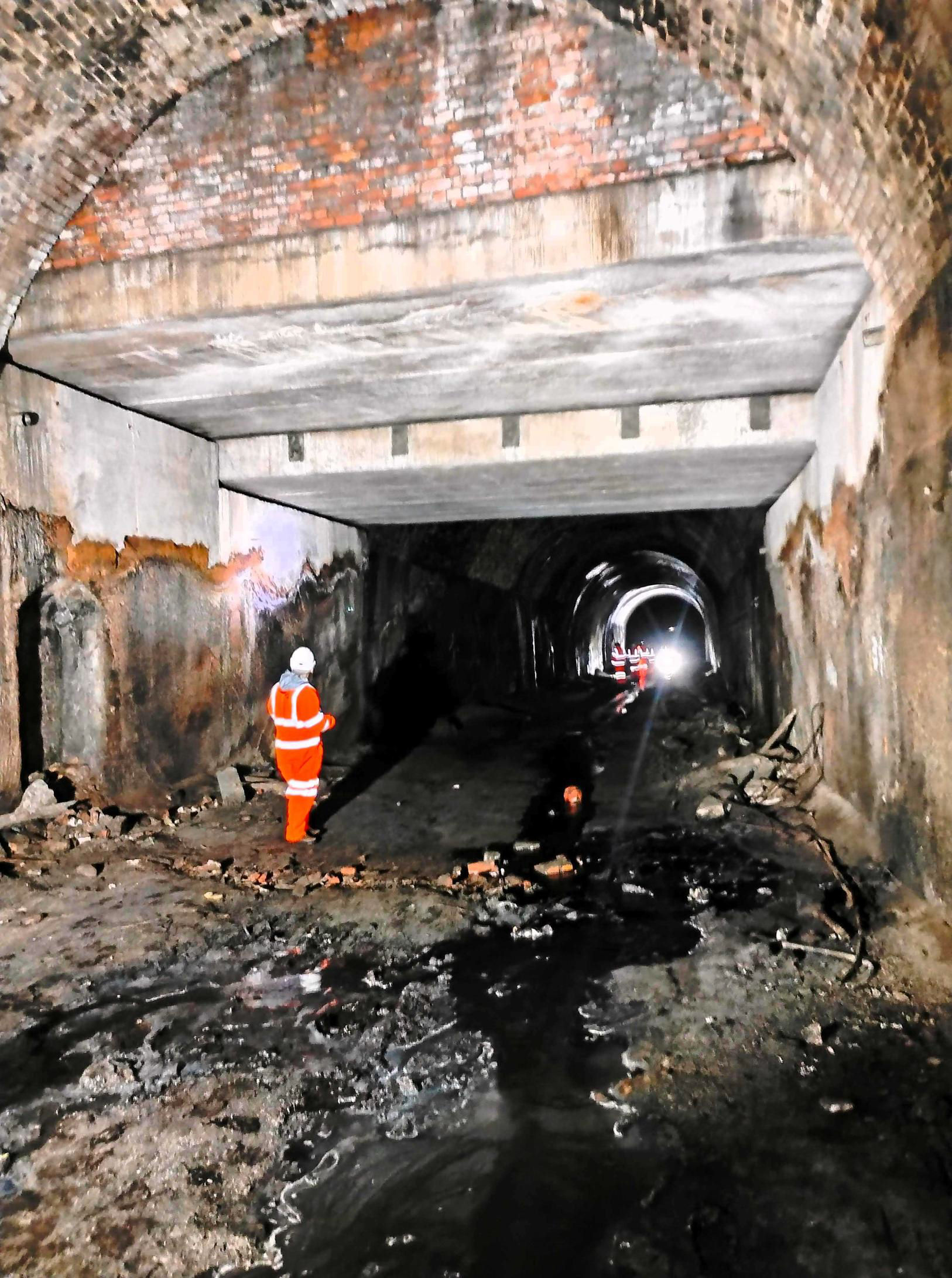
The Merseyrail Hunts Cross to Liverpool Central (Low Level) Northern Line 'bridge' with
different heights of the Up and Down lines (see report). The noise of Class 777s passing was weird.
[© Tim Hall-Smith 2026]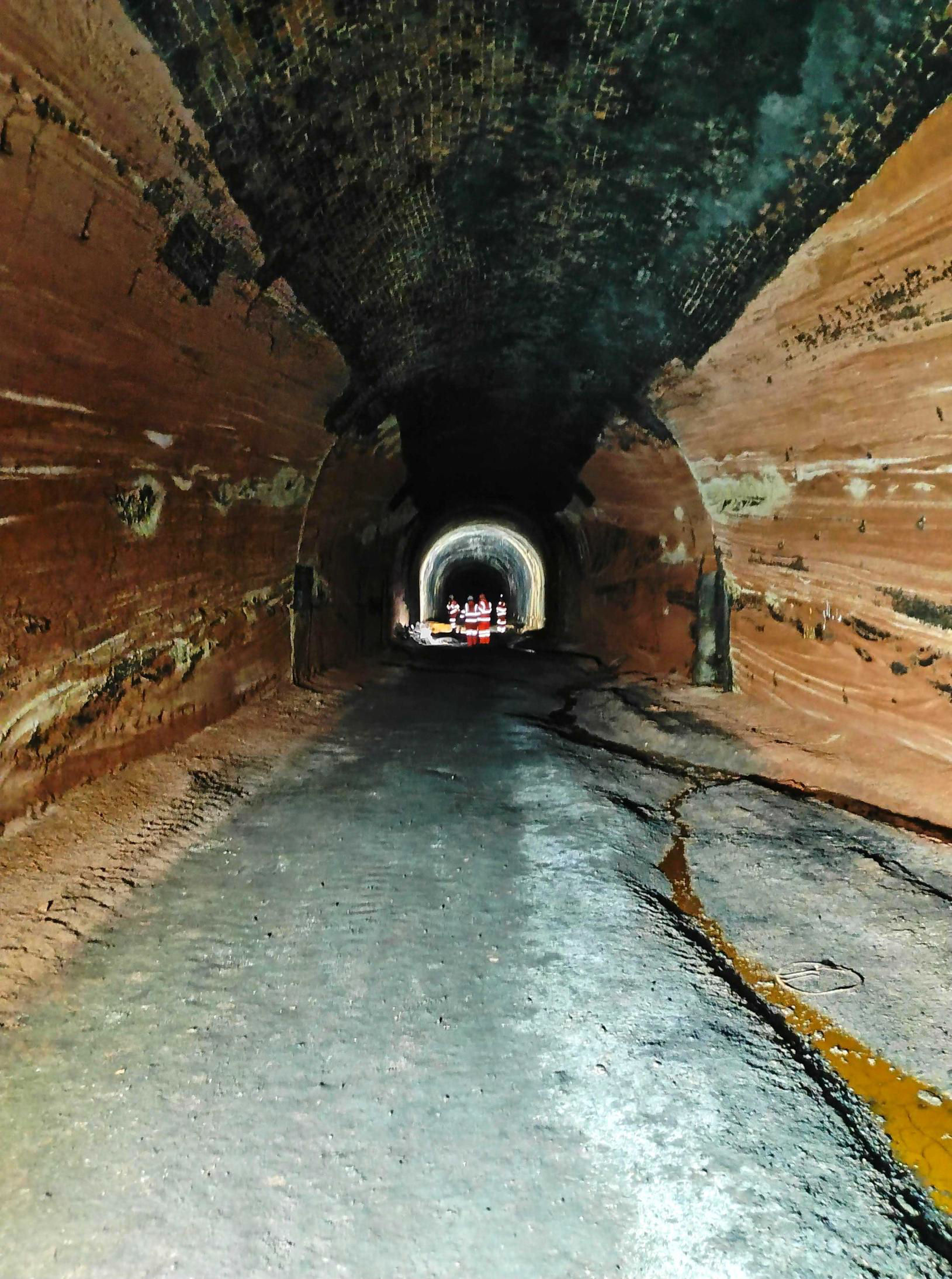
Some of Wapping Tunnel was bare unlined sandstone. Several separate streams of water were encountered, as here.
[© Tim Hall-Smith 2026]What puzzled me about this Merseyrail bridge was that it was split level, the southbound track is higher than the northbound. A fellow Society member explained that the northbound and southbound tracks diverged horizontally and vertically between here and Liverpool Central because they were originally intended to form part of a subterranean flying junction that was descoped. From this junction, another connecting line would have joined the main line at Edge Hill. It was even proposed that the Edge Hill Spur should be routed through Wapping Tunnel and indeed it is possible that the Tunnel is still safeguarded as a route for this (to become part of Merseyrail) or for similar purposes.
With e-BLN, is a 62 page feasibility study into options for a Merseyrail Edge Hill Spur, possibly using Wapping Tunnel produced as recently as 2017 (at least the consultants did very nicely out of it).
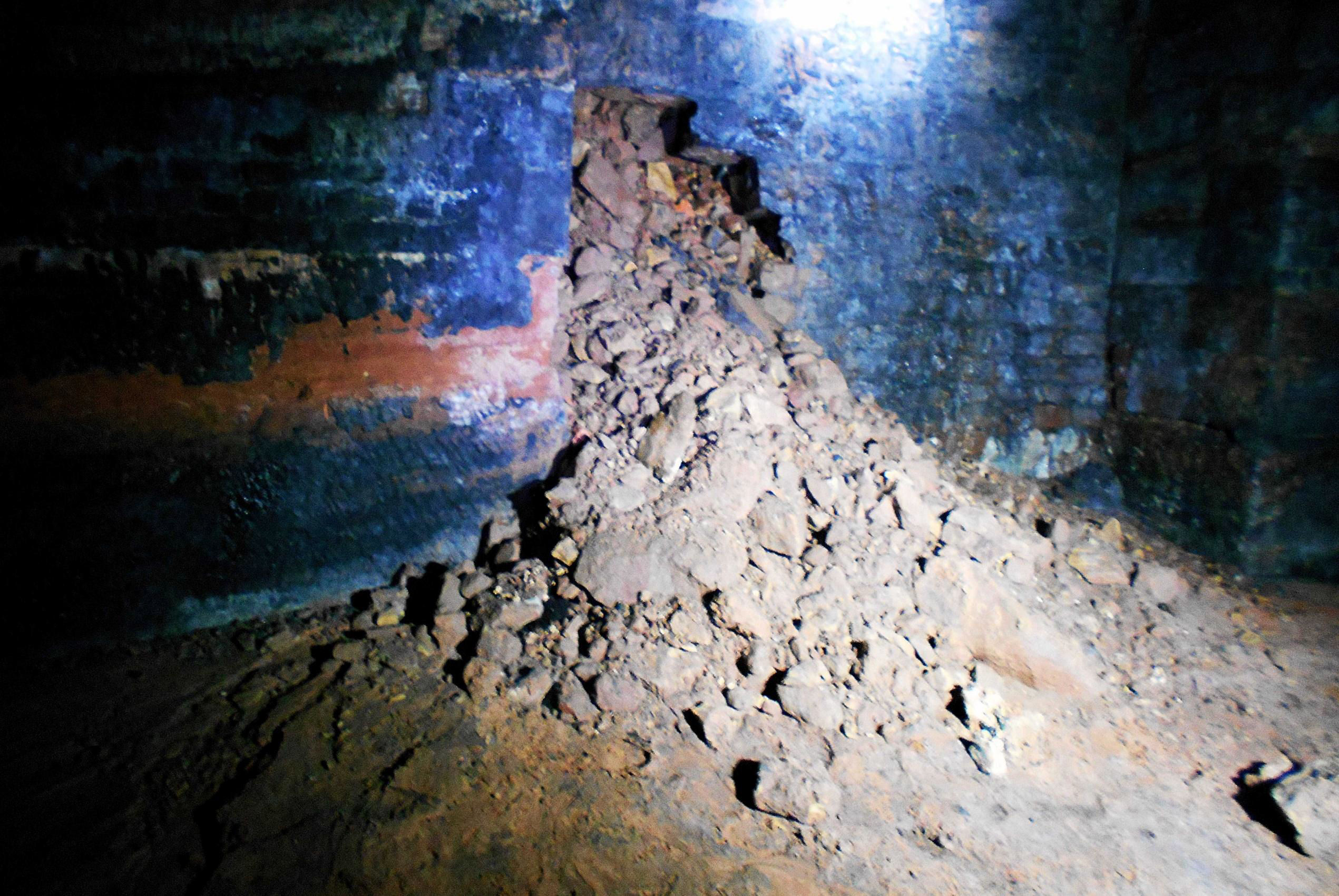
An area where the tunnel wall had failed.
[© Liz Moralee 2026]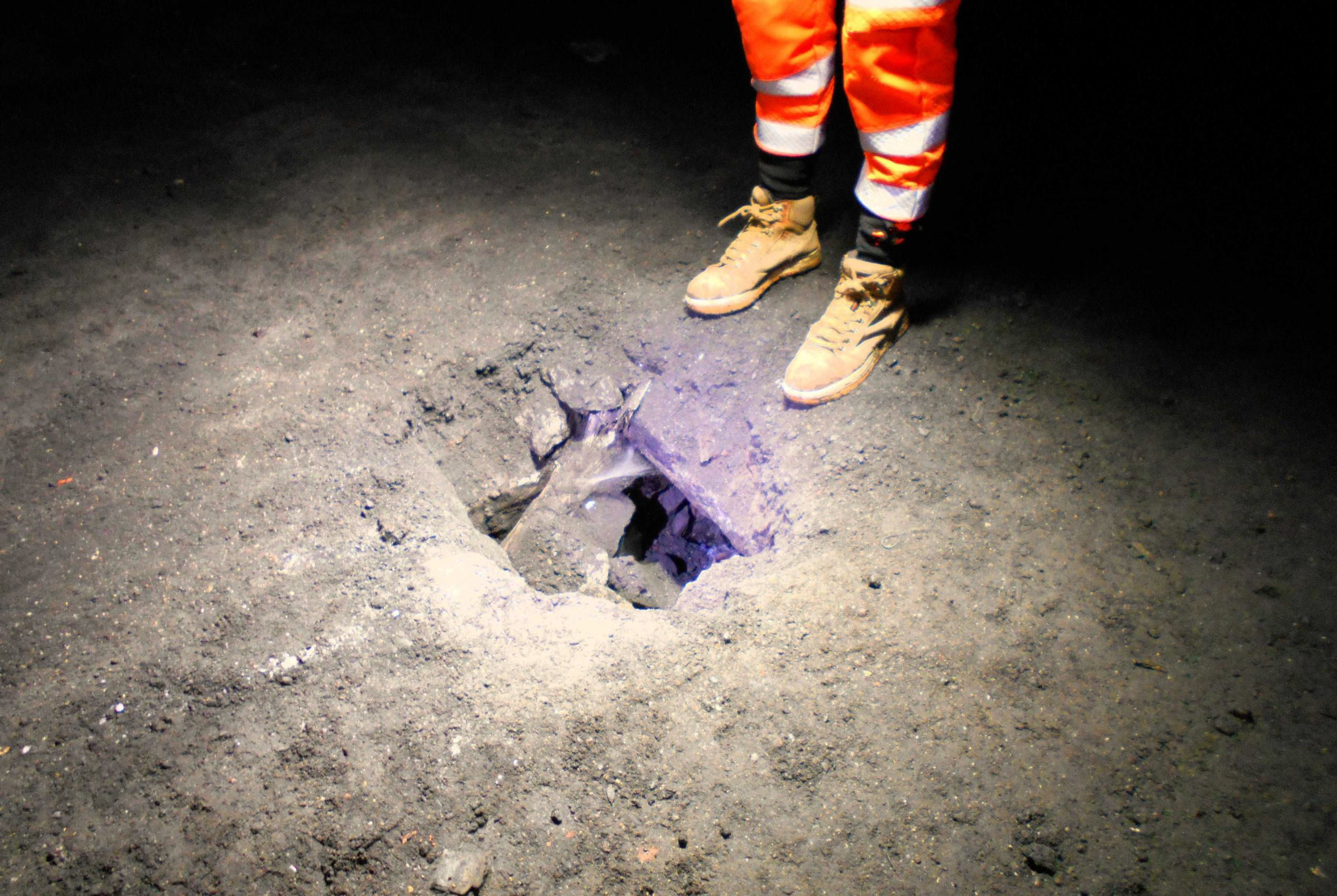
An example of why our participating members had to watch their step, although generally the Tunnel floor was sound and easy to walk on.
[© Liz Moralee 2026]About 100yds past this bridge, we reached journey's end, further progress prevented by a sea of standing water. The tunnel levels out at its western end and its exit has been partially infilled with rubble so it is hardly surprising that a deep pool has formed. I felt sure that, having passed a pair of gongs on the right but only one gong on the left, the missing gong lay concealed beneath the water's surface. Maddeningly, however, I had neglected to bring my snorkel and flippers, so the question remained unresolved.
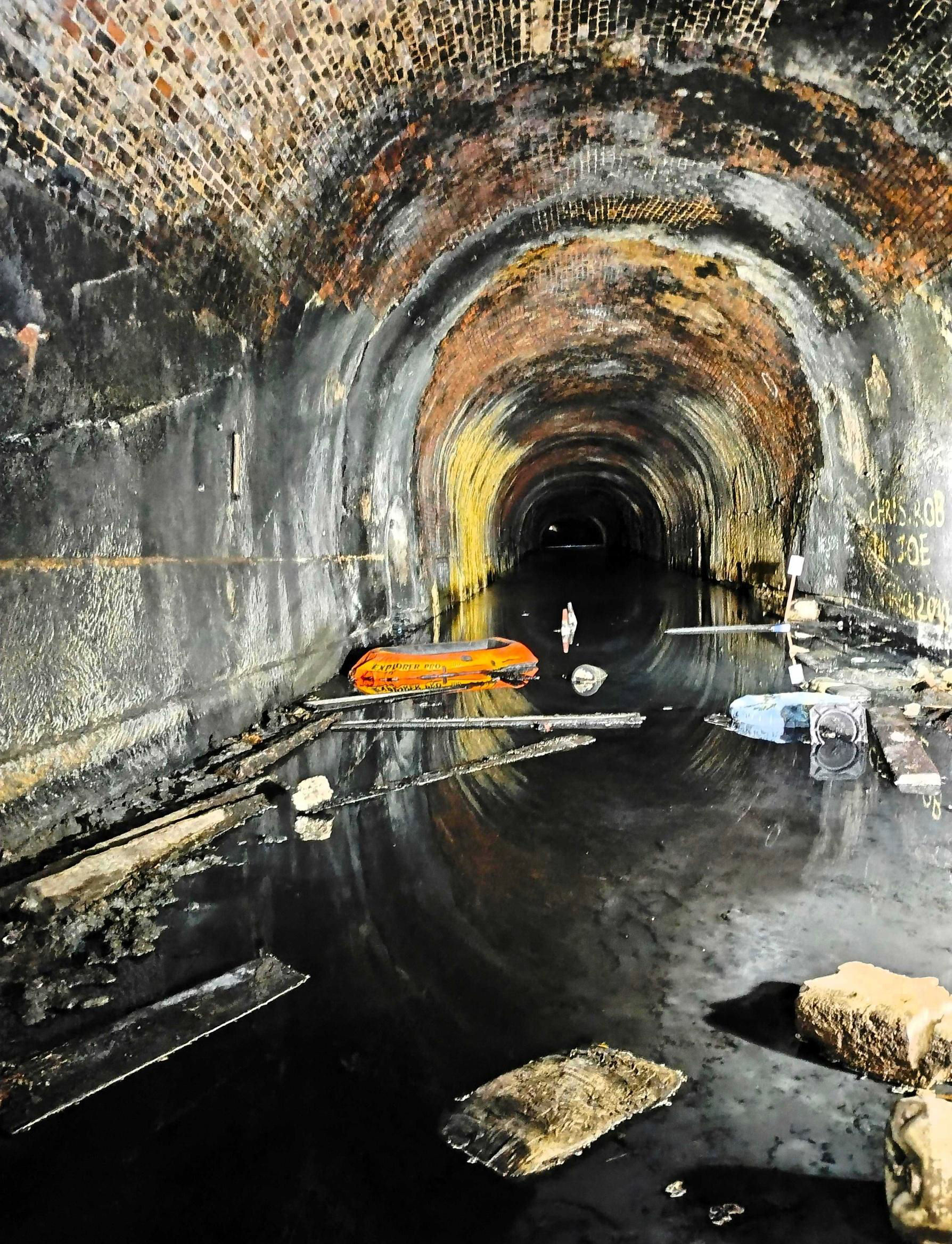
The pool in Liverpool? The blocked far end of the Tunnel was flooded (had we known
paricipants could have bought their swimming trunks or waders). This dingy was a suprise!
[© Tim Hall-Smith 2026]Enormous thanks to Adam, Chris and Rob for making this 'whopping' fixture possible, one of Adam's 'crowning glories'. It is incredible to think that the tunnel through which we walked was just three years short of 200 years old and has been closed for well over half a century. It occurred to me that, having done the tunnel on the right and the tunnel in the middle, it would be good if the Society was to arrange another railtour that took in Crown Street No5 Tunnel as it has been done in recent years on tours (as above). However, I somehow feel that the mighty Wapping Tunnel is the one that will stick in my mind. As a result of this fixture, a 'whopping' £474 donation was made to 'Centre 56' in Liverpool that offers childcare, information and support to families affected by domestic abuse or in a crisis situation.