This 'enterprising' event followed the highly successful 18 May 2025 LUAS Green Line 'Har-stone Explorer' tram tour; both arranged by the Irish Railway Record Society (IRRS). Initially 20 places were allocated for our members, later increased to 26 (all taken). I was very fortunate to be able to book a place following a late cancellation. Other BLS members booked via the IRRS website, so we were very well represented!
My method of reaching the tour was on the No871 Eurolines coach, originating from London Victoria Coach Station and caught at Birmingham (Digbeth) Coach Station. It used to run every night before the Pandemic but sadly is now Saturdays only, convenient for this Sunday tour. This service has been very useful over the years as the coach actually drives onto the Holyhead to Dublin Ferryport ship (Irish Ferries), then directly to Busáras. This is the main Dublin bus station, close to the LUAS tram stop of that name and Connolly railway station. It avoids getting lost in the extensive Dock area with its lockable steel gates and many miles of hissing pipes (probably carrying toxic products!). Alexandra Road is closed to all traffic currently, including pedestrians, at the Dublin end until October for major refurbishment work. Sadly, the solid substantial fencing across the tracks confirms that there has still been no resumption of rail traffic from Tara Mines. The dock complex is being extended further still in the Holyhead direction!
The 70 participants assembled at LUAS Red Cow Depot for 10.00, were kitted out in hi-viz vests and received a safety briefing. The many familiar faces included our Ireland Editor and his father. The Red Cow area of Dublin is named after a historic 17th Century tavern that once stood near the junction. Originally 'The Shoulder of Mutton', the establishment allegedly featured a painted sign of a red cow. The popular pub sign inspired the name of the surrounding townland and the iconic modern junction. It is a major transport interchange (buses, coaches and trams, with a large Park & Ride) where the M50 motorway meets the N7 Naas Road. Some participants had travelled directly from the airport on fast coaches that morning to do the tour as a day trip from England; others stayed for a few days or longer.
The tour, on LUAS tram 3001, started from the Depot Apron Road 6 at the shed doors. That is six shed roads from the western Depot boundary. There is a Martyn Brailsford up to date complete LUAS trackplan on our website for logged in members. On the 'Home' page, go across the top banner to 'More options...', then down to 'Track Diagrams'. Next, go across to 'Light Rail ...' and down to 'Dublin LUAS'.
3001 then left Red Cow Depot to head into Dublin City, via what staff call 'The Ladder' also avoiding the Wash Plant (covered on our return), thus the tour covered both crossovers between the Wash Plant and the triangular junction with the normal passenger line.
For most of the tour, we briefly halted at each stop (presumably to keep the computer systems happy) which were automatically announced in English and Gaelic. This confused some 'normals' waiting at the stops. Towards the end of the tour, the system must have been switched off as the announcements stopped as did the pauses. An observation was the need for the tram to very briefly move forwards after a tram stop if there was a traffic light controlled vehicular crossing - presumably to activate them.
Our tour ran to the emergency trailing crossover between Smithfield and Four Courts. After it had been manually barred over and permission had been received by radio, we used it to return to Heuston (middle line), where there was a photo stop. This line is only generally used on a Sunday afternoon when demand is such that a Heuston to Connolly shuttle is added to the mix. The next port of call was indeed Connolly, where some trams were turning back as a less frequent service was required on to The Point.
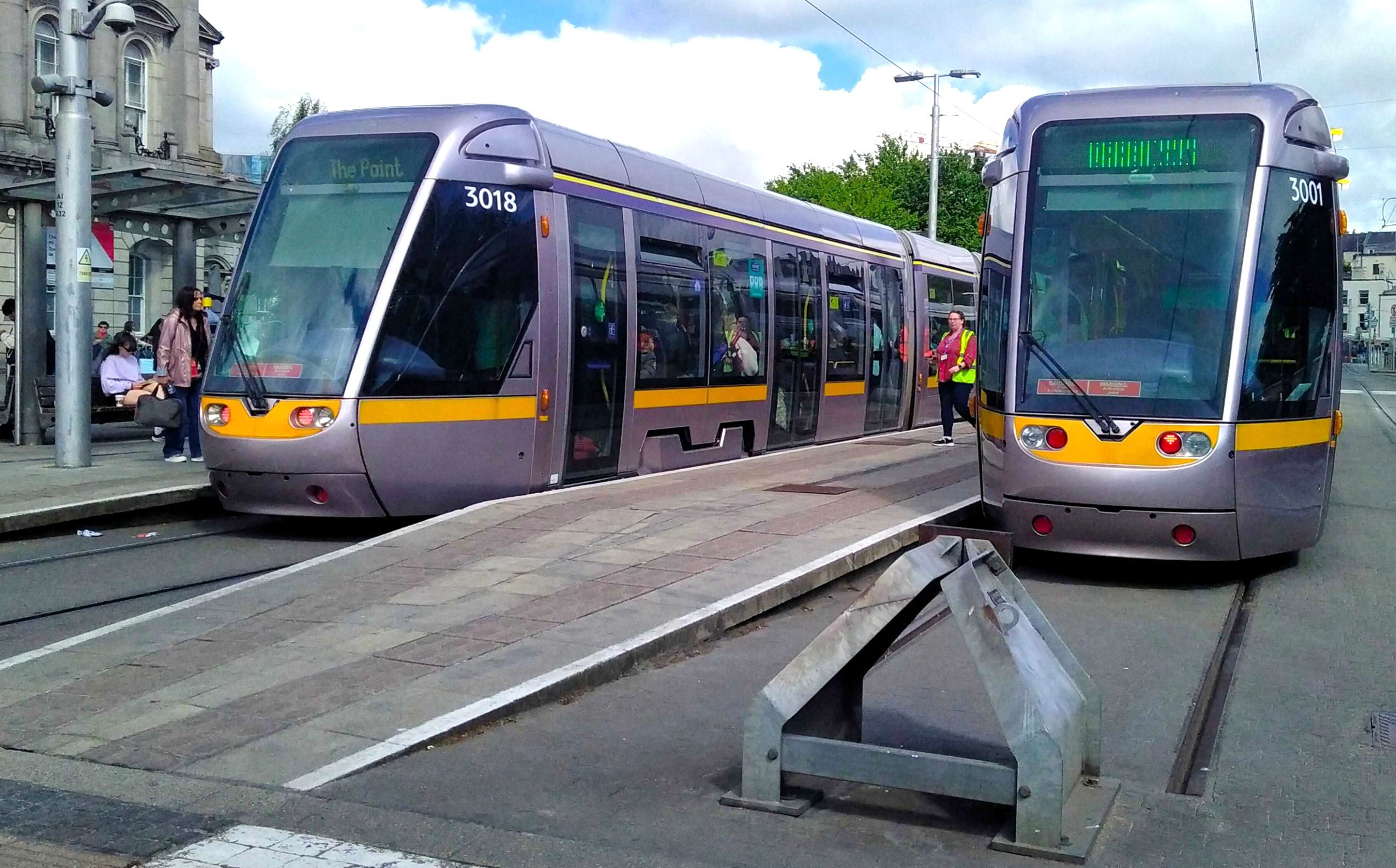
Our tour tram (left) in the centre road at Heuston tram stop, the IR station is far left
[© Phil Logie 2026]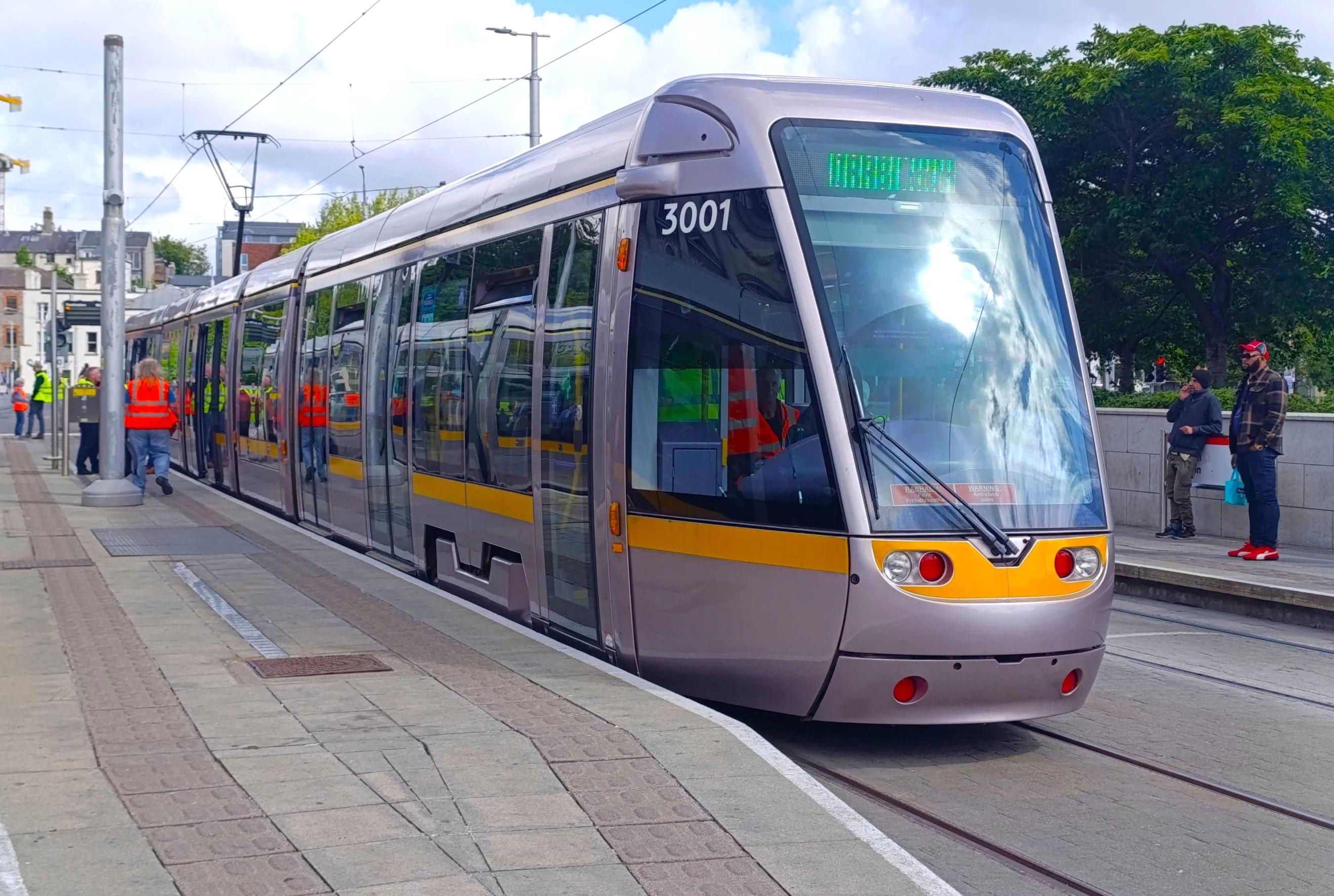
Also at Heuston centre road, the other end of our tour tram, looking towards Connolly and The Point
[© Aleksandar Stojiljkovic 2026]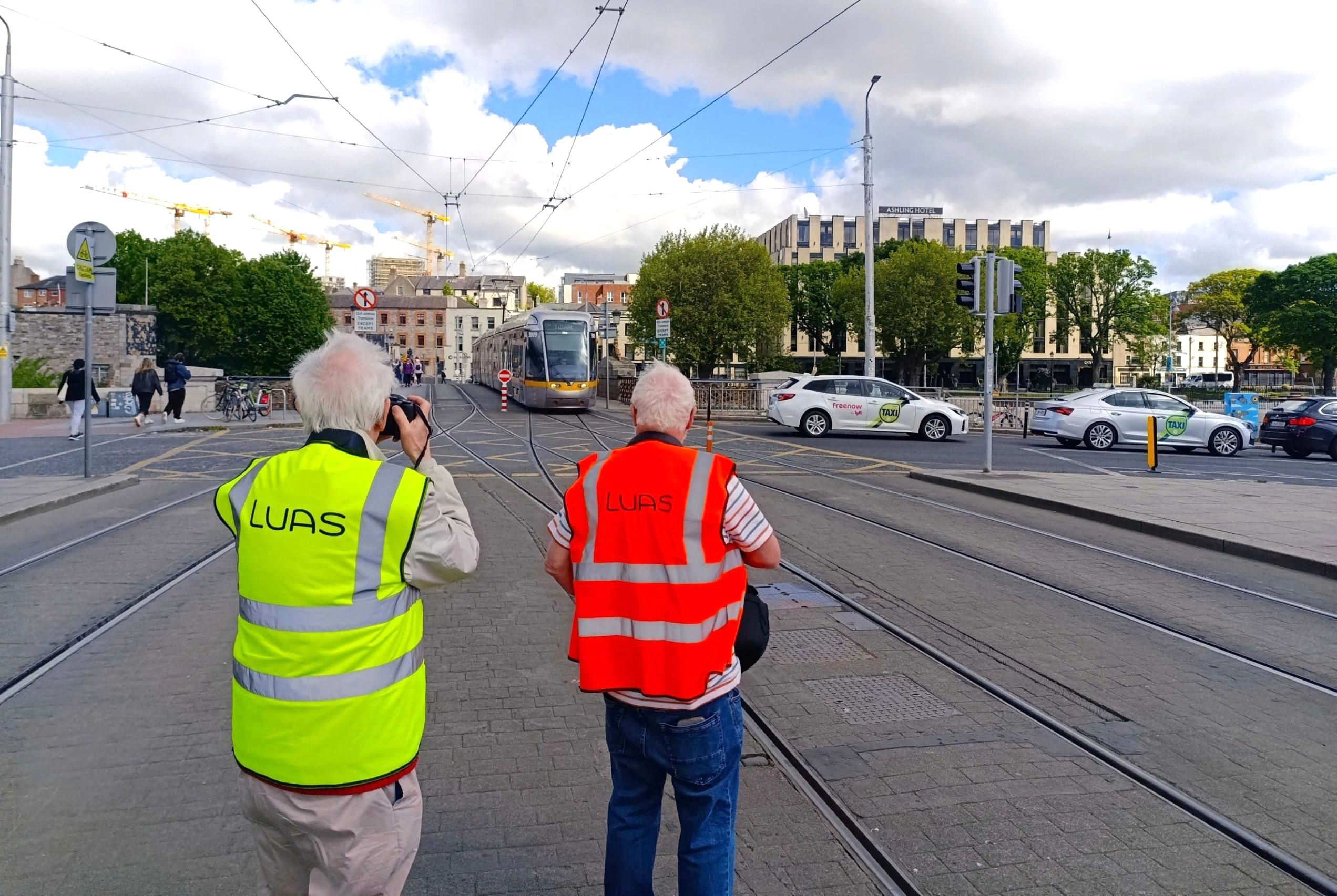
A tram to Tallaght approaches Heuston during our photo stop there.
[© Aleksandar Stojiljkovic 2026]Next a major highlight, the third side of the triangle from Connolly to The Point, only used by empty trams (up to four) stabled at Connolly to bring them into service after a major concert etc. The other track of this curve towards Connolly is never used (we were told) as there is no signalling so use would require the Police (Garda) to close the road! [Shades of railtours in Wales to the Fords engine plant branch at Bridgend requiring Police to guard the ungated crossing over the A48 into the Works.] En route to The Point, we noted the new humpback St George's Dock bridge with an unusual new road surface that sparkled, probably to draw attention to the severity of the hump. Due to a problem with the signalling, special arrangements were needed for us to run into the far left line on arrival at The Point - the points were barred across. The area is a very popular concert and events venue, participants tend to arrive over several hours but all want to return home at once afterwards. LUAS staff advised that a passenger arrival into the events platform is unheard of. An empty tram is stabled on this line during concerts etc as a barrier to avoid queue jumping by those trying to bypass the temporary 'cattle pens' set up to queue for departures after an event. This tram goes into service once the queues have cleared so is generally used very late at night and in the dark, it was much more civilized on a daytime tour!
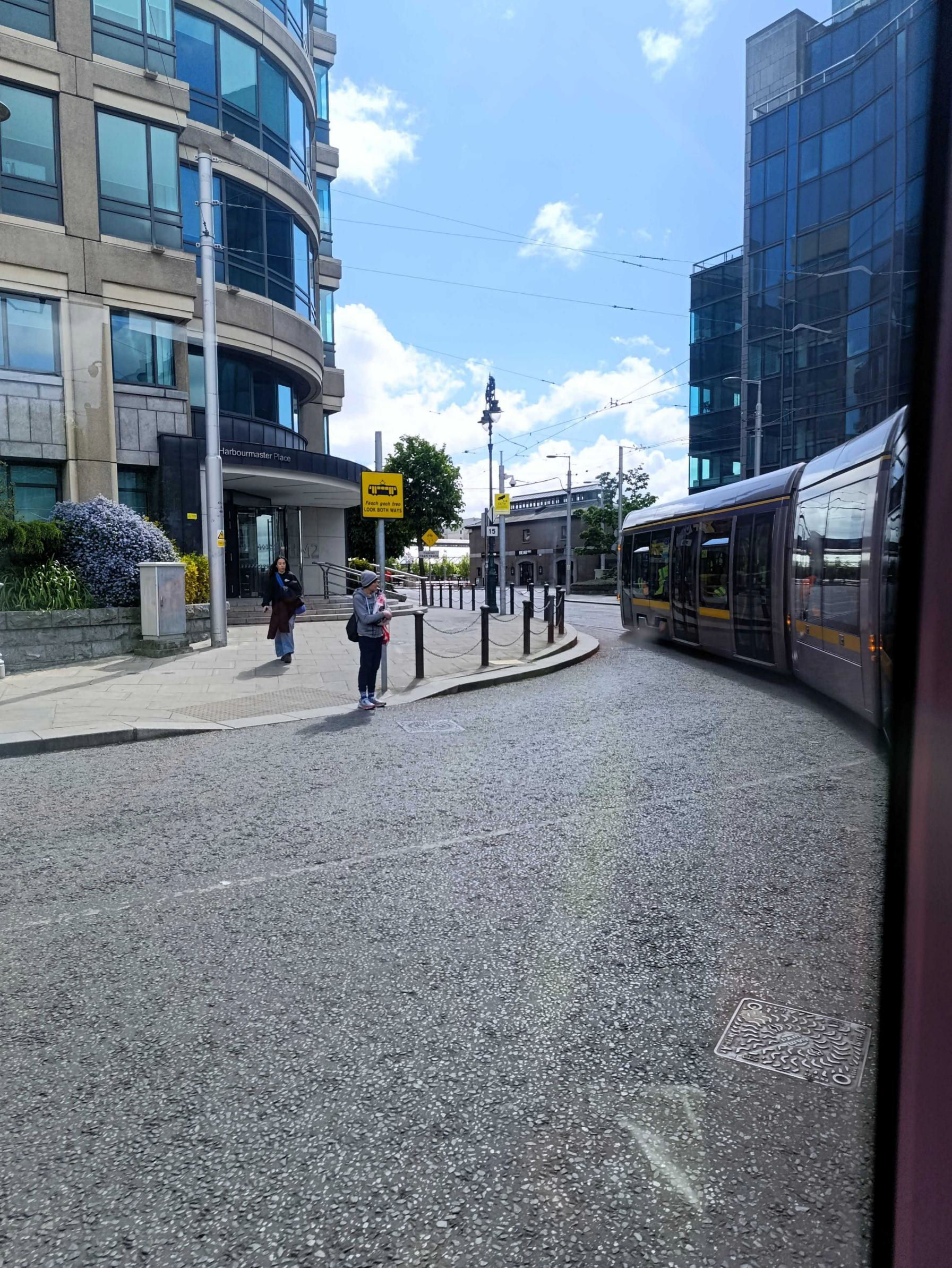
Through glass; the tour on the ultra-rare curve from Connolly towards The Point - ahead.
[© Aleksandar Stojiljkovic 2026]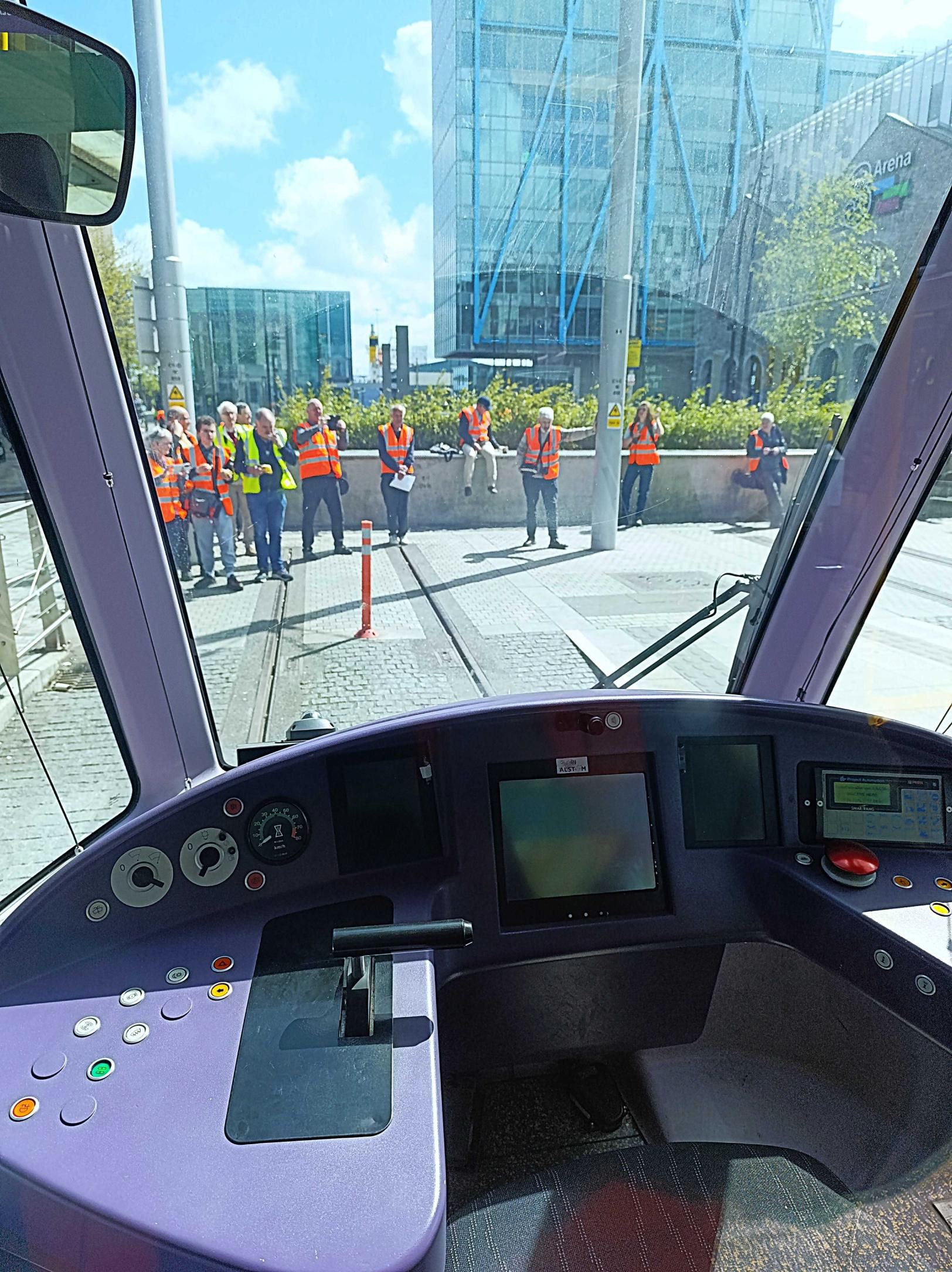
This was certainly not a pointless tour! Taken through two layers of dirty tinted glass at the
unusual far left line on arrival at The Point, it is only used by passengers on departures after events.
[© Aleksandar Stojiljkovic 2026]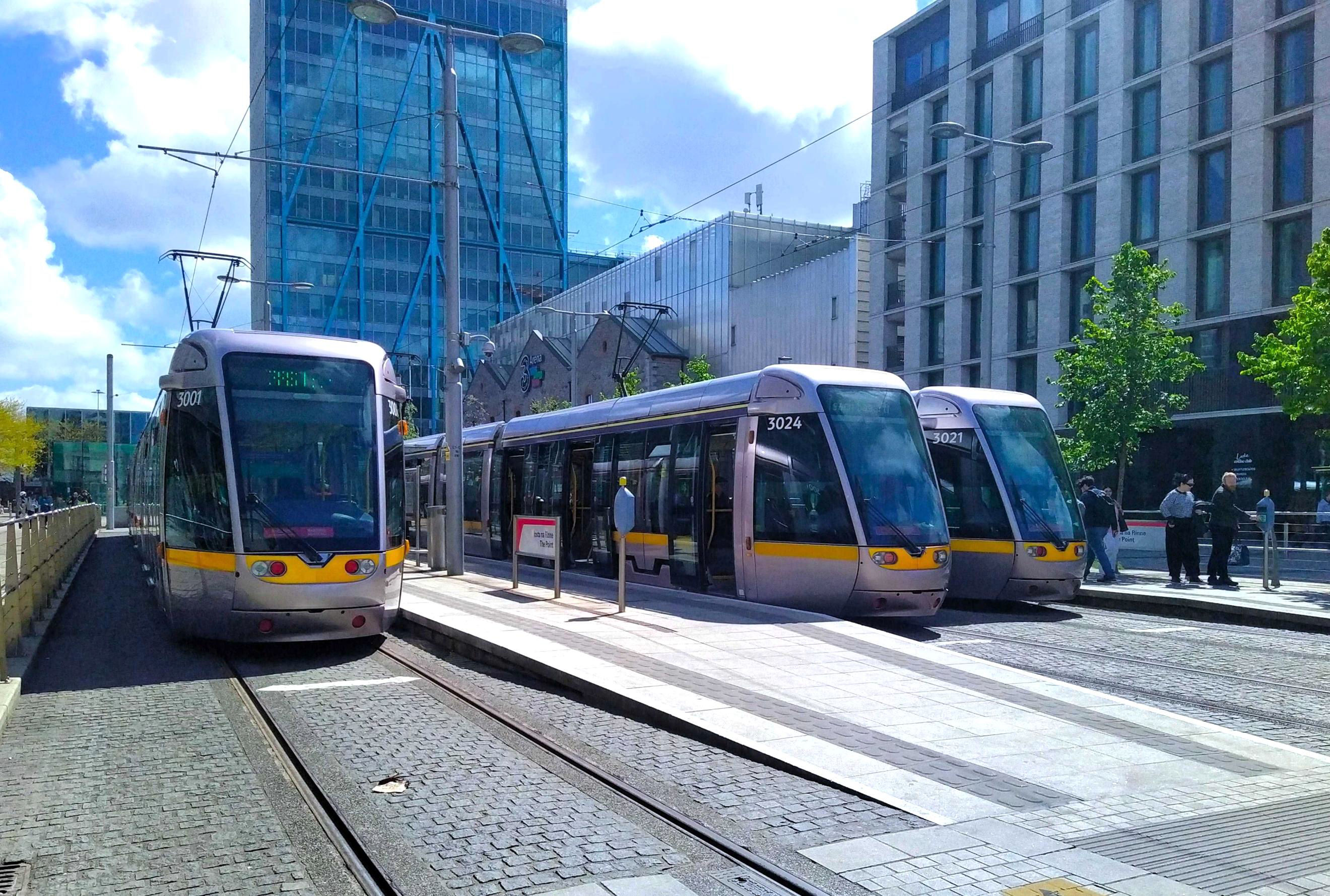
The Point, looking towards the end of line with three trams in, our tour is at the rare platform far left.
[© Phil Logie 2026]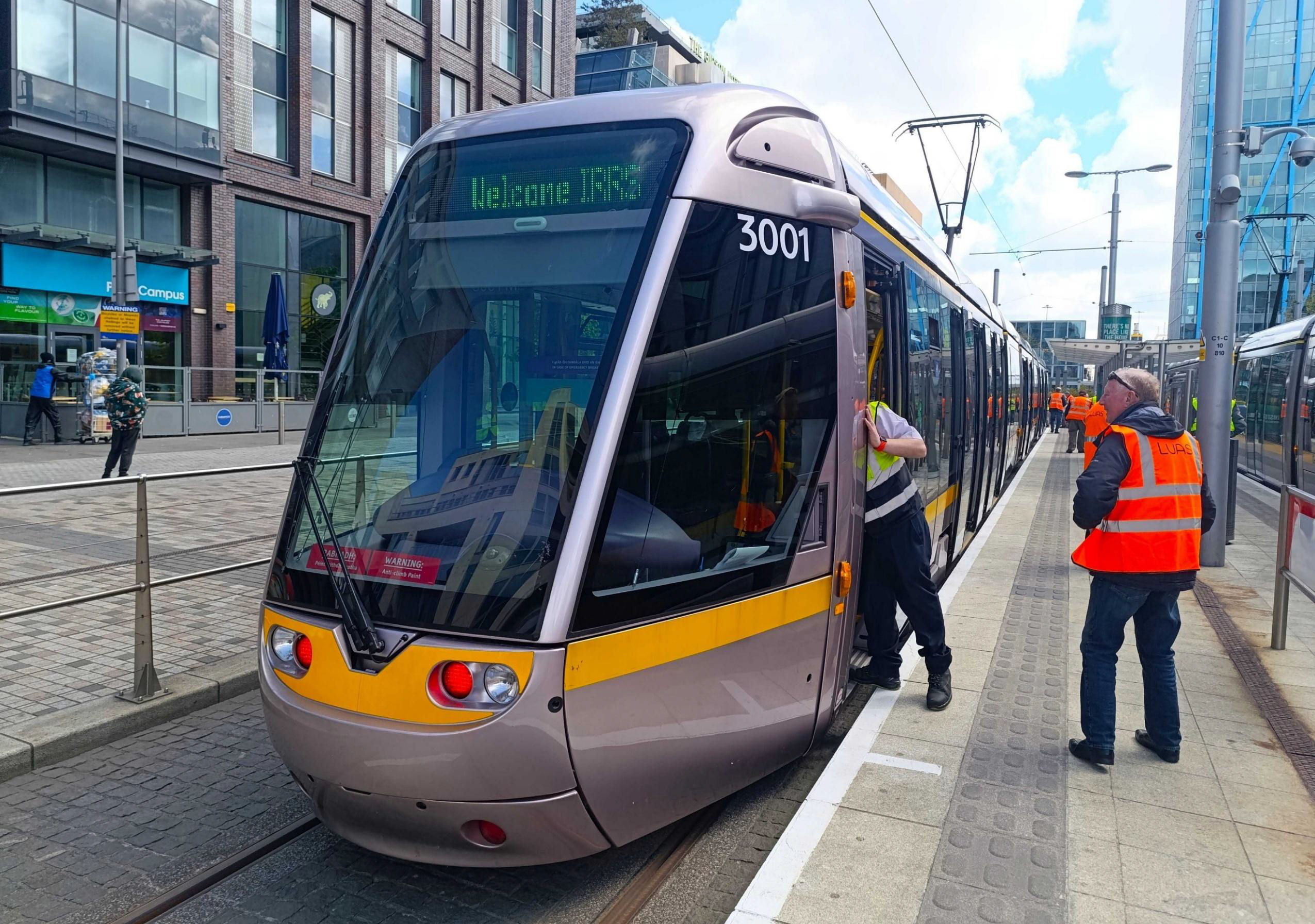
The other end of our tram at The Point.
[© Aleksandar Stojiljkovic 2026]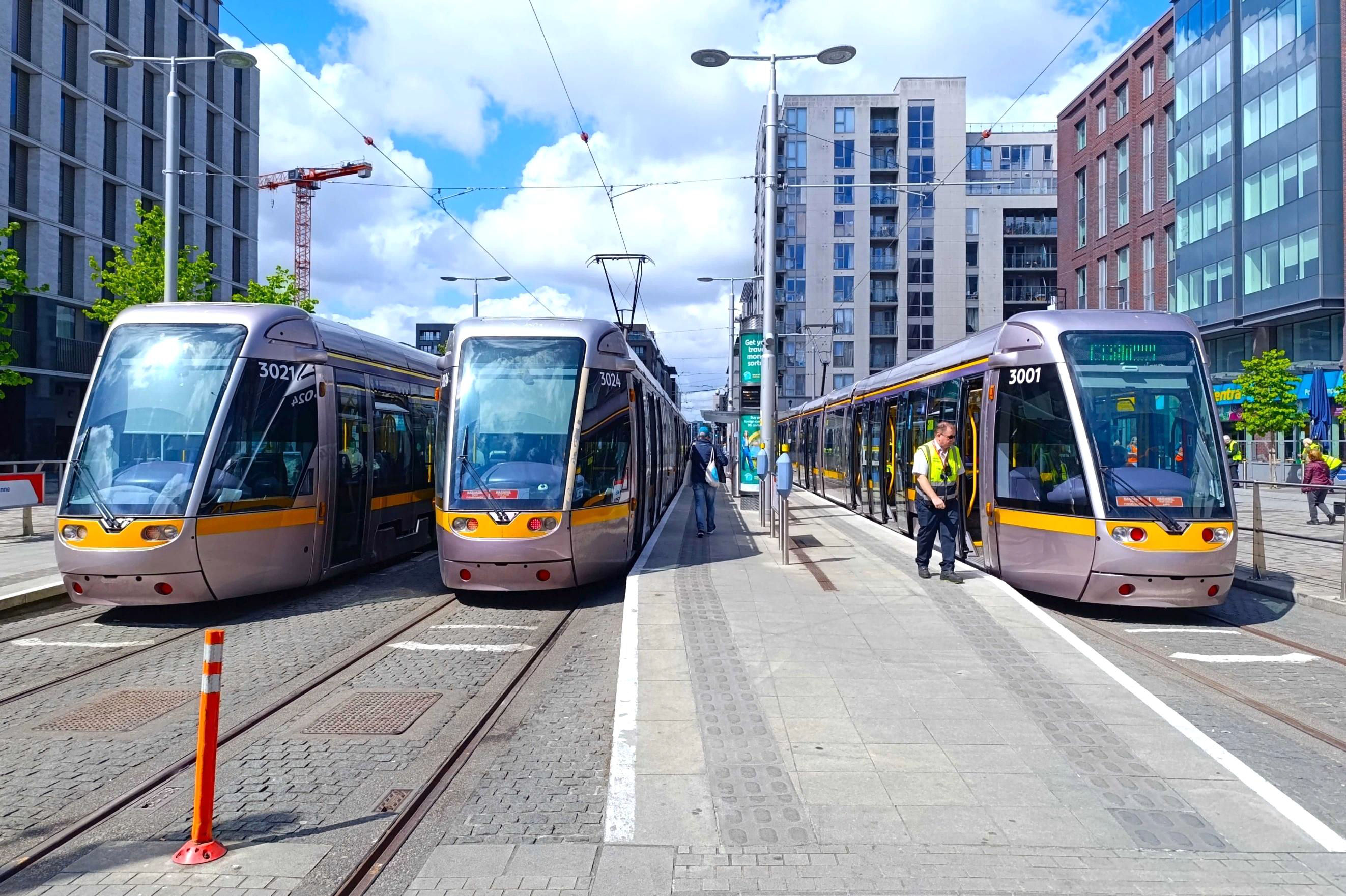
From the end of line at The Point; tour far right. If you miss the last tram, this place becomes the point of no return.
[© Aleksandar Stojiljkovic 2026]This area was once the Great Southern & Western Railway North Wall area goods depot - could those who did that claim overlap with LUAS? More to 'the point', this was another photo stop and a much used loo stop (through anonymous doors to the tram drivers' facilities). Trams don't have such provision.
3001 took us via the third side of the triangle (avoiding Connolly) then over the flat crossing with the LUAS Green Line at O'Connell Street (Sackville Street until 1924 when it was well served by the earlier generation of Dublin trams). We ran past Heuston and Red Cow Depot on the normal passenger run to the terminus at Saggart (Teach Sagard = Priest's House) and straight on beyond into the headshunt (non- preferred left line on arrival, one member had been hoping for the much shinier right side - ahem). Taking the trailing component of the scissors crossover, our tour made for the centre road at Belgard to reverse.
Then it was off to Tallaght, (location of a notable First World War aerodrome) and, again, the left hand non-preferred, headshunt and trailing crossover of the scissors - much to the amusement of some normals waiting on the platform. The name Tallaght derives from the Irish word támh-leacht, which translates to 'plague pit' or 'plague monument'. It combines támh (plague or death) and leacht (grave or memorial stone). Fortunately, we didn't stay there for very long!
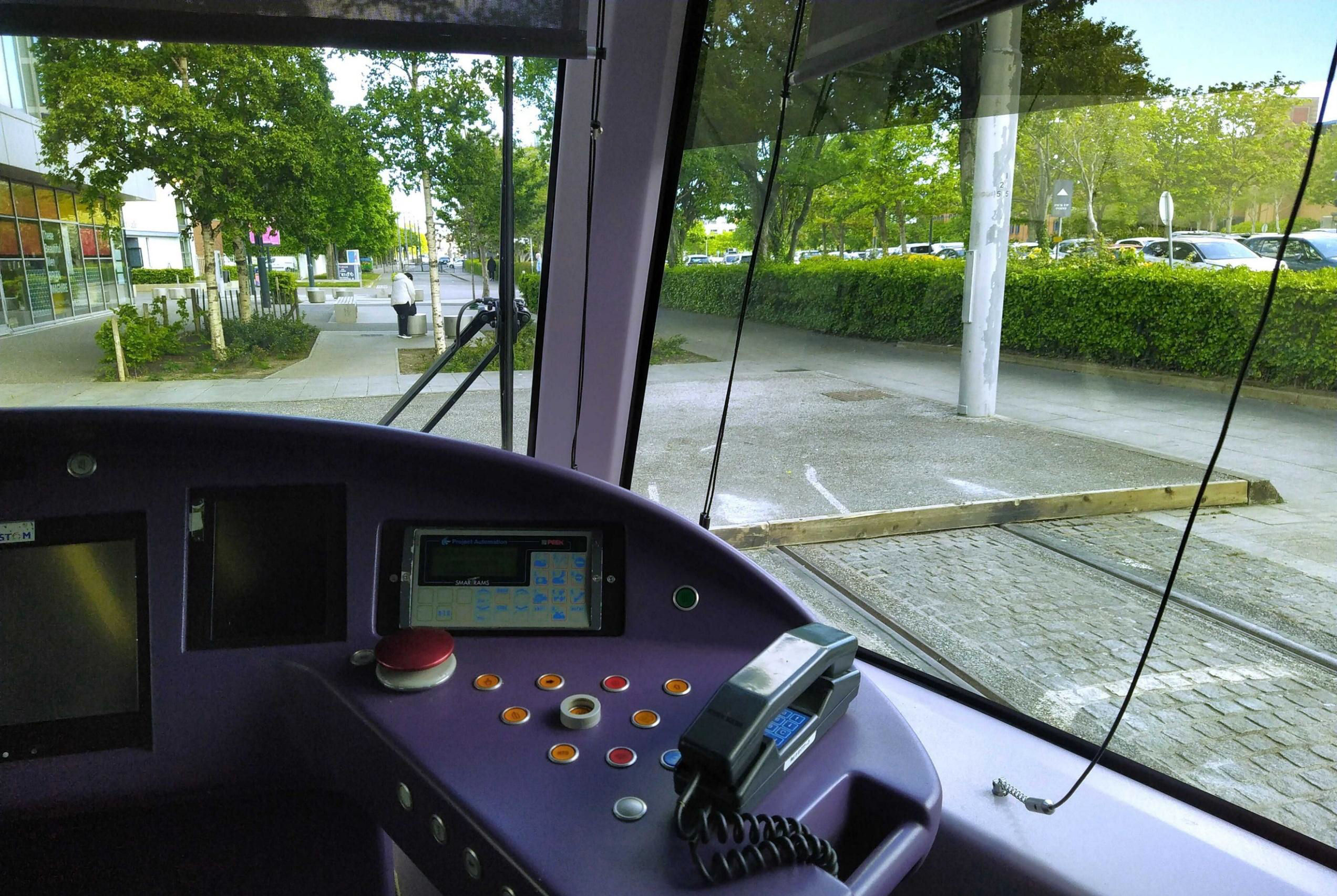
Overlap is achieved with the Dublin & Blessington Steam Tramway (at long last!). Tallaght headshunt beyond the platform, non-preferred track
[© Phil Logie 2026]Then it was another 'much sought after' highlight, through Belgard centre platform. The connections from / to the south are used regularly as, during quieter periods, the less busy Saggart line operates as a shuttle, requiring three trams, which turn back here. The link from Belgard centre platform towards Dublin is seldom used by trams in service, rare track indeed. We turned left into Red Cow Depot to complete the triangle here. This time the tour took the facing crossover to run through the Service Shed (where sand and windscreen fluid etc is topped up), then through the Wash Plant (thoughtfully switched off for us). Also thoughtfully, around 15.00, we concluded at the end of Storage Road 9, a quite different part of the Depot than we had started from. This concluded a most enjoyable and interesting tour.
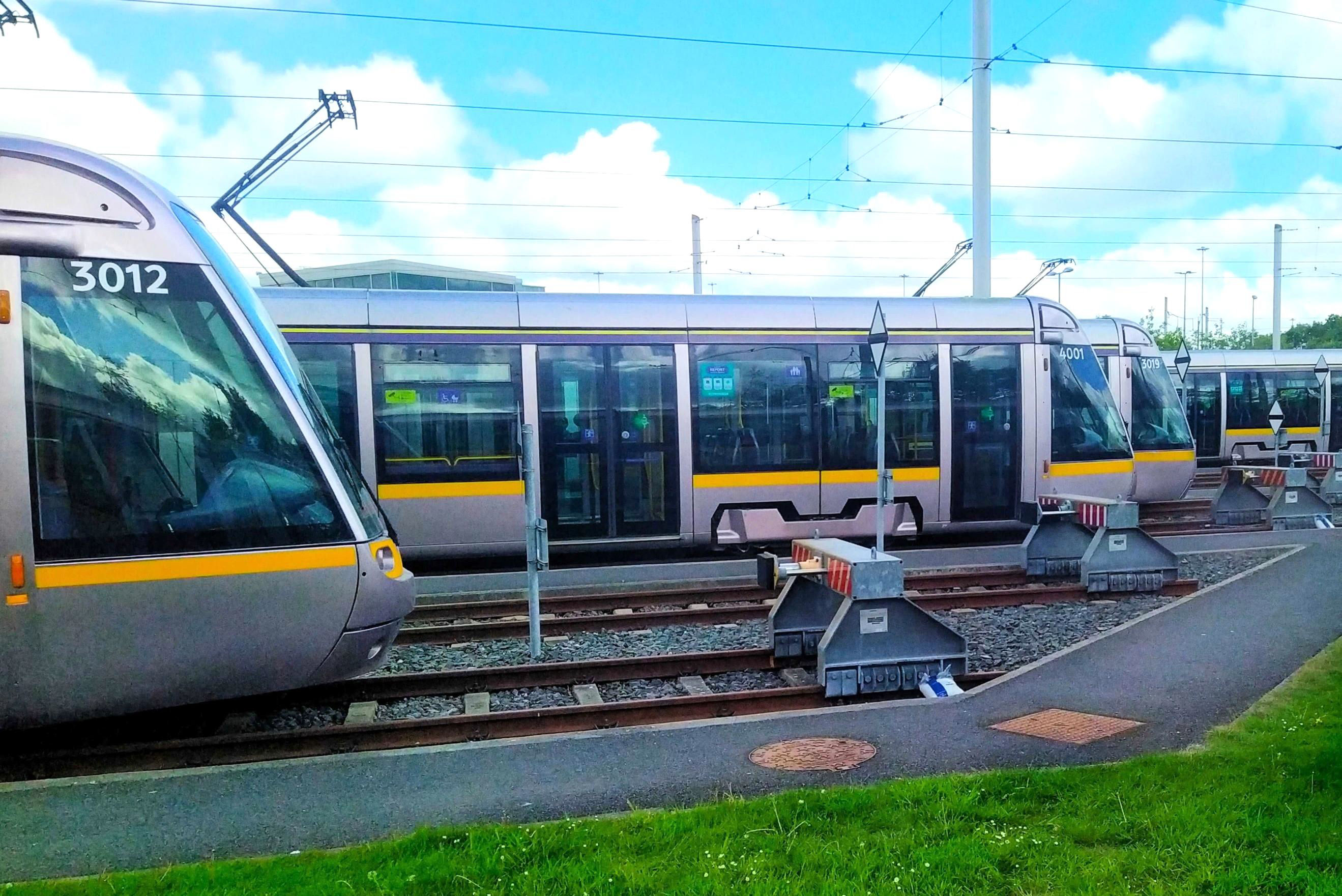
Red Cow Depot, trams are stabled on the various Storage Roads.
[© Phil Logie 2026]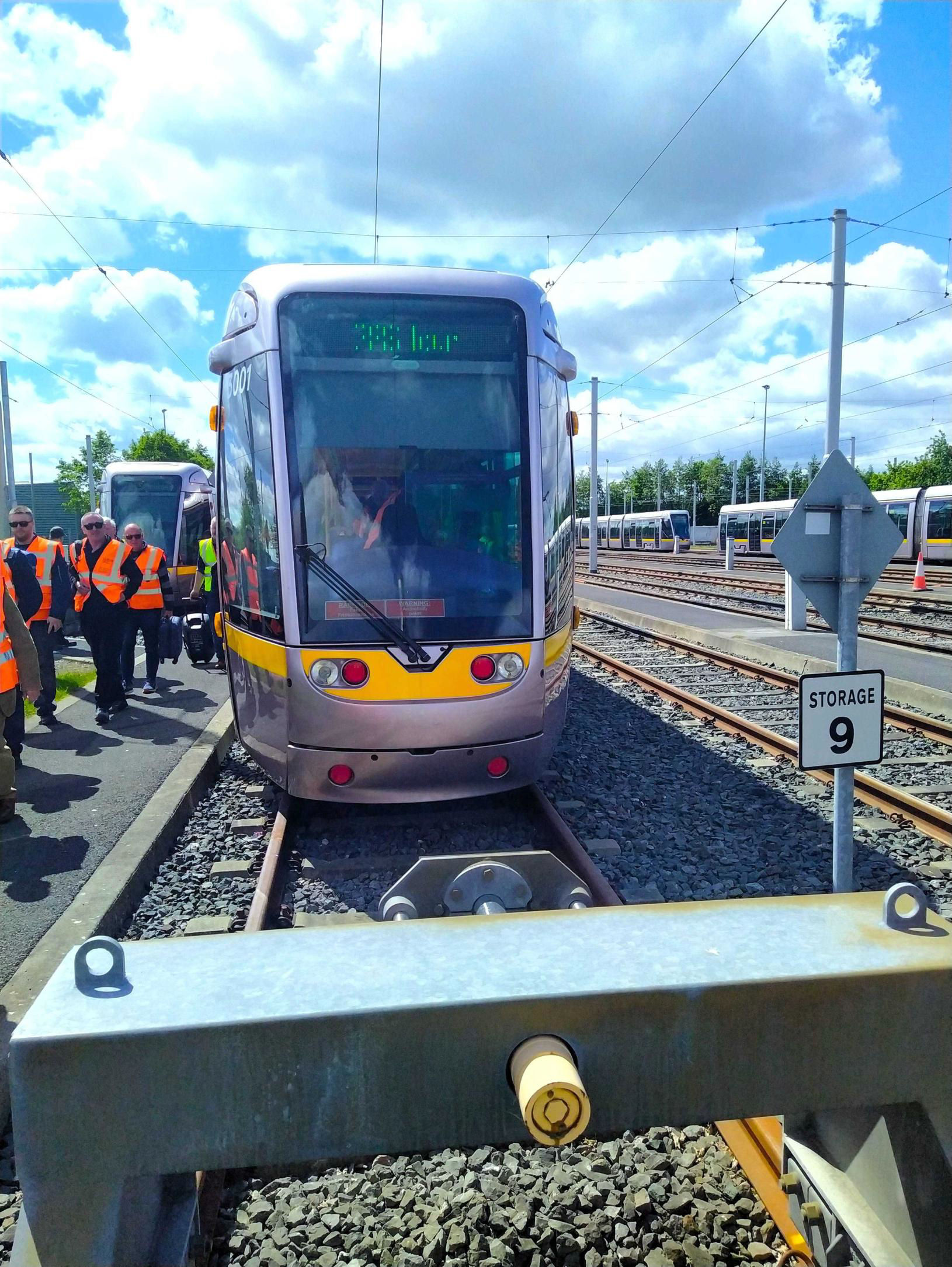
The tour ended here, at the extremity of Storage Road 9.
[© Phil Logie 2026] links to 44 well captioned photos of the tour by Neil Dinnen, who also had a major role in organising this tour. Many thanks to Transdev who have operated LUAS (which is Irish for speed) for 22 years since it opened in 2004. Around 58 million passengers were carried in 2025. On 1 Sep, KeolisAmey takes over the operation. Some asked about the name of the tour 'The Best of Both Worlds' - the two worlds are Dublin City and the suburbs. The name also pays homage to Star Trek. We look forward to more discovery on future LUAS tours, to boldly go where no gricer has gone before (!), seeking out Strange New Worlds (LUAS extensions?) and culminating with 'All Good Things …'.
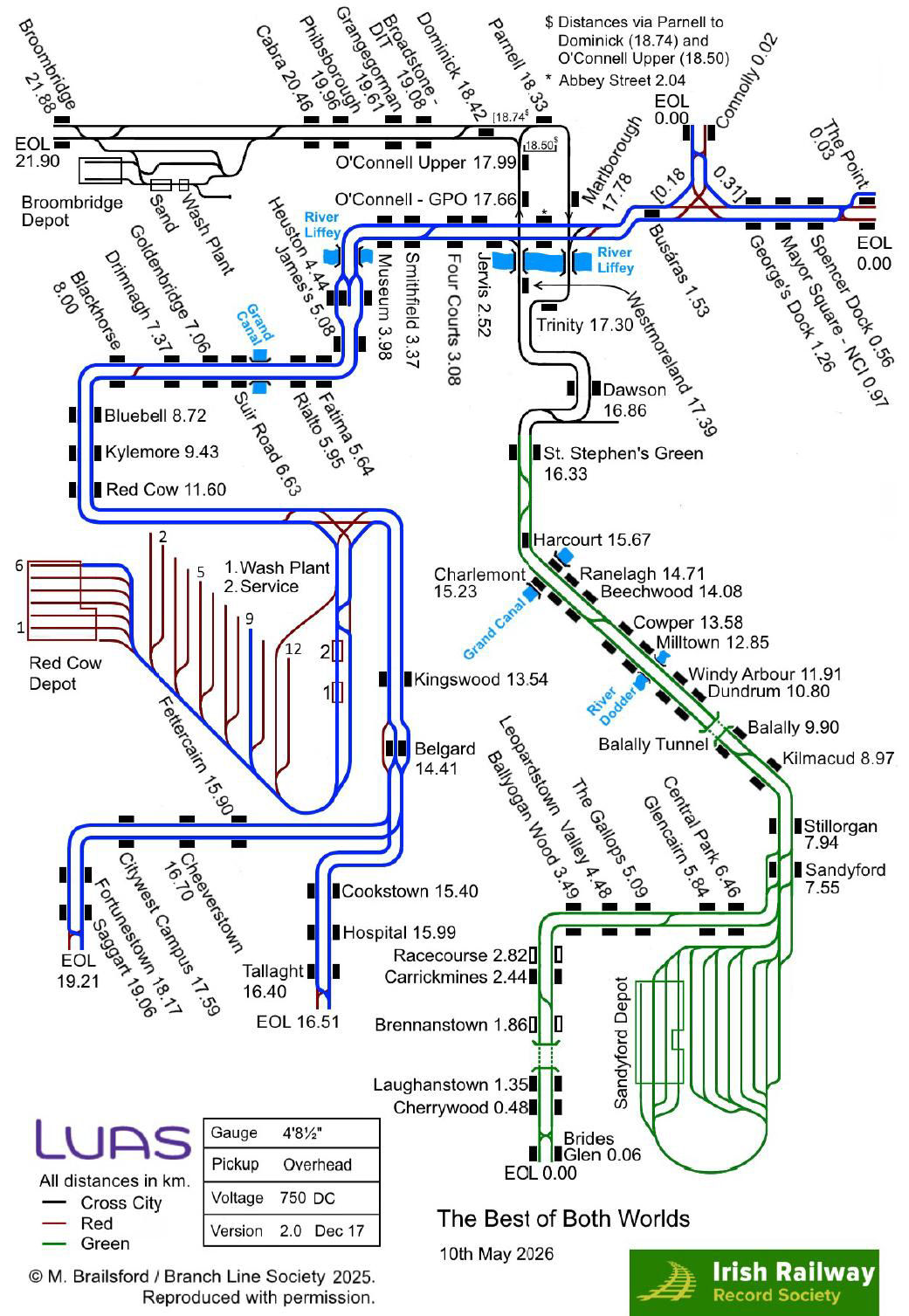
LUAS track map; for personal use only. The tour route is marked in Blue,
the Green Line is, unsurprisingly, Green except its extension from St Stephen's Green to Broombridge, opened 9 Dec 2017 which is black!
[© Martyn Brailsford / Branch Line Society 2026]Postscript: In response to Rhy's question, our knowledgeable LUAS guides (who provided a commentary throughout the tour) confirmed that a short section of LUAS trackbed at Tallaght is apparently on the trackbed of the former Dublin & Blessington Steam Tramway. The first section of this 5' 3" gauge line (which ultimately extended to 20¼ miles) opened on 1 Aug 1888. The last trams ran on 31 Dec 1932. Your Editor compared some 6" to the mile scale 1888-1913 maps superimposed on ESRI World Imagery and discovered that the end of the headshunt beyond Tallaght tram terminus is indeed coterminous with the steam tramway. Anyone who did it could achieve overlap with the LUAS Red Line!