If you thought a nine-hour tram bash covering 99km (according to some trackers) - an average speed of 11km/h - over numerous rare and non-passenger sections, wasn't enough, our participants then awaited a bus to Eisenbahnmuseum Schwechat (Schwechat Railway Museum). With Austrian precision, as our tram wended its way home back through the wide slowly closing gates of the Hauptwerkstätte, a 'Schlenki' in the local vernacular (accordion bus), or bendy bus, pulled up right before us. After a few quick photos, we were all aboard for the brief ride to the museum. We had planned to catch a service bus between Kaiser Ebersdorfer Hauptwerkstätte and Schwechat S-bahn station but, on the day the Eisenbahnmuseum Schwechat sent a heritage bus to collect us. Our tour organiser was invited to put a donation in a collection box at the museum to show everyone's appreciation. Which he did…
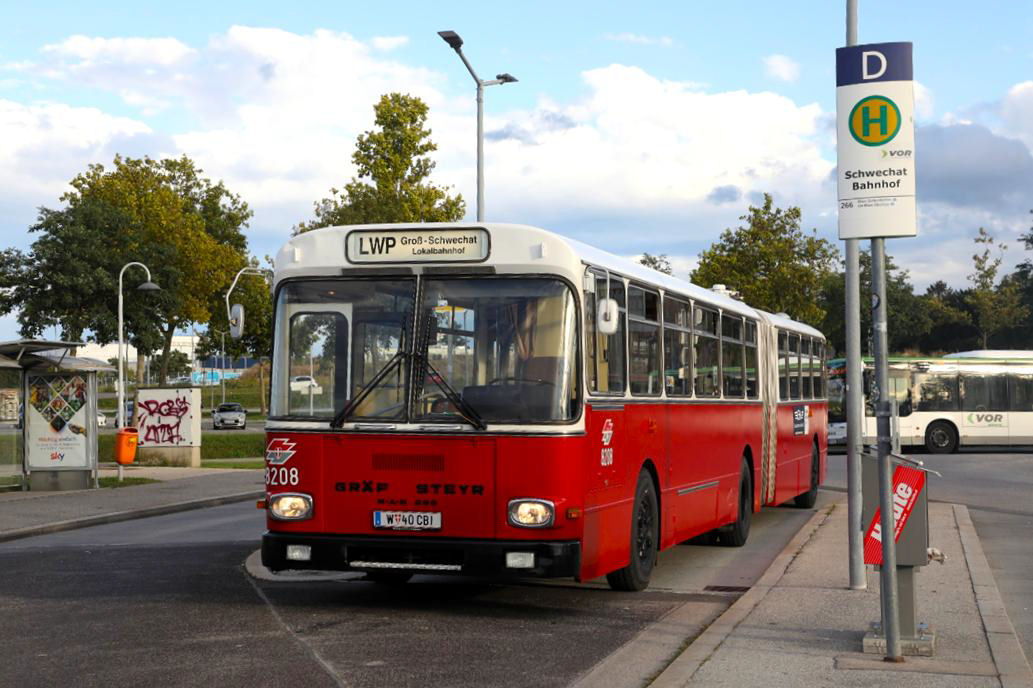
The vintage bendy bus that took members to Schwechat Railway Museum.
[© Iain Scotchman & Simon Mortimer 2025]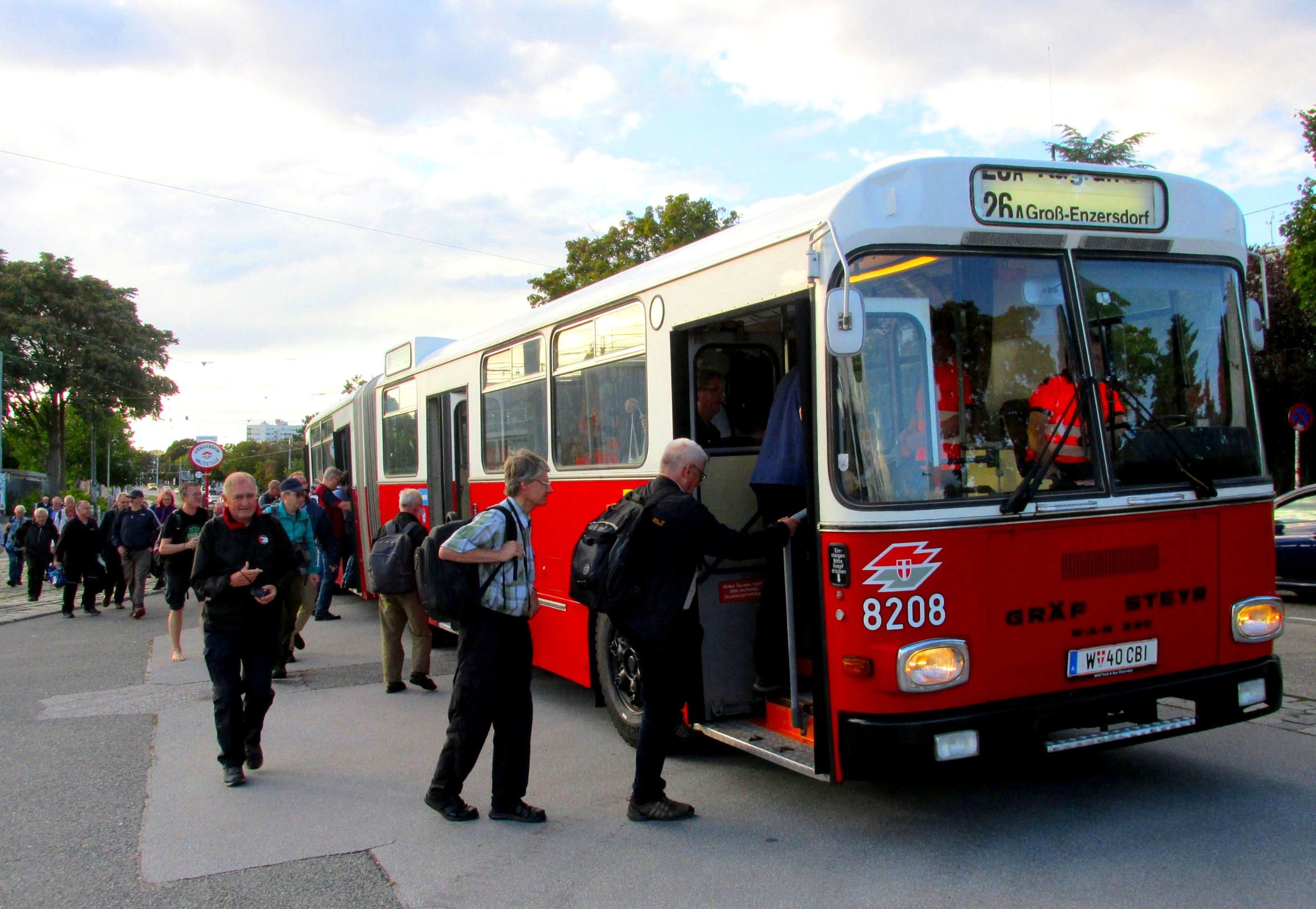
All aboard the vintage bendy bus.
[© Iain Scotchman & Simon Mortimer 2025]The bus was a GU230/54/69/A1 which, for the record, was built in 1983 entered service on 3 Jan 1984 and was withdrawn on 28 Feb 2001. It has a MAN (Maschinenfabrik Augsburg-Nürnberg) Truck & Bus Co engine, Voith drive train and a blistering top speed of 70km/hr (43½ mph). If you wonder where all this insight comes from, I photographed the information panel inside … there is a lot more where that came from! However, the journey was so short that I don't have time to type every technical foible.
We were greeted by some very cheerful museum staff who spoke excellent English making our enquiries and requests as the visit progressed straightforward. We started by joining the 600mm gauge feldbahn (an efficient German word meaning 'narrow gauge field railway') train, headed by works number 2620/1 built 1958 at Karl Marx Works, VEB Locomotivbau, Babelsberg. [VEB = Volkseigener Betrieb meaning Publicly Owned Enterprise.] It was a two-stroke relic that the site manager described as a perfect example of a product of the German Democratic Republic (East Germany) - noisy, so simple that anyone (with a hammer) could maintain it and anyone could be allowed to drive it because it is indestructible.
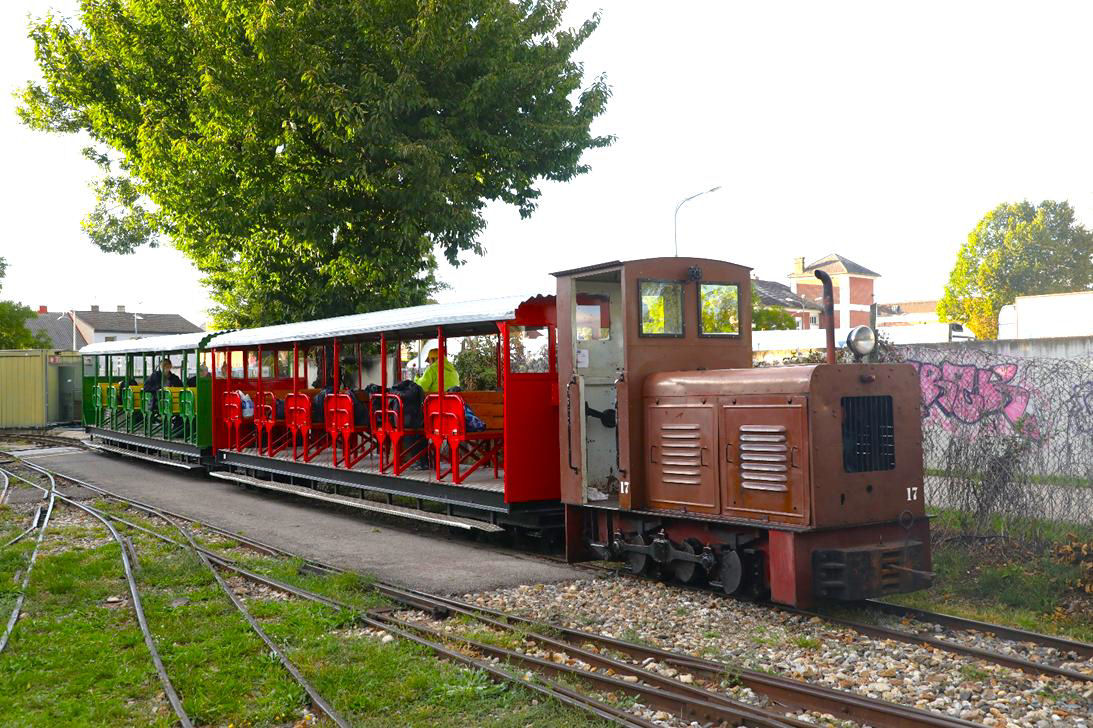
The 600mm gauge feldbahn (field railway) at the Eisenbahnmuseum Schwechat is short but was done in style with this little diesel, No17.
[© Iain Scotchman & Simon Mortimer 2025]To the drum beat and clag of our vintage machine, we set off from the entrance platform for the northern end of the site named Bahnhof (railway station) Locomotive-Werkstätte (workshop). We were then given a demonstration of the removable 600mm panel of track that crosses the standard gauge access line into the Air Liquide (a large French company supplying industrial gases) terminal, although there seemed little conviction it would ever be removed to facilitate a mainline standard gauge movement!
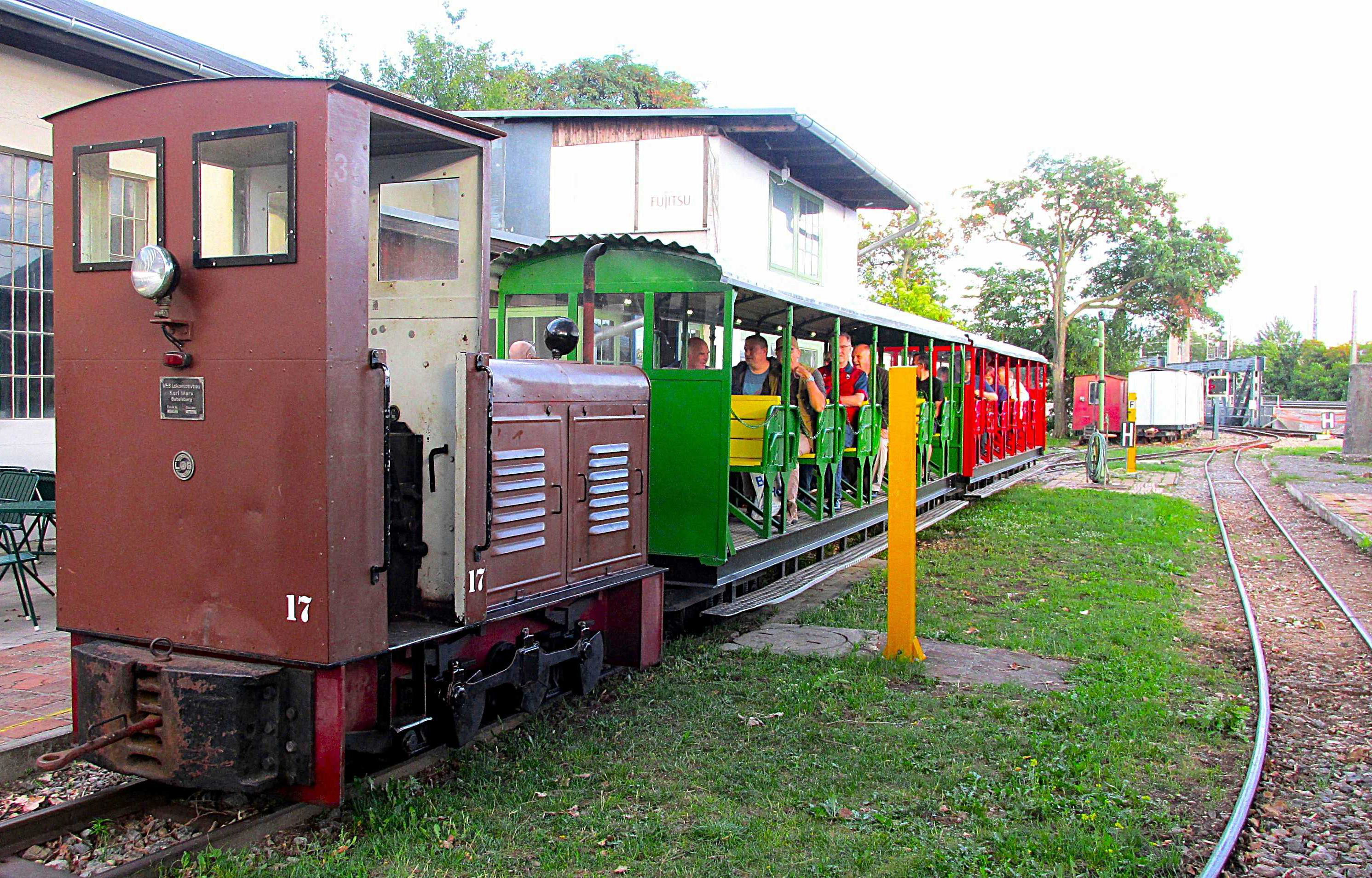
No17 works number 2620 1 built 1958 at Karl Marx Works VEB Locomotivbau Babelsberg, awaits departure at Eisenbahnmu.
[© Iain Scotchman & Simon Mortimer 2025]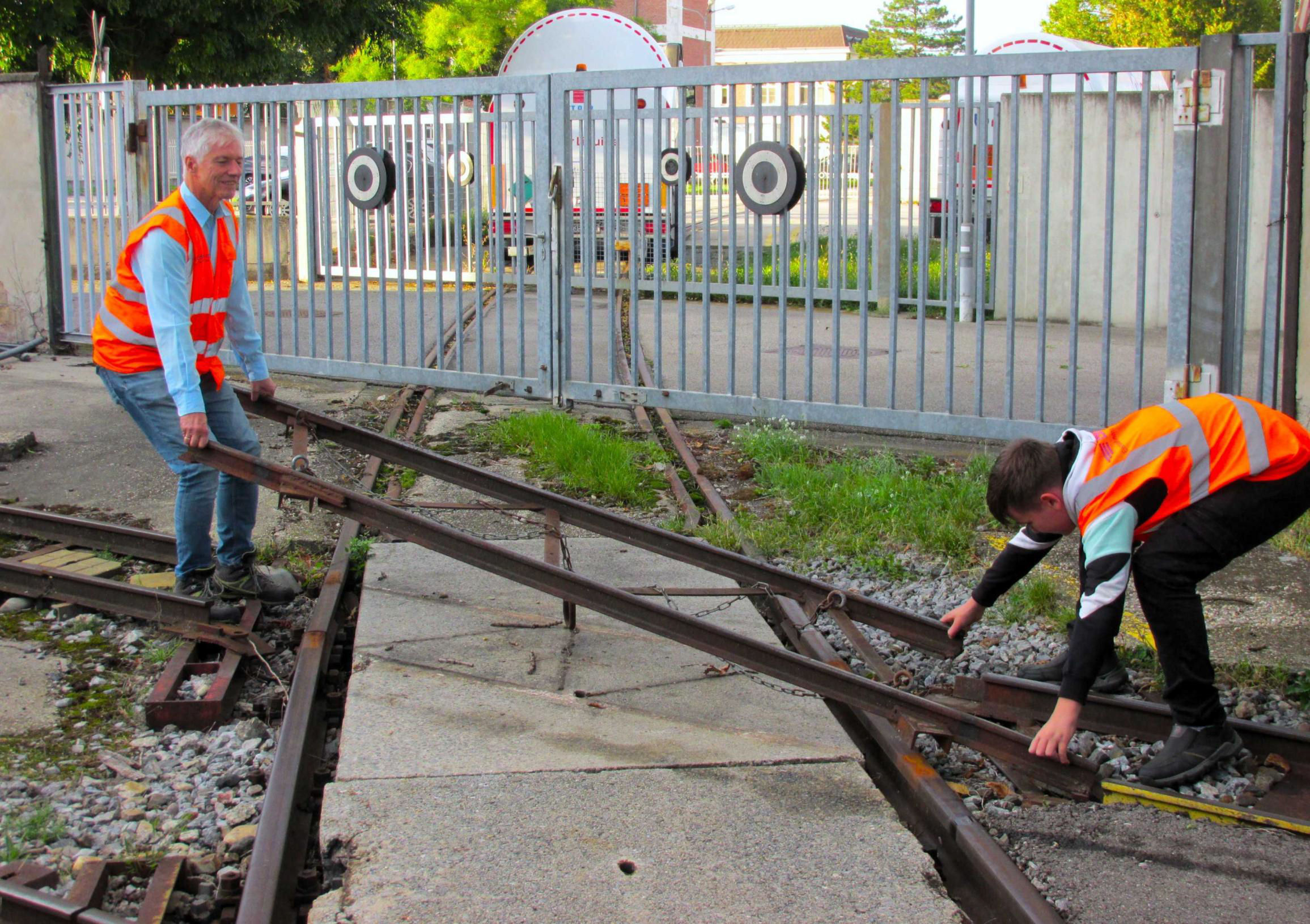
The site director (left) and helper demonstrate the removable 600mm section over the standard gauge connection into Air Liquide.
[© Iain Scotchman & Simon Mortimer 2025]The tour party then began to fragment. Some, satisfied that the 600mm gauge traversal was in the bag, headed back to the exotica of Wien, others returned on the 600mm. Some, including myself, had a tour of the running shed and the museum shed. Inside the former was quite a variety of mostly internal combustion and battery electrics. Oddly, during the description of each, few seemed to have covered themselves in glory in their working lives, being too heavy, underpowered, too long or just too damn complicated for their own good. There was a solitary steam locomotive in the shed named 'Barbara', which happens to be my wife's name. So, I photographed it on my phone and sent it back to UK with a cheery message about how good the tram tour had been and that I was now in a shed in Austria looking at a loco with her name! This solicited a response brimming with no enthusiasm whatsoever!
We toured the museum shed which had several interesting locos and a rail bicycle (another two were destroyed in incidents). An unfortunate station master had to pedal several kilometres up a severe gradient daily and then return with the braking capability of an envelope catching the breeze. Outside, in failing light, a standard gauge overhead line electrification (OHLE) inspection vehicle had turned up offering trips over the short standard gauge line. It was X-512-03 built by Tobish in 1963, with 75hp at its disposal, weighs 11 tons and can top 60km/h. In traffic it generally worked with a trailer vehicle.
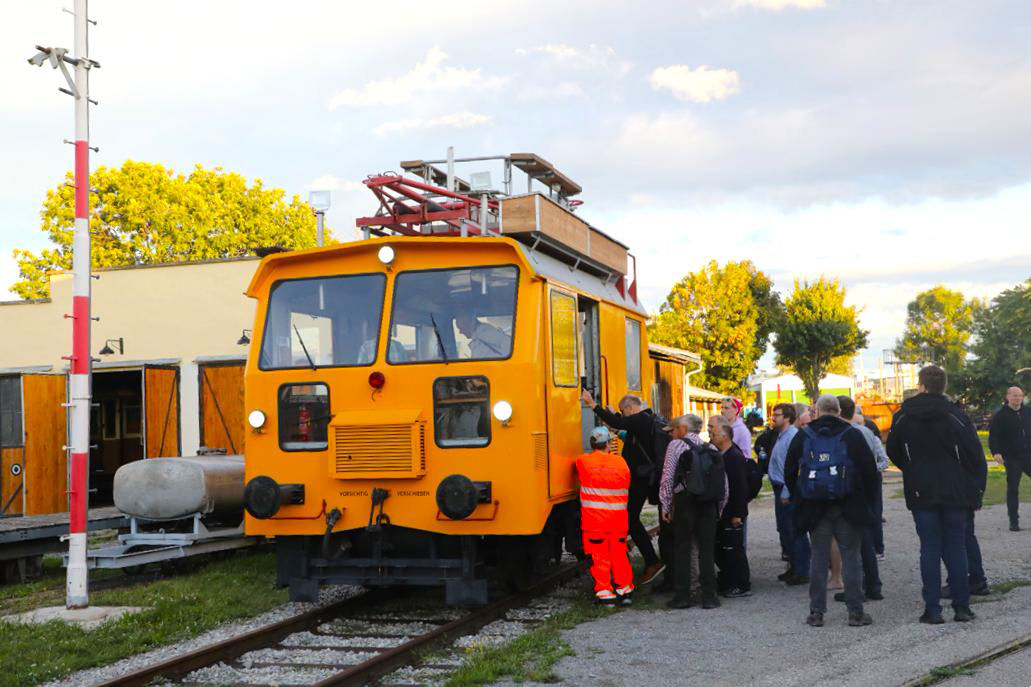
The Eisenbahnmuseum Schwechat standard gauge track, an OHLE inspection vehicle offered several rides along, so everybody had a chance.
[© Iain Scotchman & Simon Mortimer 2025]We clambered up the steps into its quite cavernous interior and, lights now blazing, began a trip parallel with the main line along the yard and over the small bridge with interlaced 600mm gauge track of the feldbahn, stopping before the stock stabled here. Return was initially as we came but we were able to ask for a point to be thrown and took a different route away from the main line. We then returned towards the bridge, giving a cheerful wave to some tour participants already stood on Schwechat station (they waved back politely!). Then the Site Manager was there holding a red rectangular line block 'STOP' sign, which was novel, for the feldbahn to trundle over the bridge! Participants on the OHLE trolley thanked our driver and bailed out to await its return. The narrow gauge train returned to the opposite platform parallel to where we had departed to go north on arrival. We boarded and traversed the narrow gauge to the southern extremity of the site. We clearly wanted to return to the original platform to achieve actual overlap and not just parallel overlap. This proved a tricky concept to convey to the very young people running the feldbahn but luckily a word to the Site Manager before our departure did the trick. On return, the point was already set and we rolled into the original platform, finishing in the dark like the night before, which seemed ages ago now. It was fulsome thanks all around and off to the station!
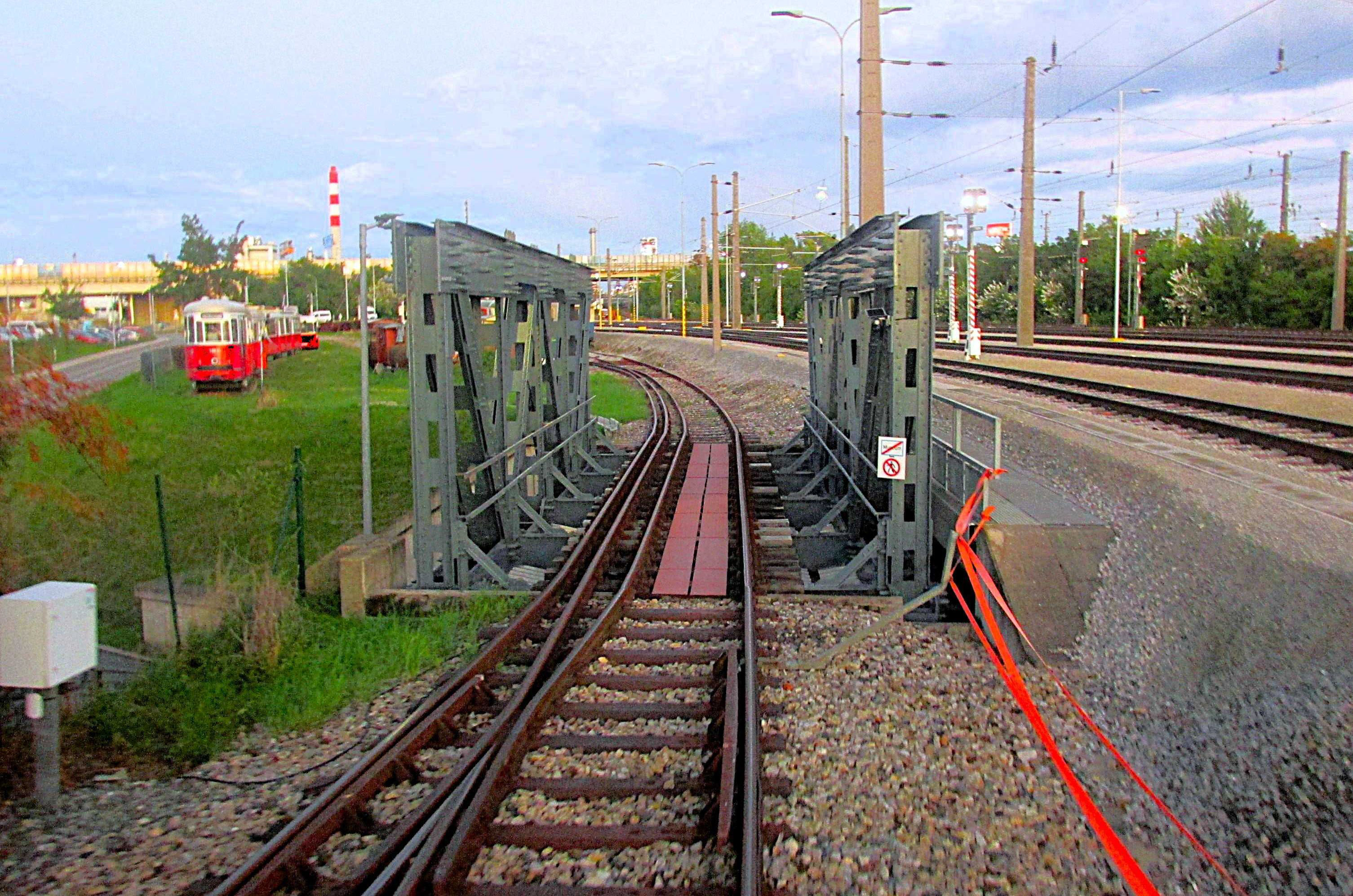
Through glass, from the OHLE trolley cab in failing light about to pass over bridge at north end of Eisenbahnmuseum Schwechat note interlaced track.
[© Iain Scotchman & Simon Mortimer 2025]
A second run, the site director has set wheel chocs on the rails ahead and holds up a STOP sign as the 600mm gauge train is about to pass to the left.
[© Iain Scotchman & Simon Mortimer 2025]We managed to buy a ticket and met our BLS organiser, Paul Griffin, on the platform (he had been diligently paying the people for our visit), in good time to catch the 19.56 back to Wien. On the return, we peeled off at our respective stations, some heading off to all points of Europe, some for flights home.
The two days had gone extremely well. For sure, there were some line losses in planning, often due to some quite bizarre circumstances but good late planning and fast thinking on the day still yielded results. The tram tour was superlatively well planned and executed, all we need now is another four or five like that and that'll be Wien rolled up? Perhaps the Wien Tram Weekender beckons. I'll leave that to Peter and the very accommodating staff at 'Rent a Bim' - really - (
https://www.rentabim.at/en/ vintage tram tours in Vienna)! Thanks to all and here's looking forward to Österreich 2026 (and, by all means, throw in some Hungarian AEV* lines, please, too) - perhaps the Hapsburg Weekender? It might catch on…
[*AEV = Állami Erdei Vasútat = State Forest Railway - narrow gauge lines, originally intended for Day 3.]